Biomemetics: Theoretical Foundations of Gene-Meme Interaction
Introduction
This document formalizes the Biomemetic Complex (BMC) — a system arising from the interaction of two replicators (genes and memes) within a single host. The goal is to move beyond descriptive metaphors toward a rigorous theoretical framework integrating evolutionary biology, neuroscience, and network science.
Conceptual foundation: For the memetic theory background, see Extended Meme Theory (EMT), Part XXVIII. For the network formalization of memes, see Network Memetics (NM). For AGI applications, see AGI Foundations.
Table of Contents
- Part I. Introduction: Why Biomemetics
- Part II. Evolutionary History: Coevolution of Two Replicators
- Part III. Neurobiological Substrate: The Hardware of BMC
- Part IV. Network Formalization: Genes as Special Nodes
- Part V. Interaction Mechanisms: Redirection, Suppression, Interpretation
- Part VI. Competition Dynamics: A Qualitative Model
- Part VII. Ontogeny: BMC Changes Across the Lifespan
- Part VIII. Cross-Cultural Variation: Different BMC Configurations
- Part IX. Pathologies: When BMC Breaks Down
- Part X. Epigenetics: Can Memes Influence Gene Expression?
- Part XI. Predictions and Falsifiability
- Part XII. Conclusions and Implications
- Appendix A. Formula Reference
- Appendix B. Glossary
- Appendix C. References
- Appendix D. Hypothetical Mathematical Formalization
Part I. Introduction: Why Biomemetics
The Problem: A Metaphorical Gap
The interaction of genes and memes has been described in the literature predominantly through metaphor:
- “Memes subjugate genes” — but how exactly?
- “Genes and memes compete” — in what units?
- “Consciousness arises from their interaction” — what is the mechanism?
Existing project documents touch on this topic:
- Extended Meme Theory (EMT), Part XXVIII — descriptively
- AGI Foundations — with an applied focus on AGI
- Network Memetics (NM) — formalizing memes only
The gap: There is no unified theoretical framework connecting biology (genes) with memetics (memes) at the level of formal models.
The Solution: The Biomemetic Complex
Biomemetics is an interdisciplinary theory integrating:
- Evolutionary biology (genetic programs)
- Neuroscience (the substrate of interaction)
- Network science (formalization of dynamics)
Key idea: Consciousness is not a product of memes by themselves, but an emergent property of dynamic tension between two replicator systems. Understanding consciousness requires modeling both systems and their interface.
Definition of the Biomemetic Complex
The Biomemetic Complex (BMC) is a system consisting of four components:
where:
- $G$ — genetic layer: the set of genetic programs and drives
- $M$ — memetic layer: the network of memes (memeplex)
- $I$ — interface: mechanisms of interaction between layers
- $S$ — shared substrate: the neurobiological foundation

BMC Component Table
| Component | Definition | Characteristics | Mutability |
|---|---|---|---|
| $G$ (genetic) | Genetically determined programs | Fixed drives, emotions | Immutable during lifetime |
| $M$ (memetic) | Network of acquired memes | Heavy-tailed topology, hubs | Dynamically modifiable |
| $I$ (interface) | Interaction mechanisms | Redirection, suppression, interpretation (in the implementation, interpretation = redirection with a smaller coefficient) | Trainable (habits) |
| $S$ (substrate) | Neurobiological foundation | Neurons, synapses, transmitters | Plastic within limits |
Why This Model Is Needed
| Problem | How BMC Solves It |
|---|---|
| “Why do beliefs affect physiology?” | Interface $I$ connects $M$ to $G$ through $S$ |
| “Why do people regress under stress?” | $G$ strengthens when $I$ is depleted |
| “Where do internal conflicts come from?” | Competition between $G$ and $M$ for shared resources in $S$ |
| “Why does therapy work slowly?” | Change requires restructuring $I$ , not just $M$ |
See also: The concept of two replicators — EMT, Part XXVIII; architecture for AGI — AGI Foundations, Introduction.
Physical Structure of a Meme in the Brain
A meme is not an abstraction but a physical structure with hierarchical organization. Different parts of a meme are localized in different brain regions and have different resistance to degradation.

| Component | Localization | Synaptic Strength | Resistance to Degradation |
|---|---|---|---|
| Core | Temporal cortex, semantic networks | Very high (consolidated) | High |
| First-order connections | Associative cortex | High | Medium-high |
| Second-order connections | Prefrontal + parietal cortex | Medium | Medium |
| Details | Hippocampus -> cortex (upon consolidation) | Low (without consolidation) | Low |
Neurobiological mechanism:
- Consolidation (systems): the meme core transfers from hippocampus to neocortex (months-years)
- Synaptic strengthening: frequent use -> LTP -> increased connection weight
- Synaptic weakening: disuse -> LTD -> peripheral degradation
Network formalization: The Fidelity function and storage modes — see NM, Part VIII.
Conceptual foundation: Meme structure: core and periphery — see EMT, Part I.
Part II. Evolutionary History: Coevolution of Two Replicators
The Problem: Why Is the Human Brain Anomalous?
The human brain is an evolutionary anomaly:
- 7 times larger than expected for a primate of our size
- Consumes 20% of the body’s energy (up to 60% in children)
- Contains functions superfluous for survival (music, abstract thought)
Standard evolutionary theory does not explain why evolution created such an “inefficient” organ.
Coevolution Timeline
First replicator: DNA
A candidate second replicator: capacity for imitation
EQ ≈ 1.5 — first material culture
EQ ≈ 2.5 — environmental modification
EQ ≈ 4.0 — symbolic communication
Art, religion, abstract memes
External meme memory
Mass copying of memes
Instantaneous global transmission
The Baldwin Effect: Memes Accelerate Genetic Evolution
The Baldwin effect (Baldwin, 1896) is a mechanism whereby learning accelerates genetic evolution without violating Darwinian principles.
Current status (2025): Gene-culture coevolution remains an active research area. The work of Kasser (2025) expands the concept: genetic changes in humans are often driven by drift, founder effects, and gene flow, not only by selection. This means that cultural influence on biology is more complex than a pure Baldwin effect — culture affects migration, population isolation, and mutational conditions. See also: Nature Communications (2019) — review of gene-culture coevolution in animals; Royal Society B (2021) — longitudinal coevolution in humans.
Mechanism:
- A meme creates an advantage for carriers of a certain genotype
- Carriers of that genotype survive and reproduce more often
- The genotype spreads through the population
- The genetic basis for the meme becomes fixed

Evidence for Coevolution
| Evidence | Description | Connection to Memes |
|---|---|---|
| Encephalization Quotient (EQ) | Growth from 1.5 to 7.0 over 2.5 million years | Correlates with cultural complexity |
| FOXP2 gene | Mutation ~200–300 thousand years ago | Critical for speech (meme channel) |
| ASPM, MCPH1 genes | Under positive selection | Linked to brain size |
| SLC6A4 genes | Variants affect learning ability | Optimization for meme reception |
| PFC hypertrophy | Prefrontal cortex +300% | Substrate for the memeplex |
Coevolutionary Fitness Formula
Total host fitness depends on both replicators and their synergy:
where:
- $W_g(t)$ — genetic fitness (survival, reproduction)
- $W_m(t)$ — memetic fitness (meme replication)
- $\alpha$ — synergy coefficient
- $synergy(g, m)$ — mutual reinforcement function
Synergy is positive when both replicators benefit:
- $synergy > 0$ : childcare (genes transmitted + memes transmitted)
- $synergy < 0$ : martyrdom (genes lose, memes win)
- $synergy \approx 0$ : neutral scenarios
Table of Evolutionary Milestones
| Period | Genetic Change | Memetic Change | EQ |
|---|---|---|---|
| 2.5 mya | Capacity for imitation | First tools | 1.5 |
| 2 mya | PFC enlargement | Oldowan culture | 2.0 |
| 1.5 mya | FOXP2 precursors | Acheulean tools | 2.5 |
| 500 kya | Fire control (genetic adaptation to smoke) | Cooking, social rituals | 3.0 |
| 200 kya | FOXP2 modern form | Proto-language | 4.0 |
| 100 kya | Modern anatomy | Full language | 5.0 |
| 50 kya | Cognitive revolution (unknown trigger) | Symbolic thought | 6.0 |
| 10 kya | Adaptation to milk, alcohol | Agriculture, writing | 7.0 |
Numerical Example: Speed of Cultural vs. Genetic Evolution
Genetic evolution:
- Time to fixation of a beneficial mutation: ~1,000 generations ~ 25,000 years
- Speed: one significant change per 25,000 years
Memetic evolution:
- Time for meme propagation: from minutes to decades
- Speed: millions of changes per single human lifetime
Ratio: Memetic evolution is faster than genetic evolution by a factor of $10^6 - 10^9$ .
Important clarification: This does not mean memes are “better.” Genes provide stability and basic functions, memes provide adaptability. BMC uses the advantages of both.
See also: Coevolution of genes and memes — EMT, Parts II, X.
Part III. Neurobiological Substrate: The Hardware of BMC
The Problem: Where Do Genes and Memes Physically Interact?
Memes are not abstractions but physical structures in the brain (synaptic connection patterns). Genetic programs are implemented through neural circuits. The question: which brain structures are responsible for which BMC layer?
Distribution Across Brain Structures

Neuroanatomical Distribution Table
| Structure | BMC Layer | Function | Phylogenetic Age |
|---|---|---|---|
| Brainstem | G | Breathing, heartbeat, arousal | >500 mya |
| Hypothalamus | G | Hunger, thirst, thermoregulation, sex | ~300 mya |
| Amygdala | G | Fear, aggression, social signals | ~200 mya |
| Nucleus accumbens | G | Reward system | ~200 mya |
| ACC (anterior cingulate) | I | Conflict detection, errors | ~100 mya |
| Insula | I | Interoception, emotional awareness | ~100 mya |
| OFC | I | Reward and context integration | ~50 mya |
| PFC (prefrontal cortex) | M | Planning, inhibition, working memory | ~10 mya |
| TPJ | M | Understanding others’ intentions | ~5 mya |
| Associative zones | M | Integration, abstract thought | ~2 mya |
| DMN (Default Mode Network) | M/I | Persistent scanning of structural gaps (SIT) | ~2 mya |
Default Mode Network as SIT Substrate
The Default Mode Network (DMN) is a set of brain structures most active at rest (in the absence of external tasks) and deactivated during goal-directed activity. Key nodes:
| DMN Structure | Function in the Context of SIT |
|---|---|
| mPFC (medial prefrontal cortex) | Assessing gap relevance relative to the self-model |
| PCC (posterior cingulate cortex) | Integrating gaps with autobiographical memory |
| Angular gyrus | Semantic processing — detecting structural inconsistencies |
| Medial temporal lobe | Reactivating unresolved contexts from long-term memory |
Thesis: The DMN is the neurobiological substrate of SIT. When external tasks do not require SEEKING, the dopamine system switches to endogenous scanning of the memeplex, identifying clusters with $SIT > 0$ . Subjectively, this is experienced as “mind-wandering,” rumination, or incubation.
Evidence base:
| Observation | Interpretation via SIT | Source |
|---|---|---|
| DMN more active during mind-wandering | Scanning gaps without an external task | Raichle et al. (2001), PNAS |
| DMN linked to self-referential processing | Assessing gaps relative to the self-model | Buckner & DiNicola (2019), Neuron |
| Anti-correlation of DMN and task-positive networks | SEEKING switches between external and SIT tasks | Fox et al. (2005), PNAS |
| DMN activity correlates with future thinking | Simulating closure scenarios for gaps | Andrews-Hanna (2012), Annals of the NY Academy |
| Insight linked to gamma burst in right angular gyrus | Moment of closure — gap filled | Kounios & Beeman (2014), Annual Review of Psychology |
| Elevated DMN activation for uncompleted tasks | Direct evidence of SIT | Poerio et al. (2017), NeuroImage |
Connection to existing M-layer structures: The DMN overlaps with PFC and TPJ — structures already described as the substrate of the M-layer. This is not coincidental: SIT is a function of the memetic layer specifically (assessing memeplex structure), implemented on the same neuroanatomical resources. The DMN can be viewed as an interface between the M-layer and SEEKING: mPFC assesses gap relevance, angular gyrus determines their position in the semantic network, PCC correlates them with history.
Sources: Raichle et al. (2001). “A default mode of brain function.” PNAS, 98(2), 676-682; Andrews-Hanna (2012). “The brain’s default network and its adaptive role in internal mentation.” Annals of the NY Academy of Sciences, 1264(1), 1-13; Kounios & Beeman (2014). “The cognitive neuroscience of insight.” Annual Review of Psychology, 65, 71-93.
DMN as Substrate of Reflection and the Self-Model Cluster (SMC)
The function of the DMN is not limited to gap scanning (SIT). The DMN is the neurobiological substrate of reflection: SMC activity directed at the system’s own memeplex (see EMT, Part XVII).
Neural Substrate of SMC
The Self-Model Cluster (SMC) is a subgraph of the memeplex containing memes about the BMC system itself: $SMC = \{m \in M : target(m) \in M \cup G \cup I\}$ (see EMT, Part XVI). Neurobiologically, SMC is implemented at the intersection of DMN and M-layer structures:
| Structure | Role in SMC | Evidence Base |
|---|---|---|
| mPFC | Self-model core: “is this about me?” assessment, integrating self-referential information | Northoff et al. (2006), NeuroImage: mPFC is a hub for self-referential processing |
| TPJ | Modeling others’ SMCs (Theory of Mind) + “self / not-self” boundary | Saxe & Kanwisher (2003), NeuroImage: TPJ active during mentalization |
| PCC / precuneus | Autobiographical memory, context of self-model over time | Cavanna & Trimble (2006), Brain: precuneus is a hub for autobiographical memory |
| Medial temporal lobe | Storing episodic context of the self-model | Buckner & DiNicola (2019), Neuron |

DMN as Substrate of Reflection: The Mechanism
Reflection = SMC scans the M-layer, finding gaps, contradictions, G/M misalignments. Neurobiologically, this is realized through the DMN:
- mPFC assesses gap relevance to the self-model: “does this concern me?”
- PCC / precuneus contextualizes the gap in autobiographical history: “when did this begin?”
- Angular gyrus determines the semantic position of the gap: “what is this connected to?”
- Medial temporal lobe reactivates relevant episodes: “has something like this happened before?”
Result: LP (Learning Progress) — a signal of whether reflection is approaching closure. If LP > 0, productive reflection leads to a new meme (abduction). If LP ~ 0, rumination depletes $E_{available}$ (see EMT, Part XVII, Part IX of this document).
Quantitative consciousness assessment — the CL metric: The quality of SMC operation can be expressed as a single number: $CL(t) = \sigma_{SW}(t) \cdot A_{SMC}(t) \cdot f(Balance(t))$ , where $\sigma_{SW}$ is network small-worldness, $A_{SMC}$ is Self-Model Cluster activity, and $f(Balance)$ is a bell-shaped function of G/M balance. CL unifies substrate (S), memetic (M), and interface (I) components of BMC into a single metric. Formalization details — NM, Part XIII.
M » G as a condition for reflection. Reflection is recursion of depth >= 2 within SMC: memes model their own memeplex. This requires a “surplus” of memes beyond the needs of modeling the world and the G-layer, i.e., $|V_m| \gg |V_u|$ (M » G). Neurobiologically, this is linked to the disproportionate development of PFC and associative zones (M-layer) relative to the limbic system (G-layer). The critical periods table below (Part IX) demonstrates this: in the “Sponge” phase (G » M) reflection is impossible; it appears only in the “Testing” phase (G ~ M, then M > G), when the memeplex first acquires sufficient capacity for self-modeling. Detailed formalization — EMT, Part XVI.
Proxy metrics for measuring CL in vivo: CL is directly computable only in a model, but each component has a measurable neurophysiological proxy. $\sigma_{SW}$ -> PCI (TMS-EEG, Casali et al., 2013): both measure the balance of integration/differentiation. $A_{SMC}$ -> DMN activity (fMRI): DMN is the neural substrate of the reflective cascade described above; L1 SMC (bodily self) maps onto posterior DMN (PCC, precuneus) + insula, L2 SMC (metacognition) onto anterior DMN (mPFC) + TPJ. $f(Balance)$ -> directed connectivity PFC->subcortical / subcortical->cortical (DCM). $I_{intero}$ (from the extended $CL_{full}$ ) -> HEP (Heartbeat Evoked Potential) + insula BOLD. A composite proxy index $CL_{proxy} = PCI \cdot DMN_{SMC} \cdot f(EC_{ratio})$ should predict subjective consciousness scales more accurately than any single component (detailed proxy table — NM, Part XII).
Evidence:
| Observation | Interpretation via SMC/Reflection | Source |
|---|---|---|
| mPFC more active during self-referential judgments than judgments about others | mPFC is the SMC core, not merely a “social” area | Northoff et al. (2006) |
| Rumination in depression linked to DMN hyperactivation | LP ~ 0 -> SMC stuck in a cycle without closure | Berman et al. (2011), Biological Psychiatry |
| Meditation reduces DMN activation and improves depression | Meditation weakens the SMC cycle -> interrupts rumination | Brewer et al. (2011), PNAS |
| mPFC damage -> impaired self-awareness (anosognosia) | Without the SMC core, reflection is impossible | Stuss (1991), Brain and Cognition |
Active Inference Cascade: SIT -> SEEKING -> Motor Output
Reflection is not the only DMN function in the BMC context. When reflection discovers a gap and LP > 0 with high SIT, an active inference cascade is triggered — the memeplex motivates the host to change reality (see EMT, Part XVIII):
DMN (reflection) -> SIT > theta -> SEEKING (VTA/NA) -> PFC (planning) -> Motor cortex -> Action
| Stage | Neural Substrate | Function in the Cascade |
|---|---|---|
| Gap detection | DMN (mPFC, PCC) | SMC finds a discrepancy between model and reality |
| SIT activation | SEEKING (VTA -> NAcc), dopaminergic pathways | Motivational signal: “explore, close the gap” |
| Planning | PFC (dlPFC), ACC | Generate action plan to close the gap |
| Execution | Motor cortex, basal ganglia | Implement the plan in the external world |
Flow State: DMN Suppression and Optimal M/G Synchronization
- DMN suppressed during flow (Ulrich et al., 2016); $A_{SMC} \to$ minimum -> $CL_{reflexive}$ low but $CL_{operative}$ high
- SIT optimal range: $SIT_{bore} < SIT < SIT_{anxiety}$ -> progressive closure without overwhelm
- Neurochemical profile: transient hypofrontality (Dietrich, 2004); PLAY elevated, FEAR minimal; $\sigma \approx 1$ (criticality)
- Predictions: flow interruption -> sharp DMN reactivation (EEG alpha spike); high-PLAY baseline -> more frequent flow; flow correlates with power-law avalanche distribution
Cross-ref: NM Part XIII: CL operative vs reflexive; AGI Foundations: Flow as target mode.
Neurotransmitters as the Currency of Interaction
| Neurotransmitter | Role in Modulation Engine |
|---|---|
| Dopamine (DA) | Learning rate ($\lambda_{lr}$ ), salience, noise ($\lambda_{noise}$ ) |
| Serotonin (5-HT) | Activation threshold ($\theta_{act}$ ), inhibition ($\lambda_{inh}$ ) |
| Norepinephrine (NE) | Speed ($\lambda_{speed}$ ), arousal |
| Acetylcholine (ACh) | Plasticity ($\lambda_{plast}$ ), encoding mode |
| Oxytocin (OXT) | Social bonding ($\lambda_{soc}$ ), in-group signal |
| GABA | Inhibitory — lateral inhibition, WM competition |
Three computational engines of BMC:
| Engine | What It Determines | Substrate |
|---|---|---|
| Graph Engine (synaptic transmission) | WHAT is active: activations, edges, WM competition | AP -> NT -> PSP |
| Modulation Engine (neuromodulation) | HOW the graph works: speed, plasticity, noise | DA, 5-HT, NE, ACh |
| Diffusion Engine (volume transmission) | BACKGROUND: priming, warming semantically related memes | NT spillover |
Physical Structure of a Meme: From Neuron to Cell Assembly
- Meme = cell assembly (Hebb 1949) = engram (Josselyn & Tonegawa 2020). Causal proof: optogenetic reactivation of specific neurons triggers memory (Liu et al. 2012)
- Population coding (Georgopoulos 1986): a meme is a distributed representation (vector in neural activation space)
- Neural reuse (Anderson 2010): neurons do not know what they encode; Broca’s area = speech + gestures + music
- Overlapping engrams (Cai et al. 2016): shared neurons between assemblies form the physical basis of edges ($w_{ij} \propto |ensemble_i \cap ensemble_j|$ )
- Mixed selectivity (Rigotti et al. 2013): one neuron participates in ~5–20 assemblies -> combinatorial power
- Sparse coding: ~1–5% neurons per meme -> capacity ~$10^4$ –$10^6$ memes
The Neuron as a Universal Computer
Dendritic computation: One biological neuron = 5–8 DNN layers (active dendrites: Na+, NMDA, Ca2+ channels). The NMDA spike is a coincidence detector (Hebbian at the molecular level). A single neuron can compute XOR (linearly inseparable). Implication: a cell assembly of ~$10^3$ neurons is computationally far more powerful than point-neuron models suggest.
Two learning rules: Pyramidal neurons use compartmentalized plasticity: (1) Basal dendrites — Hebbian (fire together, wire together), feedforward data; (2) Apical dendrites — non-Hebbian (local co-activation without spike), feedback/context/predictions. This is the anatomy of predictive coding: top-down predictions vs. bottom-up error correction.
Overlapping Ensembles: Why Connections Physically Exist
Overlapping engrams (Cai et al. 2016): shared neurons between assemblies = physical basis of edges ($w_{ij} \propto |ensemble_i \cap ensemble_j|$ ). Events occurring within a ~6 hour window share neurons (memory linking) -> causal association. In BMC: memes created within close $\Delta t$ acquire shared edges.
Mixed selectivity (Rigotti et al. 2013): one neuron participates in ~5–20 assemblies -> combinatorial power. This enables capacity scaling: not $N/s$ (linear), but $\binom{N/r}{s}$ (combinatorial).
Compressive Meme Coding
Sub-component reuse: memes are built from shared micro-ensembles (not atomic). A subset of size $r$ shared across $c$ memes yields capacity $\binom{N/r}{s}$ (combinatorial) vs. $N/s$ (linear). New meme cost: $O(1)$ new connections, not $O(s)$ neurons. Consequence: M » G requires sub-component reuse enabling a massive M without proportional G growth. Cross-ref: EMT XVI: M » G Theorem.
Neural Stigmergy: Coordination Through Traces in the Substrate
| Trace | Substrate | Lifetime | Coordination |
|---|---|---|---|
| Synaptic weight | Synaptic cleft | Hours–years | LTP/LTD: previous activation changes conductance |
| Neurotrophic factor | Extracellular space | Days–weeks | BDNF regulates new connections (“architectural stigmergy”) |
| Glial signal | Astrocyte network | Minutes–hours | Ca2+ waves = “second medium” without direct synapses |
| Volume transmission | Distributed neuromodulation | Minutes–hours | Broadcast mode-switching for the entire BMC graph |
Cross-ref: NM Part X: Stigmergy; EMT Part XII.
Neurotransmitters as Global Modulators of the BMC Graph
Neurotransmitters as global modulators (Dayan 2012, volume transmission): DA = salience/learning, NE = attention gate, 5-HT = I-layer suppression, ACh = encoding mode, OT = in-group signal.
Fidelity substrate: Full = perforated synapses + CREB transcription; Skeletal = dynamic spines + early LTP; Trace = silent synapses (Isaac 1995) + spine persistence (Yang 2009).
Sleep sources: SHY (Tononi & Cirelli 2003/2014), triple coupling (Staresina 2015, Latchoumane 2017), spine formation (Yang 2014), systems consolidation (Diekelmann & Born 2010).
Intrinsic dynamics: Physical architecture creates “channels” — preferred activation paths. Some patterns are fundamentally unlearnable regardless of motivation (BCI experiments: monkeys cannot reverse neural pattern). Confirms: the G-layer (motivation) cannot override S-substrate constraints. Architecture > willpower.
G-factor = S quality: General intelligence G = metric of substrate S in BMC. High G = more efficient substrate: faster spreading activation, higher capacity, better pattern separation (neuroefficiency: less activation for same task). G is ~60–80% heritable (Bouchard 2004), stable across lifespan (r=0.72 at age 11 vs 80). Cognitive segregation: similar-G people form networks -> memeplex homophily. Assortative mating by IQ (4x stronger than by personality) = Baldwin Effect mechanism.
Hodgkin-Huxley -> sigmoid: The Hodgkin-Huxley model (4 coupled ODEs) justifies the sigmoid in spreading activation: threshold theta = resting->action potential transition; coupled feedback (V and gates) = activation and edge weights; refractory period = why memes cannot stay permanently active.
Theta rhythm: Hippocampal 4–12 Hz oscillation (medial septum pacemaker, HCN channels). Functions: (1) cross-modal synchronization — phase = common clock binding position, vision, emotion into a single snapshot; (2) temporal ordering — each cycle = chunk (past->present->future); theta sequences = episodic memory. Phase precession: spike timing encodes position in sequence. Without theta -> no recall, no planning.
SWR tag->replay: Two-stage memory selection: awake sharp-wave ripples (SWR) tag significant experiences at pauses -> sleep SWR replay and transfer to neocortex. Competition through inhibition: strongest patterns win. Temporal compression: seconds -> ~100ms (10x) fits STDP plasticity window.
Balance Activation Formula
This is the neural proxy (correlate) of Balance; the definition itself is $Balance = \bar{a}_M/(\bar{a}_G + \epsilon)$ via the mean activations of meme nodes and utility nodes (NM, Part XIII).
| Balance | Regime | Behavior |
|---|---|---|
| > 2 | M dominance | Rational, controlled |
| 1–2 | Healthy balance | Adaptive flexibility |
| < 1 | G dominance | Impulsive, instinctive |
Dynamics: $\frac{dA_m}{dt} = \alpha \cdot S_m(t) - \beta \cdot S_u(t) - \gamma \cdot fatigue(t)$
Stress -> Balance drops. Exhaustion -> G dominance. Recovery -> Balance restores.
Diagram: Flows Between Structures

Numerical Example: Stress and Balance
Situation: A person receives criticism at work.
| Time | $A_{limbic}$ | $A_{PFC}$ | $Balance$ | Behavior |
|---|---|---|---|---|
| t=0 (before criticism) | 0.3 | 0.6 | 2.0 | Calm work |
| t=1 (moment of criticism) | 0.8 | 0.5 | 0.63 | Emotional reaction |
| t=2 (one minute later) | 0.6 | 0.4 | 0.67 | Defensive reaction |
| t=5 (five minutes later) | 0.5 | 0.6 | 1.2 | Rationalization |
| t=30 (thirty minutes later) | 0.3 | 0.7 | 2.3 | Analysis, planning |
Interpretation: The immediate reaction is genetic (status threat). Through the interface (ACC detects conflict), PFC control gradually recovers.
Important clarification: This is a simplified model. Real neurodynamic processes are considerably more complex and include feedback loops, nonlinearities, and individual differences.
See also: Neurobiological substrate in the AGI context — AGI Foundations, Part I.
Part IV. Network Formalization: Genes as Special Nodes
The Problem: How to Integrate Genes into the Network Model?
Network Memetics formalizes memes as graph nodes. But this model does not include genetic programs. An extension is needed.
Extending the Model: The BMC Graph
Definition: The BMC graph is a graph containing two types of nodes:
where:
- $V_g$ — utility nodes (genetic programs, fixed)
- $V_m$ — memetic nodes (memes, dynamic)
- $E_{gg}$ — connections between utility nodes (fixed)
- $E_{mm}$ — connections between memes (dynamic)
- $E_{gm}$ — connections between genes and memes (semi-dynamic)
Signed edges: All edge types have weights $w \in [-1, +1]$ :
- $w > 0$ — excitatory connection
- $w < 0$ — inhibitory connection
- $w = 0$ — no connection
Comparison of Node Types
| Property | Utility nodes ($V_g$ ) | Memetic nodes ($V_m$ ) |
|---|---|---|
| Origin | Built in genetically | Enter from outside via imitation |
| Mutability | Immutable | Added/removed |
| Base activation | Constant ($a^{base} > 0$ ) | Zero without stimulus |
| Connections | Fixed weights | Dynamic weights |
| Quantity | Small (~20–50) | Large (~$10^4 - 10^6$ ) |
| Topology | Not heavy-tailed | Heavy-tailed |
Utility Node Activation Formula
Unlike memes, utility nodes have a constant base activation:
where:
- $a_g^{base}$ — base drive level (always > 0)
- $w_{gi} \in [-1, +1]$ — weight of connection to stimulus $i$ (when $w_{gi} < 0$ the stimulus inhibits the utility node)
- $stimulus_i(t)$ — stimulus intensity at time $t$
Example: Hunger drive
Note (AGI implementation): In the AGI prototype, the base formula is augmented with inertia — $a_u(t+1) = \alpha \cdot a_u(t) + (1-\alpha) \cdot target(t)$ , which smooths utility dynamics and models the “viscosity” of biological drives. Details: AGI Foundations, Part I.
Diagram: Bipartite BMC Graph

Table of Basic Utility Nodes
| Utility node | Base Activation | Triggers | Associated Memes |
|---|---|---|---|
| Hunger | 0.2 | Time without food, food smell | Diet, cooking, restaurants |
| Fear | 0.1 | Threats, uncertainty | Safety, religion, politics |
| Sexuality | 0.15 | Attractive stimuli | Relationships, morality, fashion |
| Status | 0.25 | Social comparison | Career, achievements, status goods |
| Attachment | 0.2 | Close people, group | Family, friendship, patriotism |
| Curiosity | 0.15 | Novelty, puzzles | Science, art, hobbies |
| Aggression | 0.05 | Threat, frustration | Sports, competition, warfare |
Numerical Example: Activation Cascade
Situation: A person sees a food advertisement.
Initial conditions:
- $a_{hunger}^{base} = 0.2$
- $time\_since\_meal = 3$ hours
- $stimulus_{smell} = 0.8$ (very appetizing ad)
Step 1: Activation of the “Hunger” utility node
Step 2: Propagation to connected memes
| Meme | Connection Weight | Incoming Activation | New Activation |
|---|---|---|---|
| “Diet” | 0.8 | $0.74 \cdot 0.8 = 0.59$ | 0.59 |
| “Restaurant X” | 0.6 | $0.74 \cdot 0.6 = 0.44$ | 0.44 |
| “Health” | 0.4 | $0.74 \cdot 0.4 = 0.30$ | 0.30 |
Step 3: Meme competition
The “Diet” meme activates the connected “Control” meme ($w = 0.7$ ), which inhibits the desire to eat.
The “Restaurant X” meme activates the “Pleasure” meme ($w = 0.8$ ), which reinforces the desire.
Result: The outcome depends on the relative strength of the memes and the current BMC balance.
Formalization of Interaction
Influence of a utility node on a meme:
where $(1 - a_m(t))$ is the “free capacity” of the meme (saturation).
Influence of a meme on a utility node:
The direction of influence is now determined by the sign of the weight $w_{mg} \in [-1, +1]$
: a positive weight reinforces the utility node, a negative one suppresses it. A separate sign(compatibility) parameter is no longer needed.
Example: DISGUST as Interpretation: the meme “this is disgusting” has $w_{mg} < 0$ toward the corresponding stimulus, which suppresses its activation in the memeplex.
See also: Network model of memes — NM, Part V; utility nodes in AGI — AGI Foundations, Part I.
Differentiated Storage: Ranked Completeness
Problem: The brain stores thousands of memes, but its capacity is limited. How does the system cope?
Solution: Memes are stored with different completeness (Fidelity) depending on their rank in the network and frequency of use.
Fidelity Function
| Parameter | Value | Biological Meaning |
|---|---|---|
| $k_m$ | Meme degree | Number of connections (importance for the network) |
| $k_{max}$ | Max degree | Normalization by hubs |
| $\gamma$ | 0.5–1.0 | Nonlinearity of hub preference |
| $\lambda_f$ | 0.01–0.1 month$^{-1}$ | Rate of detail “forgetting” |
| $t_{last}$ | Time | Time of last activation |
| $\beta$ | 0.1–0.5 | Rate of consolidation into long-term memory |
| $age$ | Time | Time since first acquisition |
Orthogonality of Fidelity and Weight
Fidelity (storage completeness) and weight (sign of relationship) are independent characteristics of a meme. A meme can be well-studied yet rejected:
| $w > 0$ (accepted) | $w < 0$ (rejected) | |
|---|---|---|
| High Fidelity | Active belief, part of identity | Antibody: a well-studied “enemy” |
| Low Fidelity | Vague sympathy, background agreement | Vague antipathy, “something’s wrong” |
Antibody = a meme with high Fidelity and negative weight. The memeplex stores a detailed threat model for quick recognition and blocking. Degree $k_m$ in the Fidelity formula counts all meme connections — both positive and negative.
Three Storage Modes
| Mode | Fidelity | What Is Preserved | Neurobiological Substrate |
|---|---|---|---|
| Full | > 0.7 | Core + all connections + details | Cortical networks + hippocampus |
| Skeletal | 0.3–0.7 | Core + primary connections | Cortical networks (without details) |
| Trace | < 0.3 | Only core or fragment | Weak cortical traces |

Neurobiological Substrate of Fidelity
The three meme storage modes correspond to specific molecular and structural synaptic states:
| Mode | Fidelity | Synaptic Basis | Molecular Mechanism | Timescale |
|---|---|---|---|---|
| Full | > 0.7 | Perforated synapses, large stable spines | CREB-dependent transcription, new protein synthesis | Days -> years (structural stabilization) |
| Skeletal | 0.3–0.7 | Dynamic medium-sized spines | Early-phase LTP (protein synthesis-independent) | Hours -> days |
| Trace | < 0.3 | Silent synapses, dendritic tags | NMDA-only receptors (without AMPA), spine persistence | Minutes -> months |
Silent synapses (Isaac et al., 1995, Neuron): synapses containing only NMDA receptors (without AMPA). They do not transmit signals during normal activation but preserve a structural trace — the basis for rapid reactivation.
Spine persistence (Yang et al., 2009, Nature): dendritic spines formed during learning persist for months even without repeated activation. This is the physical basis of trace storage: the meme is “forgotten” functionally, but its structure is not erased.
Reactivation and savings effect (Ebbinghaus, 1885): relearning a forgotten skill occurs significantly faster than learning de novo — because silent synapses and dendritic tags are not erased. Savings = the difference between initial learning and relearning.
Consolidation timescales:
| Phase | Time | Mechanism | What Is Formed |
|---|---|---|---|
| Short-term | Minutes | Early LTP (phosphorylation) | Temporary strengthening of existing synapses |
| Intermediate | Hours | Protein synthesis | New receptors, spine growth |
| Long-term | Days | Gene transcription (CREB) | New synapses, perforation |
| Structural | Weeks -> years | Structural stabilization | Stable spines, myelination |
Adaptive Significance
| Advantage | Mechanism | Biological Benefit |
|---|---|---|
| Energy savings | Periphery not actively maintained | -20% metabolic costs |
| Rapid reactivation | Core preserved, connections restored | Days instead of years |
| Automatic prioritization | Hubs (high degree) stored more completely | Important things not forgotten |
| Update flexibility | Details change, core remains stable | Adaptation without identity loss |
Key Example: Foreign Language
Scenario: 5 years of study -> 10 years without practice -> one week in the language environment

Why “remembered” (days) rather than “learned anew” (years)?
| Process | During Learning | During Reactivation |
|---|---|---|
| Synaptogenesis | Yes (slow) | No |
| LTP | Creating new patterns | Strengthening existing ones |
| Consolidation | Hippocampus -> cortex | Already in cortex |
| Time | Years | Days |
The language core (grammatical structures, basic vocabulary) is already consolidated in the cortex. Reactivation merely strengthens weakened synapses — faster than creating new ones.
Reactivation Dynamics
where:
- $\rho$ — reactivation rate (0.1–0.5 day$^{-1}$ )
- $exposure(t)$ — exposure intensity (0–1)
Property: Initial reactivation is fast (at low Fidelity there is much “free capacity”), then slows down.
Model Predictions
| Prediction | Test | Literature |
|---|---|---|
| A forgotten language is recovered 10–100x faster than learned | Comparison relearning vs. learning | Hansen et al. (2010) |
| Grammar is preserved better than vocabulary | Grammar vs. vocabulary tests | Bahrick (1984) |
| Childhood memes are more resilient than adult ones | Longitudinal study | Conway et al. (2009) |
| Hubs (high centrality) degrade last | Network analysis + memory test | Stasevich (in development) |
Network formalization: Full Fidelity formula and numerical examples — see NM, Part VIII.
AGI application: Skeletal storage in artificial systems — see AGI Foundations, Part III.
Practical consequence: Mnemonics as a way to increase meme connectivity. More connections -> slower decay -> higher Fidelity. See NM: Associative memory vs. isolated memorization.
Multilevel Memory: Neurobiological Basis of $\kappa$
The mechanisms of edge decay, Fidelity, SIT, and continuous activation $a_i$ give rise to multilevel memory as an emergent property — without a separate module. Consolidation level $\kappa_i(t) \in \{0, 1, 2\}$ is a derived discrete parameter classifying the depth of a meme’s inscription in the neural substrate.
Molecular Markers of $\kappa$ -Levels
| $\kappa$ | Memory Type | Neural Substrate | Molecular Mechanism | Timescale |
|---|---|---|---|---|
| 0 (sensory) | Sensory buffer | Primary sensory cortex | Decaying excitation, STD (vesicle depletion) | ~250 ms – 2 s |
| 1 (STM) | Short-term | Hippocampus (DG -> CA3 -> CA1) | E-LTP: AMPA phosphorylation, CaMKII; pattern separation in DG | Minutes – hours |
| 2 (LTM) | Long-term | Neocortex (systems consolidation) | L-LTP: CREB -> protein synthesis -> new spines; structural LTP | Days – years |
Neurobiology of $\kappa$ -Transitions
$\kappa: 0 \to 1$ (sensory -> STM). The meme passes the I-filter (ACC / insula assess compatibility) -> hippocampal encoding. Mechanism: glutamate -> NMDA receptors -> Ca2+ influx -> CaMKII -> AMPA trafficking -> E-LTP. Speed: seconds. Pattern separation in the dentate gyrus (DG) ensures the uniqueness of each new meme even when similar to old ones.
$\kappa: 1 \to 2$ (STM -> LTM). Three competing pathways:
Spaced repetition ($n_{react} \geq N_{crit}$ ): repeated co-activation -> late LTP -> CREB-dependent transcription -> BDNF -> growth of new spines -> structural LTP. Typical threshold: 3–5 reactivations with intervals >= hours.
Emotional tag ($G_{align} > \theta_G$ ): amygdala (BLA) -> norepinephrine/cortisol -> enhanced hippocampal LTP; awake SWR tagging (Buzsaki, 2024, Science) marks the meme for overnight consolidation. Accelerated pathway: 1–2 exposures sufficient.
Hub status ($Fidelity \geq F_{LTM}$ ): a meme with high degree ($k_m$ ) -> many synaptic contacts -> automatic strengthening via heterosynaptic metaplasticity (Abraham, 2008). Hubs consolidate “by themselves” — through constant reinforcement from neighbors.
$\kappa: 2 \to 1$ (deconsolidation). Prolonged disuse -> spine retraction (Yang et al., 2009): dendritic spines shrink, AMPA receptors are internalized. The structure (NMDA-only silent synapses) is preserved -> savings effect: reactivation 10–100x faster than new learning. The meme transitions from Full -> Skeletal -> Trace mode.
$\kappa: 1 \to \varnothing$ (pruning). Two mechanisms:
- Passive: Synaptic downscaling (SHY, Tononi & Cirelli, 2014) during sleep: proportional weakening -> weak connections erased
- Active: Microglial pruning (complement-tagging: C1q/C3 -> phagocytosis of inactive synapses; Schafer et al., 2012, Neuron)
Engram Allocation: Competition for Consolidation
Not all STM memes transition to LTM — neurons compete for inclusion in the engram:
- CREB-dependent excitability (Josselyn & Frankland, 2015): neurons with high CREB -> increased excitability -> “win” allocation. In BMC: memes with high $C_E$ (eigenvector centrality) -> more frequently co-activated -> priority.
- Memory linking (Cai et al., 2016, Nature): events within a ~6-hour window share neurons (overlapping engrams) -> causal association. In BMC: memes created within close $\Delta t$ acquire shared edges.
- Stress -> engram expansion: cortisol increases the number of neurons in the engram -> generalized memories -> loss of specificity (PTSD). In BMC: high $E_{emot}$ -> multiple connections -> over-consolidation with loss of precision.
CLS: Two Storage Systems
Complementary Learning Systems (McClelland et al., 1995; O’Reilly et al., 2014):
| Hippocampus ($\kappa = 1$ ) | Neocortex ($\kappa = 2$ ) | |
|---|---|---|
| Learning | Fast, one-shot | Slow, interleaved |
| Patterns | Separated (unique) | Overlapping (categories) |
| Memory | Episodic (details) | Semantic (gist) |
| Rationale for the speed (CLS) | Fast writing into sparse, separated patterns leaves old traces untouched | Slow, interleaved writing, because fast learning in shared overlapping weights erases the old (catastrophic interference) |
| In BMC | New DYN nodes, high Fidelity, $\kappa = 1$ | Consolidated hubs, $\kappa = 2$ |
Transfer $\kappa: 1 \to 2$ = active systems consolidation: SWR replay -> triple coupling (SO -> spindles -> SWR) -> cortical recording. More details — in the next section.
Relation of BMC to CLS: same phenomenology, opposite rationale. BMC has the two speeds: a new meme enters fast, as a node with $\kappa = 1$ , while the transition $\kappa: 1 \to 2$ is slow and goes through replay. The CLS rationale does not carry over to BMC. In CLS, slow interleaved writing in the neocortex is needed because fast learning in shared overlapping weights causes catastrophic interference: new learning abruptly erases the old (McCloskey & Cohen, 1989; McClelland et al., 1995). At the level of M, BMC is localist: a meme is a node. A new meme gets a new node and its own embedding $\mathbf{e}_i = \mathbf{f}(t_{birth})$ , while the feature function $\mathbf{f}$ is set at the G level and is not learned (NM, Part XV, Definition 14.1). At this level there are no shared weights for new learning to overwrite, so catastrophic interference has nowhere to come from.
Interference in BMC exists, but it is graded by similarity:
- RIF suppresses competitors with $compat > \theta_{sim}$ ; allies are protected, and hubs are suppressed more weakly ($\propto 1/C_E$ ).
- Competition for the engram: a new meme with high $compat$ to an old one competes with it for consolidation (NM, “Four Mechanisms of Active Forgetting”, no. 3).
- Embedding proximity: diffusion and priming follow $\text{prox}(i,j)$ (NM, P-D2).
- A change of the trace is possible only during reconsolidation, that is, when a new input has reactivated the old meme. A moderate prediction error gives Update or Destabilize; at $\Delta_{PE} > \theta_{new}$ a new meme is born and the old one is left untouched.
All four mechanisms touch only memes close to the new one, and they grow with similarity. The embeddings and edges of memes unrelated to the new learning do not change. Displacement from WM (NM, “Four Mechanisms of Active Forgetting”, no. 2) does not depend on similarity, but it touches only working-memory retention ($\psi_i$ ), not the meme itself. So in BMC, replay during sleep serves consolidation and integration ($n_{react}$ , $\kappa$ , CONNECT, BLEND), not protection against overwriting. In the AB–AC paradigm modelled by McCloskey & Cohen (1989), the network lost the old associations almost entirely, whereas in people retroactive interference is partial and grows with the similarity of the material. CLS explains the human picture by a fast hippocampal system; the updated version of the theory also allows fast neocortical writing of schema-consistent material (Kumaran, Hassabis & McClelland, 2016). BMC explains the same picture by the localism of M. The relation to CLS is a contradiction of the rationale with matching phenomenology.
Scope of the claim. (a) Configurations of memes (coalitions, subpersonalities) are stored in shared edges $w_{ij}$ , and at this level M is distributed. The theory itself carries the Hopfield capacity ceiling over to this level (NM, Part VIII, “Connection to Hopfield networks”). A classical Hopfield network loses all patterns when overloaded. With bounded weights ($w \in [-1, +1]$ ) and decay ($\lambda_{ij}$ ), something else is expected: old configurations are displaced gradually rather than all at once. This has not been derived for BMC. (b) Beneath M lies a distributed substrate: a meme is a composition of reusable micro-assemblies (Part III, “Compressive Meme Coding”). If learning new memes changes the shared micro-assemblies themselves, the CLS rationale returns at the level of the substrate. The theory does not specify the plasticity of micro-assemblies. The claim “there is no catastrophic interference” refers to the level of M with a fixed $\mathbf{f}$ .
No distinguishing prediction. Interference that grows with similarity and has no catastrophic regime even under massed learning is expected both by CLS (people have a hippocampus) and by classical interference theory. The non-monotonic change of the trace with prediction error (item 4) is also known. The protection of hubs from interference is already recorded as P-F1. BMC and CLS differ in mechanism, but no behavioural test separates them.
Schema-Congruence (SLIMM): I-Compatibility Determines Speed
Schema-Linked Interactions between Medial and Memory systems (van Kesteren et al., 2012):
| Meme Type | I-Compatibility | Pathway | Speed $\kappa: 1 \to 2$ | Detail Level |
|---|---|---|---|---|
| Congruent with schema | High | mPFC -> fast integration | Fast | Low (gist) |
| Incongruent | Low | Hippocampus -> detailed encoding | Slow | High |
| Radically new (high SIT) | Low, but SEEKING up | Amygdala -> emotional tag | Fast | High |
In BMC this U-shaped curve arises naturally: I-compatible memes integrate quickly (many attachment points); radically new ones receive an emotional boost through SEEKING/G-alignment. Intermediate ones (moderately unfamiliar, without emotion) are the most vulnerable.
Formalization: Definition of $\kappa_i(t)$ , transition conditions, formulas — see NM, Part VIII.
Conceptual framework: BMC -> memory type mapping, predictions — see EMT, Part VIII.
Activity-Silent WM: The Synaptic Mechanism
The classical WM model (Fuster, 1973; Goldman-Rakic, 1995) explains information retention through sustained firing of PFC neurons — Active WM. However, evidence shows that WM also stores information without elevated activity — through synaptic short-term plasticity (STP) (Mongillo, Barak & Tsodyks, 2008, Science; Stokes, 2015, Trends in Cognitive Sciences).
STP mechanism: After firing cessation, elevated Ca2+ concentration remains in the presynaptic terminal (tens of seconds). The next spike causes facilitation — enhanced neurotransmitter release. Information is encoded not in neuron activity but in the pattern of potentiated synapses. This is the neurobiological substrate of $\psi_i$ in BMC: a synaptic trace existing when $a_i \approx 0$ .
Pinging — experimental evidence: A TMS pulse (Rose et al., 2016, Journal of Cognitive Neuroscience) or orienting stimulus (Wolff et al., 2017, Nature Neuroscience) reactivates a “forgotten” WM item that was not decodable from neural activity before stimulation. In BMC: external signal (spreading activation) x synaptic trace ($\psi$ ) -> reactivation.
| Component | Active WM | Latent WM (activity-silent) |
|---|---|---|
| Neural substrate | Sustained firing (PFC, dlPFC) | STP (residual Ca2+, facilitation) |
| Decodability (fMRI/EEG) | Yes | No (only after pinging) |
| Capacity | ~3–4 elements (Cowan, 2001) | ~3–4 elements |
| Duration | Seconds (requires maintenance) | Tens of seconds – minutes (STP decay) |
| BMC variable | $a_i > \theta_{act}$ , $i \in$ top-k | $\psi_i > \theta_\psi$ , $a_i < \theta_{act}$ |
Panichello & Buschman (2021), Nature: WM representations in PFC are “morphed” — partially recoded during attention switching, but recovered upon re-attention. This is consistent with the model: the $\psi$ -trace preserves the meme’s “address” but not its full activation; reactivation requires repeated spreading activation through preserved synaptic weights.
Formalization: Definition of $\psi_i(t)$ , two-compartment WM model, pinging, pointer lifecycle — see NM, Part VIII.
Episodic Memory: Neurobiological Substrate
Episodic Memory Barcodes
The hippocampus generates sparse random activation patterns unique to each event — barcodes (Chettih et al., 2024, Cell). Key properties:
| Property | Value | Function |
|---|---|---|
| Sparseness | ~5–10% of CA1 neurons | Minimizing interference between episodes |
| Randomness | Independent of content | Content-independent index (like a hash code) |
| Orthogonality | Cosine similarity < 0.1 | Different episodes -> different addresses |
| Pattern completion | ~30% of barcode sufficient | Partial cue -> full recovery |
Generation mechanism: The dentate gyrus (DG) performs pattern separation — transforming similar inputs into orthogonal representations through sparse activation of granule cells (~2–6% simultaneously active). DG -> CA3 (pattern completion via recurrent connections) -> CA1 (output + temporal ordering). The barcode is formed at the DG->CA3 junction: a random sparse sample from granule cells, fixed via rapid E-LTP.
In BMC terms: the barcode = a sparse subset of memes co-activated at episode onset. It does not encode content — it serves as a pointer through which spreading activation recovers the full set of episode memes.
Time Cells: Temporal Order Within an Episode
In CA1, time cells have been discovered — neurons that fire at a specific moment relative to episode onset (MacDonald et al., 2011, Neuron; Eichenbaum, 2014, Nature Reviews Neuroscience). Time cells create a temporal scaffold for the episode:
| Neuron Type | Localization | What It Encodes | Timescale |
|---|---|---|---|
| Place cells | CA1/CA3 | Spatial position | — |
| Time cells | CA1 | Position on the temporal axis within the episode | Seconds – minutes |
| Ramping neurons | mPFC, entorhinal cortex | Distance to the episode boundary | Seconds |
Time cells provide a temporal scaffold: within an episode, memes are not merely co-active — they are ordered. During recall, order is recovered through sequential reactivation of time cells. Without time cells — recall without order (semantic memory: “I know that X” but not “first X, then Y”).
Connection to theta rhythm: Theta-binding (~125 ms, see above) synchronizes components of a single moment. Time cells operate on a larger scale — ordering moments within an episode. Phase precession bridges these scales: spike order within a theta cycle reflects trajectory order (Dragoi & Buzsaki, 2006).
Event Boundary Neurons: Where a New Episode Begins
Episode boundaries are not arbitrary — they are detected by specialized neural circuits:
- Hippocampal boundary signals: CA1 activity changes sharply upon context switch — even without sensory changes (Baldassano et al., 2017, Neuron). The CA1 pattern “resets” — the old barcode deactivates, a new one is generated
- mPFC event model: The medial prefrontal cortex maintains a “current event model.” Upon prediction error, the model updates -> signal to hippocampus -> boundary (Zacks et al., 2007, Psychological Bulletin)
- Dopaminergic gating: Ventral tegmental area (VTA) -> hippocampus: a dopamine signal upon surprise marks the boundary and enhances encoding of the new episode (Shohamy & Adcock, 2010, Trends in Cognitive Sciences)
In BMC terms: Event boundary = the moment when prediction error ($\Delta_{PE}$ ) or a change in G-modulation exceeds a threshold. Neural substrate: mPFC monitors the event model; upon mismatch -> DA signal -> hippocampus resets the barcode.
Hippocampal Indexing Theory
The hippocampus stores not the memories themselves but indices (Teyler & DiScenna, 1986, Behavioral Neuroscience):
Hippocampus (index):  B_k -> [pointer_visual, pointer_auditory, pointer_emotional, ...]
Cortex (content):     visual_area: scene details
                      auditory_area: sounds
                      amygdala: emotional valence
Retrieval: cue -> hippocampus reactivates $B_k$ -> via index, cortical patterns are recovered -> full episode. This explains retrograde amnesia with hippocampal damage: content in cortex is intact, but indices are lost -> no access.
In BMC terms: Barcode = Teyler-DiScenna index. Memes ($\kappa = 2$ , semantic) are stored in the graph. Barcodes ($\kappa = 1$ , episodic) are temporary pointers to meme configurations. Trace transformation = index loss while content is preserved.
Barcode Lifecycle: Neurobiology
| Phase | Neural Process | BMC Analog |
|---|---|---|
| Creation | DG pattern separation -> sparse E-LTP in CA3 | $B_k$ generation at event boundary |
| Tagging | Awake SWRs mark barcode for replay (Buzsaki, 2024) | SWR tag -> priority for overnight consolidation |
| Sleep replay | Sleep SWR reactivates barcode with ~10x compression | Pattern completion: $B_k$ -> $M_k$ -> DECOMPOSE |
| Consolidation | Content -> L-LTP in neocortex; hippocampal trace weakens | $M_k$ : $\kappa: 1 \to 2$ ; $B_k$ : replay ceases, coherence drops |
| Fading | Neurogenesis in DG displaces old engrams (Akers et al., 2014, Science) | $B_k$ lost; trace transformation complete |
| Flashbulb | Amygdala -> enhanced E-LTP + protection from neurogenesis | Emotional tag -> $B_k$ preserved -> vivid recall |
Formalization: Definition of $\varepsilon_k$ , event boundary detection, temporal chaining — see NM, Part VIII.
Conceptual framework: Episodes as discrete units of experience — see EMT, Part VIII.
Sleep as a Meme Consolidation Mechanism
The Problem: The Working Memory Buffer
The hippocampus functions as a working memory buffer with limited capacity. During the day, new memes accumulate in this buffer — both received from outside and internally synthesized. The buffer overflows -> unloading is necessary.
Solution: Sleep is the process of transfer from the buffer (hippocampus) to long-term storage (neocortex).
Active Systems Consolidation: The Transfer Mechanism
Triple coupling — temporal coordination of three oscillations (Staresina et al., 2015, Nature Neuroscience — hierarchical nesting SO->spindles->ripples in humans; Latchoumane et al., 2017, Neuron — causal proof through optogenetic spindle induction):
| Oscillation | Frequency | Source | Function |
|---|---|---|---|
| Slow oscillations (SO) | 0.5–1 Hz | Neocortex | “Window” for recording |
| Sleep spindles | 11–15 Hz | Thalamus | Synaptic plasticity |
| Sharp-wave ripples (SWRs) | 80–120 Hz | Hippocampus | Memory reactivation |

Two-stage SWR system — tag -> replay: Consolidation begins not during sleep but during wakefulness. Awake SWRs occur during activity pauses (stops, task completion) and mark significant episodes for subsequent consolidation — this is tagging (Jadhav et al., 2012, Science; Fernandez-Ruiz et al., 2019, Science). In terms of episodic memory (see above): awake SWR tags the barcode $B_k$ of an episode; sleep SWR reactivates $B_k$ -> through pattern completion the full $M_k$ is recovered -> DECOMPOSE. Compression ~10x (seconds -> ~100 ms) falls exactly within the STDP plasticity window of the neocortex (Buzsaki, 2015, Neuron). Competition through inhibition creates narrow windows — the strongest patterns (with highest centrality) win, explaining differential decay: $\lambda_{ij} = \lambda_0 / (1 + \alpha \cdot C(i) \cdot C(j))$ .
Theta rhythm as a substrate clock: In addition to overnight triple coupling, a key role in meme formation is played by the theta rhythm (4–12 Hz) — the hippocampus’s internal clock, generated by the medial septum through HCN channels (Buzsaki, 2002, Neuron). Theta performs two functions: (1) modality synchronization — the phase of the theta cycle = a common clock for binding meme components (visual + emotional + contextual -> one cell assembly); (2) ordering — each theta cycle = one chunk (past->present->future), theta sequences are stitched into an episodic chain (Dragoi & Buzsaki, 2006, Neuron). Phase precession provides a temporal code: spike order within a cycle = meme order on a trajectory. Without theta rhythm, internal sequences (recall, planning, SIT-driven navigation) do not arise — this is a fundamental S-constraint on memeplex dynamics.
Connection to triple binding: Theta-mediated synchronization is the neural substrate of temporal binding: memes activated within a single theta window (~125 ms) are bound into a unified cluster of consciousness. Along with structural binding (ensemble overlap, see below) and competitive binding (WM competition — only a coherent coalition is admitted), three binding types are formalized in NM, Part XIV.
Consolidation probability formula:
where:
- $\alpha_{SO}, \alpha_{spindle}, \alpha_{SWR}$ — amplitudes of corresponding oscillations (normalized, 0–1)
- $E_{emotional}$ — emotional intensity of the experience (0–1)
- $\gamma$ — emotional enhancement coefficient (~1.0–2.0)
Decomposition, Binding, and Recombination During Sleep
Model: Integral experience -> decomposition -> binding -> recombination (BLEND) -> pruning
The consolidation cycle includes five steps:
FOR each consolidation cycle:
  1. DECOMPOSE: decompose the experience into components (SWS, sharp-wave ripples)
  2. CONNECT: bind components to existing categories (SWS -> neocortex)
  3. BLEND: recombine components from different clusters (REM)  <-- NEW
  4. PRUNE: remove weak edges (synaptic homeostasis)
  5. STRENGTHEN: reinforce frequent edges (repeated replay)
The BLEND step is the key addition: during REM sleep, overlapping replay of related memories reinforces shared elements, forming cognitive schemas (Lewis & Durrant, 2011), creating conditions for meme recombination across clusters. Sleep restructures memory representations, facilitating “morning-after” insights (Wagner et al., 2004).
Neurobiological Basis of Sleep Processes
Synaptic Homeostasis Hypothesis (SHY) (Tononi & Cirelli, 2003, Brain Research Bulletin; Tononi & Cirelli, 2014, Neuron): wakefulness = net synaptic potentiation (learning strengthens synapses). Sleep = net synaptic downscaling (proportional weakening of all synapses). Result: strong pathways survive, weak ones are erased — this is the physical basis of PRUNE in our model.
Spine formation during sleep (Yang et al., 2014, Science): motor skill learning -> sleep -> growth of new dendritic spines on specific dendritic branches (not random). REM sleep deprivation blocks this process. This is the physical basis of STRENGTHEN.
Active systems consolidation (Diekelmann & Born, 2010, Nature Reviews Neuroscience): SWS provides systems consolidation (hippocampus -> neocortex transfer), REM provides synaptic consolidation (stabilization of transferred traces). The dual mechanism explains why both sleep phases are necessary.
Correspondence of sleep phases and operations on the BMC graph:
| Operation | Sleep Phase | Neural Mechanism | Source |
|---|---|---|---|
| DECOMPOSE | SWS | Sharp-wave ripples reactivate patterns | Diekelmann & Born 2010 |
| CONNECT | SWS -> neocortex | Triple coupling (SO + spindles + SWRs) | Staresina et al. 2015 |
| BLEND | REM | Overlapping replay, chaotic recombination | Lewis & Durrant 2011 |
| PRUNE | SWS | Synaptic downscaling (SHY) | Tononi & Cirelli 2014 |
| STRENGTHEN | REM/SWS | Spine growth on specific branches | Yang et al. 2014 |
Trace Transformation: The Synaptic Mechanism
Repeated replay transforms the engram at the molecular level — separating the fate of core and peripheral synapses:
Core synapses (high co-activation, connection to G-drives): replay -> repeated LTP -> CREB-dependent transcription -> BDNF -> new spines (Yang et al., 2014) -> structural LTP. Result: neocortical representation strengthened ($\kappa: 1 \to 2$ ).
Peripheral synapses (weak co-activation, contextual details): SHY downscaling (Tononi & Cirelli, 2014) -> proportional weakening -> below survival threshold -> microglial pruning (C1q/C3-tagging). Result: detail lost.
Barcode ($B_k$ in DG/CA3): maintained as long as replay continues. When core memes are integrated in the neocortex and replay ceases, neurogenesis in DG creates new neurons that integrate into existing circuits and degrade old barcode sparseness through interference — not direct replacement but pattern rewriting (Akers et al., 2014, Science; blocking neurogenesis slows forgetting) -> $B_k$ loses distinguishability -> retrieval via barcode impossible -> memory = gist without the episodic “wrapper.”
Molecular timescale of trace transformation:
| Step | Mechanism | Time | Result for BMC |
|---|---|---|---|
| E-LTP | CaMKII, AMPA trafficking | Hours | $\kappa = 1$ : STM encoding |
| L-LTP | CREB -> protein synthesis -> BDNF | Days | Beginning of $\kappa: 1 \to 2$ for core memes |
| Structural LTP | Spine growth, stabilization | Weeks | $\kappa = 2$ : LTM |
| Systems consolidation | Hippo -> neo transfer complete | Months | Barcode lost, gist in neocortex |
Formalization: Fidelity_core(n), Fidelity_periph(n), N_replay^req, timeline — see NM, Part VIII.
Example: First visit to a castle
| Input Experience | Decomposition | Binding to Categories |
|---|---|---|
| Visual | Gray stone, towers, narrow windows | -> “Antiquity,” “Middle Ages” |
| Tactile | Cold, dampness, roughness | -> “Dungeon,” “Discomfort” |
| Emotional | Awe, slight fear | -> “Grandeur,” “Protection,” “Permanence” |
| Spatial | Spiral staircases, enfilades | -> “Labyrinth,” “Verticality” |
Result: A new meme group “medieval castles” is created, connected to all the above categories. The first visited castle “colonizes” this group.

New connection weight formula:
where:
- $w_{base}$ — base weight (~0.3)
- $E_{emotional}$ — emotional intensity (0–1)
- $N_{replay}$ — number of overnight reactivations (typically 5–20)
- $\gamma$ — emotional enhancement coefficient (~1.0–2.0)
Emotional Enhancement of Connections
Empirical base:
- Wagner et al. (2001): emotional memories are enhanced by sleep
- Payne et al. (2008): REM sleep is critical for emotional memory
Modified edge decay:
Emotionally colored connections (biomemetic in nature) decay more slowly.
Dreams: REM as Stochastic BLEND With Weakened I-Layer
Consolidation during sleep = optimization of the M-layer. But dreams are a separate phenomenon requiring explanation: why dream content is bizarre and why it is not random.
Neurochemical basis of I-layer weakening:
| Neurotransmitter | Wakefulness | REM Sleep | Consequence for I-Layer |
|---|---|---|---|
| Acetylcholine | Normal | Elevated | Enhances M-activation, but without control |
| Norepinephrine (LC) | Normal | Near 0 (LC silent) | I-layer loses “attentional” control |
| Serotonin (raphe) | Normal | Near 0 | Lowered threshold for strange associations |
| ACC/insula | Active (conflict detection) | Suppressed | I-filter disabled |
Result: The M-layer actively recombines (BLEND), but without I-filtration. Meme combinations that are rejected during the day by the immune system as incompatible freely form temporary clusters -> bizarre dreams.
Dream content via SIT:
SIT-gaps (unresolved questions from the day) maintain high activation through the night. During BLEND they function as attractors for stochastic recombination: the M-layer tries to close gaps by testing combinations without I-constraints. This explains why we often dream about themes that concern us.
Functional consequences:
| Dream Type | Neuromechanism | Function |
|---|---|---|
| Ordinary | BLEND + SIT-attractors | Recombination, seeking closure through new connections |
| Nightmare | Amygdala hyperactive (FEAR) + I-suppressed | FEAR-dominant G-stimulation of M-layer |
| Lucid dreaming | Partial reactivation of ACC + dlPFC | I-layer partially restored -> control over BLEND |
| REM without dreams | BLEND without sufficient M-activation | Quiet weight consolidation |
Compatible data:
- Voss et al. (2009): lucid dreamers show elevated ACC and dlPFC activity — structures interpreted as the I-layer in BMC
- Walker & Stickgold (2004): REM deprivation reduces creativity — compatible with loss of BLEND recombination
- Nir & Tononi (2010): neural activity in REM resembles wakefulness in strength but not in pattern — compatible with a stochastic M-mode
Conceptual connection: Dreams as a BMC mechanism — see EMT; offline simulation in AGI — see AGI Foundations.
Sleep Quality’s Effect on Fidelity
Extended formula:
where $S_{quality}$ — sleep quality (0–1):
Typical values: $w_{SWS} = 0.6$ , $w_{REM} = 0.4$ , $t_{SWS}^{norm} \approx 100$ min, $t_{REM}^{norm} \approx 90$ min.
Numerical Example: Night After Visiting a Castle
| Time | Phase | Process | Cycle Step | Result |
|---|---|---|---|---|
| 23:00–00:30 | NREM1-2 | Transition to sleep | — | Buffer full |
| 00:30–02:00 | SWS | Triple coupling, replay #1–5 | DECOMPOSE + CONNECT | Decomposition into 12 components |
| 02:00–03:00 | REM | Recombination + emotional integration | BLEND | Strengthening “awe,” “fear” connections; new combinations |
| 03:00–05:00 | SWS | Replay #6–15 | CONNECT + PRUNE | Binding to categories, removing weak ones |
| 05:00–07:00 | REM | Generalization + recombination | BLEND + STRENGTHEN | Formation of “castles” category, insights |
Summary:
- ~40 new connections created
- Emotional connections: $w \approx 0.7$ (high)
- Neutral connections: $w \approx 0.4$ (medium)
- After one year without repetition: emotional connections will persist, neutral ones will degrade
Model Predictions
| Prediction | Test | Status |
|---|---|---|
| Sleep deprivation impairs consolidation | Walker (2017) | Confirmed |
| Emotional memes consolidate faster | Payne et al. (2008) | Confirmed |
| TMR accelerates consolidation of target memes | Rasch et al. (2007) | Confirmed |
| SWS quality predicts Fidelity | In development | — |
Network formalization: Overnight network optimization and sleep’s effect on edge decay — see NM: Overnight network optimization.
Operationalization for native BMC: Sleep cycle with DECOMPOSE -> CONNECT -> BLEND -> PRUNE -> STRENGTHEN -> REPLAY phases, including S-input shutdown and modulator regimes of the three engines (AGI Foundations, Part VII).
Active Forgetting: Molecular Mechanisms
Passive decay (SHY — Tononi & Cirelli, 2014) is not the only forgetting mechanism. Neurobiology identifies at least 6 molecular pathways of active forgetting:
| # | Mechanism | Molecular Pathway | Timescale | BMC Analog |
|---|---|---|---|---|
| 1 | Dopamine double-receptor | dDA1 -> learning; DAMB -> forgetting (Berry et al., 2012; Yi Zhong) | Hours | I-gate: one signal encodes, another erases |
| 2 | Rac1/Cdc42 cascade | Rac1 -> PAK -> Cofilin -> actin depolymerization (Shuai et al., 2010) | Hours–days | I-suppression -> Fidelity damage |
| 3 | AMPAR internalization | Clathrin-mediated endocytosis (Dong et al., 2015) | Minutes | $w_{ij}$ decrease |
| 4 | Neurogenesis (DG) | New neurons -> engram competition (Akers et al., 2014) | Weeks | Interference |
| 5 | Microglial pruning | C1q/C3 -> synapse phagocytosis (Schafer et al., 2012) | Days–weeks | Sleep pruning |
| 6 | Prefrontal inhibition | PFC -> GABA -> thalamus/hippocampus (Anderson & Green, 2001) | Seconds | I-mediated suppression ($I_{sig}$ ) |
BMC unifies all 6 mechanisms along two axes: passive (SHY, neurogenesis-interference — background process without intentionality) vs. active (GABA inhibition, Rac1 cascade — the I-system triggers suppression of specific memes). Key discovery by Yi Zhong: active forgetting is not a side effect but a separate biochemical process, regulated independently of learning.
Reconsolidation: The Plasticity Window
Nader et al. (2000) — the seminal experiment: anisomycin injection (protein synthesis blocker) after reactivation of consolidated memory -> memory loss. Conclusion: recall places an LTM meme into a labile state requiring renewed protein synthesis (re-stabilization).
PE-dependency. Pedreira et al. (2004): recall without prediction error does not trigger lability. Reconsolidation is triggered only by expectation-reality mismatch — “routine” recall is safe.
Boundary conditions. Suzuki et al. (2004): old and strong memories are more resistant to reconsolidation — they require greater PE or longer reactivation. Mechanism: multiple replay cycles create a distributed engram with redundant connections that is not fully destabilized by a single recall.
Therapeutic application. Schiller et al. (2010): reconsolidation update protocol — extinction within the 6-hour lability window updates fear memory without erasure. In BMC terms: recall + moderate PE -> update ($w_{ij}$ are modified, $\kappa$ preserved), not erase ($F_i \to F_{prune}$ ).
Network formalization: $I_{sig}$ , $Labile(m_i, t)$ , RIF, boundary conditions, 4 predictions — see NM: Active forgetting and reconsolidation.
Automatization: Neurobiological Substrate
The transition from deliberative (WM-dependent) to automatic (WM-independent) execution of behavioral sequences has a clear neurobiological correlate: a shift of control from dorsomedial striatum (DMS) to dorsolateral striatum (DLS).
| Learning Stage | Neural Substrate | Plasticity | BMC Mechanism |
|---|---|---|---|
| Early (deliberative) | PFC -> DMS, hippocampus | Corticostriatal LTP (DMS) | $habit \approx 0$ , WM-controlled |
| Intermediate (chunking) | DMS + DLS co-active | Chunking in DMS, DLS beginning | Chunk formed, $habit < \theta_{habit}$ |
| Late (automatic) | DLS-SNr-PF-DLS loop | Thalamostriatal LTP (DLS) | $habit > \theta_{habit}$ , $Auto(S)$ active, WM cost -> 0 |
| Override (de-auto) | vlPFC -> premotor -> DMS reactivation | Prefrontal inhibition of DLS | $Cost_{override} \propto habit^2$ |
Grillner et al. (2025, PNAS): DLS-SNr-PF-DLS loop as a “habit repository” — a closed loop through basal ganglia and thalamus requiring no cortical control. Key data: (a) cortex is dispensable for expression of already automatized sequences (motor cortex lesion does not disrupt habits); (b) ZIP injection (PKMzeta inhibitor) into DLS -> habit loss with preserved deliberative skill; (c) plasticity is localized in thalamostriatal (PF->DLS) synapses, not corticostriatal.
Turner et al. (2022, J Neurosci): DMS and DLS functionally compete — DMS engagement early in learning slows transition to DLS-dominant mode (the deliberative system “does not release” control). DMS damage accelerates automatization — without a competitor, DLS “takes over” earlier. This explains why explicit verbalization (deliberation) slows motor learning (Masters, 1992, British Journal of Psychology).
Chunking is not automatization. These are orthogonal processes with dissociable neural substrates: chunking = uniting elements into a unit (DMS-mediated, hippocampal pre-ordering; Soni & Frank, 2025, eLife — chunking as a WM optimization strategy through PFC-BG gating); automatization = transfer of control to DLS (habit-learning). One can chunk without automatizing (a new chunk still requires a WM pointer) and automatize without explicit chunking (a long chain with gradual habit growth).
Yewbrey & Kornysheva (2024, J Neurosci): The hippocampus pre-orders sequences (element order) — hippocampal activity during planning predicts the order of upcoming movements. Subcortical structures (striatum, thalamus, cerebellum) are activated during execution but do not encode sequence identity, suggesting complementary roles: hippocampus — “what and in what order,” striatum — executive control.
Solano et al. (2024, J Neurosci): Sleep within ~1h of sensorimotor training -> ~30% enhancement of motor consolidation. Mechanism: spindle-SO coupling (contralateral cortex) enhances motor trace consolidation. Difference from declarative consolidation: declarative -> SWR-driven (hippocampus->cortex); motor -> spindle-SO coupling. Critical window ~1h ($T_{crit}$ ). In the BMC context: an analogous spindle-SO mechanism presumably strengthens edges in automatic chains (Auto(S)).
De-automatization (override). vlPFC (ventrolateral prefrontal cortex) as a “valve” — inhibits DLS output and reactivates the DMS pathway (Lakshminarasimhan et al., 2024; Coutureau & Killcross, 2003, Behavioral Brain Research). Override cost is nonlinear: $Cost_{override} \propto habit^2$ — deeply automatized sequences require powerful prefrontal intervention. Under stress (WM overload) prefrontal resources are depleted -> DLS “takes over” -> relapse.
H. floresiensis: neuroanatomical constraints. Brain ~420 cc -> proportional reduction of PFC and striatum. Falk et al. (2005, Science): endocast LB1 shows extensive reorganization (expanded temporal lobe, developed Brodmann area 10), but reduced absolute volume. In BMC terms: sufficient for basic G x M integration (genetic programs + simple memes), but insufficient for complex automatization — limited DLS loop capacity + limited WM pointer system -> cognitive ceiling. Oldowan tool level = maximum achievable with this substrate.
Network formalization: $Auto(S)$ , $habit$ , $wm\_cost$ , $P_{auto}$ , $Cost_{override}$ , predictions P-A1–P-A5 — see NM: Automatization.
Character (Temperament): Individual Weights of Emotional Systems
The Problem: Why Does One Event Elicit Different Reactions?
Two people visit the same castle. One remembers it as “a creepy place,” the other as “interesting to explore.” Given identical input experiences, different memes are formed.
Hypothesis: The difference is caused by individual weights of emotional systems — character (temperament).
Temperament Vector T
Based on Panksepp’s 7 emotional systems (Panksepp, 1998):
| Component | Panksepp System | Valence | Function | Range | Mean |
|---|---|---|---|---|---|
| $T_{SEEK}$ | SEEKING | + | Curiosity, exploration | 0.5–2.0 | 1.0 |
| $T_{FEAR}$ | FEAR | - | Threat avoidance | 0.5–2.0 | 1.0 |
| $T_{RAGE}$ | RAGE | - | Boundary defense | 0.5–2.0 | 1.0 |
| $T_{LUST}$ | LUST | + | Reproduction | 0.5–2.0 | 1.0 |
| $T_{CARE}$ | CARE | + | Offspring care | 0.5–2.0 | 1.0 |
| $T_{GRIEF}$ | GRIEF/PANIC | - | Loss signal, attachment | 0.5–2.0 | 1.0 |
| $T_{PLAY}$ | PLAY | + | Social learning | 0.5–2.0 | 1.0 |
Interpretation: $T_i > 1$ means heightened system reactivity, $T_i < 1$ means reduced reactivity.
Evolutionary Roots of Character: T in All Mammals
Key fact: Panksepp’s 7 emotional systems are homologously conserved across all mammals — from rats to primates. Character is not a uniquely human phenomenon but a fundamental property of the mammalian brain.
| Species | Research | Example Traits | Heritability |
|---|---|---|---|
| Cats | “Feline Five” (2017, n=2802) | Neuroticism, Extraversion, Dominance | Not measured |
| Dogs | Pavlov (1900s), modern genetics | Excitable, Lively, Quiet, Inhibited | h2 = 0.4–0.6 |
| Macaques | Yale (1938+) | Bold, Meek, Aggressive, Passive | h2 = 0.14–0.35 |
| Horses | Breed studies | Trainability, Reactivity | h2 = 0.15–0.40 |
| Chimpanzees | Crawford (1938) | First empirical study | h2 = 0.07–0.63 |
Neurotransmitter Profiles of Panksepp Systems
Each of the 7 systems relies on a characteristic set of neurotransmitters:
| System | Neurotransmitters (+) | Function |
|---|---|---|
| SEEKING | Dopamine, glutamate | Curiosity, anticipation, “wanting” |
| FEAR | Glutamate, CRF, CCK | Flight/freezing under threat |
| RAGE | Substance P, acetylcholine | Aggression when freedom is restricted |
| LUST | Gonadal steroids, vasopressin/oxytocin | Reproductive behavior |
| CARE | Oxytocin, prolactin | Caring, attachment, empathy |
| PANIC/GRIEF | CRF, glutamate (oxytocin and opioids inhibit) | Separation distress, grief |
| PLAY | Opioids, endocannabinoids | Social play, skill development |
Global modulators (act on all systems simultaneously): glutamate (+), GABA (-), norepinephrine (+), serotonin (-). These modulators set the overall tone: high norepinephrine increases excitability of all systems (stress mobilization), while serotonin reduces it (stabilization, satiation).
Source: Panksepp (2011). “The basic emotional circuits of mammalian brains: Do animals have affective lives?” Neuroscience & Biobehavioral Reviews, 35(9), 1791-1804.
Why this matters for the theory:
- Character = utility node weights. T variability is observed in all mammals because utility nodes (emotional systems) are the same neural circuits
- Evolutionary advantage of variability. “Fluctuation selection” — not always the same trait is optimal. A reservoir of different T values in the population
- Humans differ NOT in having character but in memeplex complexity. A cat has T but no memeplex to subordinate these weights
G-Programs and WM: The Dual Competition Model
dlPFC serves both working memory and emotion regulation simultaneously — one resource pool (Pessoa, 2009, TiCS). When a G-program is activated, part of PFC resources is redirected to processing the affective signal, reducing the number of available WM pointers. Empirically: CDA K-score ~ 2 under negative affect vs. ~ 3.5 under neutral conditions — loss of ~50% WM capacity (Figueira et al., 2017, SCAN; Stout et al., 2017, Scientific Reports).
Neurotransmitter mechanism by G-program:
| G-program | WM-Interference Mechanism | $w^{capture}$ |
|---|---|---|
| FEAR | Amygdala->dlPFC inhibition: NE burst + CRF -> direct suppression of WM maintenance | 1.0 |
| RAGE | Substance P -> PFC disorganization; vmPFC recruited for attack planning; crude attack planning preserved | 0.8 |
| GRIEF | CRF -> sustained PFC load: rumination as “looped” WM operation, occupying pointers | 0.7 |
| LUST | Gonadal steroids -> partial attention capture; PFC partially free | 0.3 |
| CARE | Oxytocin -> minimal PFC load; CARE compatible with cognitive activity (caregiving requires planning) | 0.2 |
| PLAY | Endorphins + endocannabinoids -> reduced FEAR/RAGE tone -> WM released | 0 |
| SEEKING | Dopamine recruits WM (directs), but does not compete for pointers — SEEKING uses WM | 0 |
Mechanism: amygdala activation -> NE burst -> dlPFC interference + simultaneous vmPFC recruitment for emotion regulation -> fewer resources for WM maintenance. PLAY is the exception: endorphins and endocannabinoids reduce the tone of negative systems (FEAR, RAGE), freeing PFC resources -> WM during PLAY >= WM during neutral state. This is the neurobiological basis for the effectiveness of learning through play.
Formalization: $k_{eff}(t) = k_{active}(t_{dev}) - n_{captured}^G(t) - n_{captured}^{signal}(t)$ , capture-weights, PTSD-loop — see NM: G->WM competition.
Signal Memes as a Second Source of WM Capture
The table above describes WM capture by G-programs (affective channel). But WM slots are competitive: they are captured not only by the G-layer but also by the M-layer — specifically, by signal memes. Mechanism:
- Grounding: associating a signal with a referent through Hebbian co-activation requires simultaneous activation of both memes -> occupies a WM slot
- Routing: routing the signal (to whom, when, through which channel) requires executive WM resources
- Fidelity maintenance: maintaining signal accuracy (kappa-consolidation of signal memes) competes with maintenance of navigation/survival memes
At $k_{eff} \approx 3\text{--}4$ active slots, even one signal meme = 25–33% loss of survival-relevant capacity. Ten survival experiments (predator avoidance, cooperative foraging, farming, goal-directed navigation, $N$ =8–150) test whether language parasitizes WM.
Across ten survival experiments in the gridworld — including predator avoidance and cooperative foraging, $N$ =8–150 — communication conferred no measurable survival advantage: $\Delta_{alive} \approx 0$ or negative at the tested $N$ (DOI: 10.5281/zenodo.19181798). The $R_{expr}$ paper’s environment, which has no cooperative tasks or predators, shows the same null. In a small cooperative pilot without predators (DOI: 10.5281/zenodo.19309824), ReceiveOnly ended with slightly more energy, a survival proxy (mean 80.5 vs Blocked 75.0; Wilcoxon $p = 0.10$ ; 14/20 seeds) — not significant at this power. This does not mean language has no survival function: it clearly can be used for coordination. The narrower claim BMC makes is that the subjective pressure to communicate is driven by $R_{expr}$ — memetic replication pressure, M-fitness — rather than by survival need. This is a hypothesis about the tested scale, not an established result.
Generalized formula:
where $n_{captured}^{signal}$ = number of WM slots occupied by signal memes (grounding, routing, fidelity). This is the second WM competition channel: G -> WM (affective, subcortical) and M -> WM (signal, cortical).
Consequence: language can arise only under resource surplus — the environment must be sufficiently rich for the organism to survive with reduced $k_{eff}$ . This is the basis of the Language Emergence Threshold — see EMT, Part XXVIII.
Evolutionary status of language. Language is optimized for M-fitness (transmission fidelity, compressibility), not G-fitness (survival). This is the only known case where M permanently suppresses G not as an anomaly (kamikaze, anorexia) but as a species norm. Prediction P-BM28.
Computationally verified. Ten survival experiments in the BMC engine ($N$ =8–150, including predator avoidance and cooperative foraging): $\Delta_{alive} \approx 0$ or negative. A null without a stated equivalence bound and power analysis is not confirmation; an equivalence test (TOST) and a margin remain to be specified. Provenance: the engine commit hash and per-experiment seed list for this result are not yet published; until they are, the number is not independently reproducible.
- Compositionality (P-NM3 line): BMC TopSim 0.72 vs REINFORCE 0.60 ($p = 0.011$ ).
- Survival neutrality (P-BM28): $\Delta_{alive} \approx 0$ or negative across ten survival experiments at $N$ =8–150, including predator avoidance and cooperative foraging; a small cooperative pilot without predators shows slightly higher energy for ReceiveOnly (n.s.). Partly run; the run part does not separate BMC from Rogers (1988), which predicts the same survival null.
Lewis signaling game: 85–97.5% accuracy across 25–533 concepts without gradient-based optimization. See DOI: 10.5281/zenodo.19181798.

Formalization:
The T vector is structurally identical for all mammals. Differences:
- Value ranges may vary between species
- In humans, T is modulated by the memeplex (via interface I)
- In animals, T directly determines behavior
Sources: Selected Principles of Pankseppian Affective Neuroscience (PMC6344464); The ‘Feline Five’ (PLOS ONE, 2017); Animal personality (Wikipedia).

Modified Utility Node Activation Formula
Current formula (see above):
With character factored in:
where $T_g$ is the character vector component for utility node $g$ .
Influence of Character on Connection Formation
Modified new connection weight formula:
where:
- $e_g$ — emotional node (utility node)
- $T_g$ — character weight for the given emotion
- $a_g$ — emotion activation during the experience (0–1)
Consequence: With high $T_{FEAR}$ , connections to the “Fear” node form more strongly.
Numerical Example: Two People Visit a Castle
| Parameter | Person A | Person B |
|---|---|---|
| $T_{FEAR}$ | 1.5 (anxious) | 0.6 (calm) |
| $T_{SEEK}$ | 0.7 (cautious) | 1.4 (curious) |
| Stimulus: dark corridors | 0.5 | 0.5 |
| $a_{FEAR}$ | $1.5 \cdot (0.1 + 0.5) = 0.90$ | $0.6 \cdot (0.1 + 0.5) = 0.36$ |
| $a_{SEEK}$ | $0.7 \cdot (0.15 + 0.4) = 0.39$ | $1.4 \cdot (0.15 + 0.4) = 0.77$ |
| $w_{new}$ (castle->fear) | $0.3 \cdot (1 + 1.5 \cdot 0.90) \cdot 10 = 7.05$ | $0.3 \cdot (1 + 1.5 \cdot 0.36) \cdot 10 = 4.62$ |
| $w_{new}$ (castle->curiosity) | $0.3 \cdot (1 + 1.5 \cdot 0.39) \cdot 10 = 4.76$ | $0.3 \cdot (1 + 1.5 \cdot 0.77) \cdot 10 = 6.47$ |

Result after one year:
- Person A: “Castles are creepy places” (fear connection dominates)
- Person B: “Castles are interesting places to explore” (curiosity connection dominates)
Character Inheritance
Empirical base: Twin studies show Big Five heritability of 40–60% (Jang et al., 1996).
| Big Five Trait | Heritability |
|---|---|
| Neuroticism | 41% |
| Extraversion | 53% |
| Openness | 61% |
| Agreeableness | 41% |
| Conscientiousness | 44% |
Transmission formula:
where:
- $\alpha_i \in [0, 1]$ — mixing coefficient for component $i$
- $\epsilon_i \sim \mathcal{N}(0, \sigma^2)$ — mutational noise
Inheritance modes:
| Mode | Mechanism | Example |
|---|---|---|
| Full copy | $T_{child} = T_{parent_k}$ | “Exact copy of character” |
| Averaging | $\alpha = 0.5$ for all $i$ | Blend of both parents’ traits |
| Mosaic | $\alpha_i$ random for each $i$ | Bits of character from different parents |
| Dominant | $\alpha$ close to 0 or 1 | One parent’s predominance |

Example: 4 children — each has bits of parental character, the last one is a “carbon copy” (“Full copy” mode).
Model Predictions
| Prediction | Test | Status |
|---|---|---|
| Monozygotic twins have similar T | Twin studies | Confirmed (r ~ 0.5) |
| T is stable over the lifespan | Longitudinal studies | Confirmed (Costa & McCrae) |
| Children inherit T components from parents | Family studies | Confirmed (40–60%) |
| High $T_{FEAR}$ -> anxious memeplexes | Psychopathology | Confirmed |
Network formalization: Spreading activation modulation by the T vector — see NM: Network modulation by character.
Sources: PMC: Selected Principles of Pankseppian Affective Neuroscience; PubMed: Jang et al. (1996).
Extension: Binding to Panksepp Systems
Three-Level Meme Binding
Following Panksepp & Biven (2012), emotional systems are organized into three levels. Memes bind to each level differently:
| Level | Brain Basis | When Binding Forms | Meme Type | Example |
|---|---|---|---|---|
| Primary (unconditional) | Subcortical: PAG, hypothalamus, amygdala | At birth (genetically fixed) | Basic emotional reactions | Fear of loud sounds, pleasure from warmth |
| Secondary (conditioned) | Basal ganglia, upper limbic | Early childhood (sponge phase) | Conditioned triggers — first synthesized memes | “Mom = safety,” “darkness = fear” |
| Tertiary (cognitive) | Neocortex | Maturity | Cognitive reinterpretation (Interpretation in I-layer) | “Fear is a sign of growth,” “anger is unconstructive” |
Consequence: Tertiary-level memes can modulate the expression of primary programs but cannot cancel them. Dementia is regression from tertiary to primary.

Affective Space: M-Layer Construction Over Discrete G
Central thesis: The G-level is discrete (Panksepp is right), the M-level is continuous (Barrett is right). Both are right at different levels of BMC.
G: discrete circuits. Panksepp’s seven systems are separate neural circuits with distinct nuclei (PAG, hypothalamus, VTA, BLA), different neurotransmitters (see table above), and different output patterns. The primary level: discrete, evolutionarily conserved, identical across all mammals.
M: continuous construction. The tertiary level is neocortical interpretation. Simultaneous activation of multiple G-programs produces a blend — a continuous point in affective space:
where $\mathbf{v}_g$ is a fixed vector in (valence, arousal) coordinates per G-program (Russell, 1980, J Pers Soc Psychol):
| G-Program | Valence | Arousal | Description |
|---|---|---|---|
| SEEKING | +0.6 | +0.7 | Anticipation, curiosity |
| FEAR | -0.8 | +0.9 | Threat, flight/freeze |
| RAGE | -0.7 | +0.8 | Frustration, attack |
| LUST | +0.5 | +0.6 | Desire, attraction |
| CARE | +0.8 | +0.2 | Tenderness, protection |
| GRIEF | -0.9 | -0.3 | Loss, separation distress |
| PLAY | +0.9 | +0.5 | Joy, social engagement |
$E(t)$ is emergent from discrete G-activations, modulated by $T$ . “Nostalgia” = $E$ near GRIEF + SEEKING + CARE; “Schadenfreude” = PLAY + RAGE blend. M-memes cluster certain zones of E-space, giving them names and cultural interpretations.
Cultural variability. Amae (Japanese) = CARE + GRIEF + acceptable dependency blend. Saudade (Portuguese) = GRIEF + SEEKING + absent object. Schadenfreude (German) = PLAY + RAGE + another’s failure. Identical G-activations -> different M-clusters -> different “emotions.” This explains Barrett (2017, How Emotions Are Made): constructivism is correct for M, not for G. Cultures with different M-memes carve up the continuous E-space differently (Wierzbicka, 1999, Emotions Across Languages and Cultures).
Dementia as a test. When $M \to 0$ (neocortical neurodegeneration), blends disappear, exposing discrete primary G-patterns: pure FEAR, pure RAGE, uncontrolled GRIEF. If Barrett were entirely right (emotions are only constructions), there would be no discrete emotions in dementia — but they exist, and they correspond precisely to subcortical G-systems. This is a strong argument for the two-level model.
BMC position: Barrett is right for the M-level (continuous, culturally constructed); Panksepp for the G-level (discrete, biologically fixed). BMC reconciles these positions through a three-level architecture: primary G -> secondary conditioned -> tertiary M-construction.
Formalization: Blend formula $E(t)$ , $\mathbf{v}_g$ coordinates — see NM: Affective Space.
SEEKING as Metasystem
SEEKING is not merely one of the seven systems. It is recruited by all others and functions as a metasystem — the “currency of attention” (dopamine).
where:
- $T_{SEEK}$ — individual weight from the character vector
- $a_{SEEK}^{base}$ — SEEKING base activation
- $\alpha_s$ — recruitment coefficient from system $s$
- $a_s(t)$ — activation of system $s$ at time $t$
Interpretation: When FEAR is activated (threat), it recruits SEEKING to search for an exit. When CARE is activated (need to care), it recruits SEEKING to find an object of care. Dopamine is not “reward” but “directed curiosity.”

Structural Incompleteness as SEEKING’s Second Input (SIT)
Problem: The current SEEKING formula describes recruitment from other emotional systems:
This explains why SEEKING is activated by fear (search for escape), care (search for object), curiosity (search for novelty). But the formula does not explain persistent SEEKING activation during unresolved tasks — without external stimuli, without recruitment from other emotions. Under the current model, an unresolved task should decay through edge decay. But this does not happen.
Structural Incompleteness Tension (SIT) — the tension of structural incompleteness — is SEEKING’s second input, alongside recruitment from emotional systems. Structural gaps in the memeplex generate SEEKING activation endogenously, proportional to the cluster’s importance and the degree to which the gap is unfilled.
Extended SEEKING formula:
where:
- $SIT(C) = \sum_{g \in gaps(C)} relevance(g) \cdot centrality(C) \cdot (1 - closure(g))$ — structural incompleteness tension of cluster $C$ (see NM: SIT)
- $LP(C, t) = \frac{d}{dt} closure(C, t)$ — Learning Progress: the rate of approaching closure
- $\gamma_{SIT}$ — individual SIT sensitivity coefficient
Key point: The SIT term is inside the bracket $T_{SEEK}$ . This means SIT modulates base curiosity, not emotional recruitment. A person with high $T_{SEEK}$ (researcher, scientist) reacts more strongly to structural gaps. A person with low $T_{SEEK}$ may have the same gaps but feel no discomfort.
LP-filter as a temporal modulator:
| LP State | Subjective Experience | SIT Contribution to SEEKING |
|---|---|---|
| $LP > 0$ (progress) | “I’m about to find the answer!” | High — SEEKING intensifies |
| $LP \approx 0$ (stagnation) | “Dead end, don’t know how to approach it” | Fades — the problem “lets go” |
| $LP$ suddenly $\gg 0$ (breakthrough) | “Aha! A new approach!” | Spike — return to old problem |
| $closure \to 1$ | “Got it!” | $\to 0$ — SIT resolves |
False closure and evolutionary logic: SIT generates persistent cognitive tension that consumes resources. Evolution developed a false closure strategy: fill the gap with any available node, even one with zero empirical validity. “Why is there thunder?” -> “Zeus is angry” — SIT decreases, cognitive load drops, resources are freed for survival. This is cheaper than maintaining an open question for years. Hence — religion, superstitions, magical thinking, conspiracy theories (details — NM: False closure).

Consequences of the extended formula:
- Spontaneous return to tasks: An unresolved task with $SIT > 0$ periodically “surfaces” — especially when SEEKING load from other sources is low (rest, falling asleep, walking)
- Differential curiosity: Two people with identical memeplexes but different $T_{SEEK}$ will react differently to gaps
- Scientific obsession: Very high $T_{SEEK}$ + significant gap -> $SIT_{eff}$ can dominate other motivations
- DMN activation: Without external tasks, SEEKING switches to SIT-driven scanning — neurobiologically this is the Default Mode Network (see above, Part III: DMN)
DISGUST as an I-Layer Mechanism
DISGUST is not one of Panksepp’s 7 systems (he classified it as a sensory affect). However, in biomemetic theory DISGUST plays a key role as an interface mechanism (I-layer): a genetic program recruited by the memetic layer for marking “foreign” memes.
Evolution of DISGUST:
| Stage | Object | Mechanism | Neural Substrate |
|---|---|---|---|
| Pathogen disgust | Rotten food, feces | Innate | Insular cortex (insula) |
| Sexual disgust | Incest, unacceptable partners | Genetically prepared | Same insula |
| Moral disgust | “Foreign” ideas, taboos | Memetically recruited | Same insula (Haidt, 2001) |
Key observation: The physiological substrate is identical for all levels — the insular cortex is activated identically during physical and moral disgust (Rozin et al., 2008). This means the memeplex co-opts a ready-made genetic mechanism for marking hostile memes.
DISGUST = the main neuromechanism for assigning negative weight. When the memeplex “rejects” an idea, it literally activates the same neural circuit as disgust at rotten food.
Sources: Panksepp & Biven (2012). The Archaeology of Mind; Haidt (2001). “The Emotional Dog and Its Rational Tail”; Rozin, Haidt & McCauley (2008). “Disgust” (in Handbook of Emotions).
Neurobiological Levels of Immune Filtration
DISGUST is not the only immune filtration mechanism. Hierarchical filtration at different processing levels is described in attention research (Broadbent, 1958; early vs late selection) and predictive processing (Friston, 2005). BMC interprets these levels as per-level immune subsystems $I^{(k)}$ , each with its own neural substrate:
| Level | Neural Substrate | Filtration Type | What It Rejects | Speed |
|---|---|---|---|---|
| Sensory (L0) | Thalamic gate, primary sensory areas | Attentional filter (norepinephrine -> threshold up) | Noise, irrelevant stimuli | ~50 ms |
| Perceptual (L1) | Secondary sensory areas, fusiform, STS | Pattern recognition (mismatch detection) | Impossible combinations, perceptual artifacts | ~100–200 ms |
| Semantic (L2) | PFC (ventromedial), ACC, insula | Cognitive assessment + DISGUST response | Semantic contradictions, “foreign” memes | ~200–500 ms |
| Abstract (L3) | dmPFC, PCC (DMN), dlPFC | Metacognitive check vs G-core | Memes violating core values, self-inconsistency | ~500+ ms |
Key observation: Filtration speed increases from bottom to top — lower levels react in tens of milliseconds (attentional gate), upper levels in hundreds (reflective assessment). This creates cascading filtration: a stimulus that passes the L0 filter may be rejected at L2, but with a delay. Empirically: the amygdala reacts to threat in ~100 ms (L1), PFC suppresses false alarm in ~200 ms (L2) — the I-layer begins working (see Part VII: conflict cascade).
Consequence for development: Upper-level immune filters mature later than lower ones. The age periods below correspond to known stages of cognitive development (Piaget) and data on PFC maturation (Gogtay et al., 2004); the mapping onto BMC I-levels is an interpretation of these data, not an independent prediction:
| Age | Maturing Filter | What Is Open to Entry | Consequence |
|---|---|---|---|
| 0–2 | $I^{(0)}$ (sensory) forming | Everything above L0 | Massive meme entry (sponge phase) |
| 2–6 | $I^{(1)}$ (perceptual) strengthening | L2–L3 open | Hub formation without critical filtration |
| 6–12 | $I^{(2)}$ (semantic) forming | L3 still weak | Beginning of critical thinking, but abstract vulnerability |
| 12–25 | $I^{(3)}$ (abstract) maturing (PFC myelination) | Everything filtered | Adolescent vulnerability to ideological capture = immature $I^{(3)}$ |
This explains why radicalization is most effective with adolescents (immature $I^{(3)}$ ) and least effective with the elderly (rigid $I^{(3)}$ , but at the cost of plasticity).
Pathologies as I-level disruptions:
| Pathology | Disrupted Level | Mechanism |
|---|---|---|
| ADHD | $I^{(1)}$ –$I^{(2)}$ unstable | Irregular LC -> chaotic filtration |
| Autism | $I^{(2)}$ hyper-strict | Rejects unstructured (social) memes |
| Schizophrenia | $I^{(1)}$ –$I^{(2)}$ weakened | Passes incompatible memes -> SMC fragmentation |
| Antisocial disorder | $I^{(3)}$ not formed | No value-based meme filtering |
Formalization: $I^{(k)}$ as immune subsystem of level $k$ , G-invariants — see NM, Part IX. Engineering specification: AGI Foundations, Part IV.
Part V. Interaction Mechanisms: Redirection, Suppression, Interpretation
The Problem: How Do Memes Influence Genetic Programs?
A meme cannot “switch off” a genetic program — it is hardcoded. But a meme can modify its expression through three mechanisms.
Three Interface Mechanisms

1. Redirection
Mechanism: The meme does not cancel the drive but links it to an alternative goal.
| Genetic Program | Natural Goal | Redirected Goal | Mediating Meme |
|---|---|---|---|
| Status | Dominance, resources | Spiritual perfection | Religious asceticism |
| Aggression | Physical violence | Athletic competition | Sports culture |
| Attachment | Biological family | Religious community | “Brothers and sisters in Christ” |
| Sexuality | Reproduction | Creativity | Sublimation (Freud) |
Redirection cost:
The farther the meme’s goal from the genetic one, the higher the cost.
2. Suppression
Mechanism: The meme creates competing activation that inhibits the genetic program’s expression.
Suppression cost formula:
where:
- $\beta$ — base cost coefficient
- $a_g(t)$ — strength of the suppressed program
- $duration$ — suppression duration
- $habit(m)$ — degree of automatization (0 to 1); formal definition, dynamics, and $Auto(S)$ — see Automatization: neurobiological substrate
Important: Suppression is depletable. Resources for suppression are limited.
3. Interpretation
Mechanism: The meme changes the meaning of the genetic program’s signal without changing the signal itself.
| Genetic Signal | Interpretation Without Meme | Interpretation With Meme |
|---|---|---|
| Fear | “Danger, flee” | “Sign of God’s will” (religion) |
| Sexual attraction | “I desire this person” | “This is a sin” (asceticism) |
| Hunger | “Need to eat” | “Fasting strengthens the spirit” (religion) |
| Pain | “Stop the action” | “Pain = growth” (sports) |
Mechanism Comparison Table
| Parameter | Redirection | Suppression | Interpretation |
|---|---|---|---|
| Cost | Medium | High | Low |
| Stability | High | Low | Medium |
| Failure mode | Return to original goal | “Breakdown” | Cognitive dissonance |
| Formation time | Years | Months | Fast |
| Stress resistance | High | Low | Medium |
Diagram: Three Mechanisms in Action

Suppression Energy Budget
Total energy budget:
where:
- $E_{max}$ — maximum energy resource (restored by sleep)
- $Cost_{supp,i}$ — cost of suppressing the $i$ -th program
- $Cost_{active,j}$ — cost of active processes
Failure modes:
| Condition | Result |
|---|---|
| $E_{available} < \theta_{min}$ | Suppression drops, impulsive behavior |
| $E_{available} < 0$ | “Breakdown,” complete loss of control |
| Prolonged deficit | Chronic stress, burnout |
Numerical Example: Diet and Hunger
Situation: A person on a diet sees a cake.
Parameters:
- $a_{hunger} = 0.6$
- $a_{diet\_meme} = 0.4$
- $habit_{diet} = 0.3$ (recently started)
- $E_{available} = 0.5$
Suppression cost calculation:
After 10 minutes:
At $\theta_{min} = 0.1$ , suppression begins to weaken.
Conclusion: Without external help (leaving the kitchen) or meme reinforcement (remembering the diet goal), the person will probably eat the cake.
See also: Gene-meme interaction mechanisms — AGI Foundations, Part II.
Expression: Neurobiology of Replication Pressure
The three mechanisms above (redirection, suppression, interpretation) describe how memes influence G-programs. But there is a symmetric question: how do memes use the neuronal substrate for their own replication? Redirection, suppression, and interpretation are the M->G interface. Replication pressure is M->output: the mechanism by which activated memes are “pushed out” through the communication channel.
Formalization: $R_{expr}(m_i, t)$ — see NM, Part X.
The Speech Apparatus as a Replication Substrate
Genes replicate via DNA polymerase — an enzymatic complex refined over billions of years of evolution. Memes replicate via the speech apparatus — a neuromotor complex in which key roles are played by:
- Broca’s area (BA 44/45, posterior IFG): articulation planning, syntactic structuring — “assembling” the meme into a linear word sequence
- Wernicke’s area (BA 22, posterior superior temporal gyrus): decoding incoming speech — “unpacking” the meme on the recipient’s side
- Arcuate fasciculus: Broca <-> Wernicke link — a closed “understood -> can say” circuit, necessary for self-monitoring of speech (the meme is checked before output)
- Motor cortex (BA 4) + basal ganglia: articulation execution — the physical “printing” of the meme

Inner Speech as Pre-Expression
Vygotsky (1934): thought passes through inner speech before becoming external. In BMC terms: an activated meme first passes through the internal circuit of Broca (premotor planning without articulation), and only with sufficient $R_{expr}$ transitions to motor execution. Inner speech is a trial run of replication: the meme is “assembled” into linear form, checked through the arcuate fasciculus, and upon passing the I-filter is released externally.
This explains the delay between meme activation and utterance: the internal circuit requires ~200–400 ms (Indefrey & Levelt, 2004) for lemmatic selection and phonological encoding.
Mirror Neurons and “Contagion” of Pressure
Mirror neurons, discovered in zone F5 of monkeys (Rizzolatti et al., 1996), are activated both during action execution and observation of others’ actions. Zone F5 is the homolog of human Broca’s area (BA 44); the hypothesis of language evolving from the mirror system: Rizzolatti & Arbib (1998). In the context of speech:
- When listening to an interlocutor, the listener’s speech motor areas are activated phoneme-specifically: hearing words with lingual consonants enhances tongue motor potentials (Fadiga et al., 2002, TMS study)
- This activation is not random: the incoming meme via Wernicke -> motor mirror system activates related memes of the listener
- Related memes receive an activation boost -> their $R_{expr}$ grows -> the listener feels their own pressure to express
This is the neuronal basis of the “I had a similar experience!” phenomenon: the incoming meme via the mirror system activates the listener’s associated memes, which accumulate sufficient $R_{expr}$ for expression.
Neurochemistry of Social Reward
Successful communication (replication success) is reinforced via the mesolimbic pathway:
- VTA -> NAcc: dopamine release during self-disclosure (Tamir & Mitchell, 2012, PNAS): talking about oneself activates the same NAcc regions as monetary reward; participants forfeited ~17% of potential earnings for the opportunity of self-disclosure
- In BMC interpretation: NAcc reward for self-disclosure = dopaminergic reinforcement for successful meme replication. Not “people like talking about themselves” (phenomenology), but “the substrate reinforces meme replication just as it reinforces resource acquisition” (mechanism)
- Oxytocin enhances social bonding -> lowers $\theta_{expr}$ (expression threshold) -> more memes pass the I-filter -> more “open” communication
Two Neurochemical Evidences for $R_{expr}$
1. Tip-of-the-tongue (TOT). The meme is activated (the subject knows what they want to say), but lemmatic selection fails (the word cannot be found). Subjectively felt as pressure — direct evidence of $R_{expr}$ :
- Meme activation is high (it is “knocking” on the channel)
- The channel is blocked (phonological code not retrieved)
- Result: an unpleasant feeling of incompleteness — analogous to SIT at the level of a single act of communication
2. Taboo effect (Wegner, 1987). “Don’t think of a white monkey” -> the meme is activated more strongly. The I-system suppresses the meme ($I_{sig}$ high), but the meme is already activated -> high $R_{expr}$ . The conflict between I-suppression and expression pressure produces ironic monitoring: the stronger the suppression, the higher the pressure. This conflict is neuroanatomically localized: PFC (suppression) vs Broca (expression planning) vs ACC (conflict detection).

Sources: Rizzolatti et al. (1996) — mirror neurons in F5; Rizzolatti & Arbib (1998) — F5->Broca homology and language evolution; Fadiga et al. (2002) — phoneme-specific motor facilitation during speech listening (TMS); Tamir & Mitchell (2012, PNAS) — self-disclosure activates NAcc reward circuits; Indefrey & Levelt (2004) — temporal course of word production; Wegner et al. (1987) — paradoxical effects of thought suppression; Wegner (1994) — ironic process theory; Vygotsky (1934) — inner speech.
Part VI. Competition Dynamics: A Qualitative Model
The Problem: How to Understand Replicator Competition?
The description “genes and memes compete” is insufficient. A model is needed that allows:
- Understanding which layer dominates at any given moment
- Predicting transitions between regimes
- Explaining observed phenomena (breakdowns, willpower, impulsivity)
Key Idea: Competition for Limited Attention
Genetic programs ($G$ ) and the memetic layer ($M$ ) compete for a shared resource — attention. At any moment, attention is distributed unevenly between them.
What affects the balance:
| Factor | Shifts Toward G (genes) | Shifts Toward M (memes) |
|---|---|---|
| Physical state | Hunger, fatigue, pain, sexual arousal | Satiation, rest, absence of acute needs |
| Stress | Acute stress -> fight/flight | Safety -> opportunity for reflection |
| Training | — | Meditation, mindfulness practices |
| Meme strength | — | Deeply rooted beliefs linked to identity |
| External stimuli | Instinct triggers (threat, food, potential partner) | Value reminders, social context |
Four System Regimes

| Regime | When It Arises | Subjective Experience | Example |
|---|---|---|---|
| Meme dominance | Calm, safety, training | “I am in control” | Calmly following a plan |
| Balance | Normal | Slight tension, but manageable | Ordinary day with minor temptations |
| Gene dominance | Acute stress, strong hunger, threat | “I’m being carried away,” “I can’t stop” | Panic, diet breakdown, aggression |
| Conflict | Strong meme vs strong drive | Agonizing struggle, depletion | “I want to, but I mustn’t” |
Example: A Person on a Diet
Morning (regime: balance)
- Full after breakfast, rested
- “I’m losing weight” meme active
- Hunger drive low
- -> Easy to stick to the plan
Evening after work (regime: conflict -> gene dominance)
- Tired, work stress
- “I’m losing weight” meme weakened by fatigue
- Hunger drive strengthened (6 hours without food + stress)
- Sees the refrigerator (trigger)
- -> Breakdown
What could have helped:
- Not allowing strong hunger (remove G trigger)
- Resting before making decisions (restore M)
- Removing food from sight (remove external stimulus)
- Reminding oneself of the goal (activate the meme)
Example: Street Aggression — G/M Tension as a Consciousness Trigger
The diet illustrates slow G/M competition (hours). Aggression illustrates instantaneous competition — and reveals a fundamental property: conscious thinking is triggered by tension between G and M.
Scenario: A person is walking down the street, approached by an aggressive stranger.
Time     What happens                       BMC Regime
-----    ---------------                    ----------
0 ms     Stimulus: threatening gesture      Entry via amygdala
50 ms    G-layer reacts: RAGE or FEAR       G dominance
         a_g^base -> fight/flight
         Cortisol, adrenaline up
         Balance drops sharply
200 ms   I-layer begins working:            Conflict
         Suppression (suppress impulse)
         Interpretation (assess threat)
500 ms   M-layer engages:                   M gaining weight
         "He's drunk, better leave"
         "There are cameras here, not worth it"
         "I have a family at home"
1-2 sec  Decision: leave / respond          Balance or
         (depends on competition outcome)   M dominance
Key observation: The M-layer was not thinking before the stimulus appeared. Memes about caution, cameras, family were in the memeplex but dormant. It was the G-layer that created tension that activated M.
Without the G-layer there is no trigger for M. Without the M-layer there is no brake for G. Conscious thinking is not an independent activity but a reaction of M to tension created by G.
Neurobiological substrate:
| Time Phase | Substrate | Function |
|---|---|---|
| 0–100 ms | Amygdala -> hypothalamus -> PAG | G-layer: instant threat assessment, preparation for action |
| 100–300 ms | Amygdala -> PFC (ventromedial) | I-layer: Suppression — PFC begins inhibiting amygdala |
| 200–500 ms | dlPFC, ACC | M-layer: working memory loads relevant memes |
| 500+ ms | PFC -> motor cortex | Decision: M-layer controls the action (or doesn’t, if G won) |
What determines the outcome:
| Factor | Outcome: G wins | Outcome: M wins |
|---|---|---|
| Stimulus strength | High (real life threat) | Low (verbal provocation) |
| Host’s $T_{RAGE}$ | High (impulsive temperament) | Low (calm temperament) |
| I-layer training | No practice | Experience with conflicts, meditation |
| Eigenvector of brake-memes | Low (“family” meme is peripheral) | High (“family” meme is a hub) |
| $E_{available}$ | Low (tired, stressed) | High (rested, resources available) |
Conclusion: consciousness is neither a passive observer nor a “boss” over the body. Consciousness (M-layer) is a competitor who is awakened when the G-layer creates tension. No tension — no need for conscious thinking. This explains why routine actions are performed “on autopilot”: with low G/M tension, the M-layer is not activated, and behavior is controlled by habits (entrenched memes with high inertia, not requiring WM involvement).
Regime Transitions
The system can abruptly switch between regimes when conditions change:
| Transition | What Happens | Trigger |
|---|---|---|
| Balance -> G Dominance | Loss of control | Strong stress, exhaustion, powerful trigger |
| G Dominance -> Conflict | “Came to” mid-action | External reminder, acute phase ending |
| Conflict -> M Dominance | Willpower victory | Time, support, absence of triggers |
| M Dominance -> Balance | Relaxation | Goal achieved, safety |
Practical Consequences
Willpower is a depletable resource: M/G conflict is depleting. After prolonged struggle, breakdown probability increases.
Prevention beats fighting: Easier to prevent G dominance (avoid triggers) than to fight in conflict mode.
Environment beats intentions: External stimuli strongly affect the balance. Changing the environment is more effective than “willpower.”
Training works: Meditation and mindfulness practices strengthen M’s ability to suppress G.
Methodological note: This qualitative model describes observed phenomena without claiming quantitative precision. Mathematical formalization (e.g., via Lotka-Volterra-type equations) is possible but requires empirical parameter calibration that is currently absent. See Appendix D for a possible formalization direction.
SIT as the Fifth Competition Factor
To the four previously described G/M competition factors (physical state, stress, M training, meme strength), a fifth is added: Structural Incompleteness Tension (SIT).
SIT creates endogenous M-layer motivation independent of external stimuli and not derived from genetic drives. It is the only competition factor that works in favor of the M-layer autonomously:
| Competition Factor | Direction of Influence | Source | Temporal Profile |
|---|---|---|---|
| Physical state | G up under exhaustion | Homeostasis | Cyclic (daily) |
| Stress | G up under stress | Cortisol, HPA axis | Episodic |
| M training | M up with practice | Meditation, education | Cumulative |
| Meme strength (centrality) | M up with strong memes | Memeplex | Stable |
| SIT | M up with structural gaps | Unfilled positions | Persistent |
SIT interactions with other factors:
Stress + SIT: Stress suppresses the M-layer, but SIT continues to generate SEEKING activation. Result: rumination — obsessive return to unresolved problems precisely during stress, when the M-layer is weakened and cannot work effectively toward closure. This explains the paradox: stress reduces cognitive abilities but intensifies “fixation” on problems.
Low energy + SIT: Under exhaustion, the G-layer dominates, but SIT-driven thoughts continue to intrude. Subjectively: “can’t stop thinking about the problem even though I’m tired.” Hence — insomnia with unresolved problems.
High M training + SIT: Meditation and mindfulness allow observing SIT activation without automatically following it. The M-layer does not suppress SIT but chooses when to allocate resources to it.
Strong memes + SIT: Clusters with high eigenvector centrality containing gaps generate maximum SIT — these are the most “obsessive” unresolved problems (life questions, professional puzzles).
See also: Formal definition of SIT — NM, Part VIII; Resource competition — AGI Foundations, Part II.
Part VII. Ontogeny: BMC Changes Across the Lifespan
The Problem: BMC Is Not Static
BMC configuration changes throughout life:
- Children easily accept memes
- Adolescents test boundaries
- Adults are stable but rigid
- The elderly resist change
How to formalize these changes?
Critical Periods
A critical period is a time window during which certain meme types can enter with minimal resistance.

Critical Periods Table
| Age | Phase | PFC State | BMC Balance | Openness to Memes | Panksepp Binding Level | Risks |
|---|---|---|---|---|---|---|
| 0-6 | Sponge | Immature | G » M | Maximum | Primary dominates | Traumatic memes |
| 6-12 | Organization | Maturing | G > M | High | Secondary forming | Maladaptive patterns |
| 12-25 | Testing | Active development | G ~ M | Medium | Tertiary forming | Destructive ideologies |
| 25-60 | Stabilization | Mature | M > G | Low | Tertiary dominates | Rigidity |
| 60+ | Rigidity | Declining | M » G or declining | Minimal | Regression to primary | G regression |
Balance by Age Formula
where:
- $C_{PFC}(age)$ — degree of prefrontal cortex maturation
- $C_{limbic}$ — constant (limbic system matures early)
- $M_{density}(age)$ — memeplex density
- $M_{max}$ — maximum memeplex capacity
Approximate $C_{PFC}(age)$ values:
| Age | $C_{PFC}$ | Comment |
|---|---|---|
| 5 years | 0.3 | Minimal control |
| 12 years | 0.5 | Partial control |
| 18 years | 0.7 | Suboptimal control |
| 25 years | 1.0 | Full maturation |
| 40 years | 1.0 | Stability |
| 60 years | 0.9 | Beginning of decline |
| 80 years | 0.6 | Significant decline |
BMC Lifecycle Diagram

Table: Consequences of Missing a Critical Period
| Critical Period | Meme Type | Consequences of Missing | Examples |
|---|---|---|---|
| 0-3 years | Basic attachment | Attachment disorders | Orphanage children |
| 0-6 years | Native language | Incomplete language mastery | Feral children |
| 0-6 years | Basic trust | Paranoid tendencies | Early trauma |
| 6-12 years | Social norms | Antisocial patterns | Isolation |
| 12-20 years | Abstract thinking | Concrete thinking | Cognitive deprivation |
Numerical Example: Openness Change
Model of openness to new memes:
where $O_{base} = 1.0$ , $age_{peak} = 10$ , $\lambda = 0.003$ .
| Age | Openness | Interpretation |
|---|---|---|
| 5 | 0.93 | Very open |
| 10 | 1.00 | Peak openness |
| 15 | 0.93 | Still open |
| 25 | 0.65 | Declining |
| 40 | 0.30 | Low openness |
| 60 | 0.08 | Minimal |
Conclusion: Core memes should enter before ~25 years. After that, entry is difficult.
See also: Memeplex ontogeny — EMT, Part VI.
Openness as a Cross-Cluster Plasticity Modulator
The openness function $O(age)$ (see table above) not only regulates the probability of new meme entry but also modulates reactivation of cross-cluster connections.
Mechanism: During Hebbian reactivation (both nodes co-activated), intra-cluster edges are reactivated at full strength $\Delta w$ , while cross-cluster edges are modulated:
Biological basis: Openness to experience is linked to dopaminergic activity (DeYoung, 2013), specifically tonic dopamine modulation of distal cortical connections. Age-related decline in dopaminergic activity (Backman et al., 2006) reduces plasticity of “long-range” associative pathways while preserving plasticity of local (intra-cluster) ones.
Phases:
| Age | $O(age)$ | Cross-Cluster Reactivation | Effect on $Q$ |
|---|---|---|---|
| 5 | 0.95 | 95% of $\Delta w$ | $Q$ low, high integration |
| 15 | 0.85 | 85% of $\Delta w$ | Slow $Q$ growth |
| 25 | 0.65 | 65% of $\Delta w$ | Beginning of crystallization |
| 40 | 0.30 | 30% of $\Delta w$ | Significant $Q$ growth |
| 60 | 0.08 | 8% of $\Delta w$ | $Q$ maximal, rigidity |
Additional mechanism at $O < 0.3$ : In addition to weakened reactivation, differential plasticity engages — background strengthening of intra-cluster and weakening of cross-cluster connections (see NM: “Differential plasticity at low openness”).
Age Crises as Cascading Hub Restructuring
Critical periods (table above) describe smooth BMC dynamics. However, ontogeny also contains crises — discrete phase transitions during which memeplex topology reorganizes in an avalanche-like fashion (see EMT, Part XVII).
Mechanism: Hub Displacement
A crisis is the moment when the old hub is weakened (information gap, changed circumstances, G/M misalignment) and an alternative hub has already accumulated enough connections for avalanche-like capture:
When $k_j$ (degree of the new hub) exceeds $k_i$ (degree of the old), connections begin to avalanche-transfer -> cascading restructuring = crisis.
Key point: “adult” memes (responsibility, independence, mortality) exist in a child’s memeplex long before the crisis, but as weak peripheral nodes. A crisis is not the appearance of new memes but the capture of connections by already existing memes.
Age Crisis Table
| Crisis | Age | Old Hub (weakening) | New Hub (capturing) | G/M Trigger | Neural Substrate |
|---|---|---|---|---|---|
| Age 3 crisis | 2-4 | “Mom decides” | “I’ll do it myself” (autonomy) | Motor maturation -> G-signal “I can” vs M “not allowed” | PFC maturation (frontal lobes) |
| Adolescent | 12-17 | Parental hub-memes | Own identity memes | Puberty (G: hormonal surge) -> dissonance with childhood M-layer | PFC restructuring; peak dopamine sensitivity |
| Midlife crisis | 35-50 | “Career / family / duty” | “What’s it all for?” (existential meme) | G: declining $T_{SEEK}$ ; M: SMC discovers gap between life model and outcome | DMN reflection; dopamine decline |
| Existential | 60+ | “Future” (planning) | “Legacy” / “meaning of life lived” | G: substrate degradation; M: SMC models finitude | PFC degradation; increased DMN |
Children After Upheavals
Serious stress (parent’s death, war, violence) is a forcible destabilization of the child’s memeplex. Trauma creates massive SIT -> old hubs (childhood world models) cannot provide closure -> “adult” hubs (which already existed but were weak) get a chance to capture connections -> the child “suddenly” starts reasoning like an adult.
This is not maturation but emergency hub displacement: the memeplex restructures under pressure, bypassing normal phases. The price is instability: “adult” hubs captured connections without having sufficient periphery (childhood memes are not integrated but suppressed -> high internal dissonance -> risk of pathologies, see Part IX).

Predictions:
| Prediction | Test |
|---|---|
| Crises correlate with sharp growth of betweenness centrality of new hubs | Longitudinal analysis of semantic networks before/after crisis |
| Post-trauma children show higher modularity Q (unintegrated clusters) | Semantic networks of traumatized vs control |
| Midlife crisis more common in people with high Q (rigid memeplex, accumulated dissonance) | Correlation of Q and crisis onset age |
See also: Hub displacement — EMT, Part XVII; network formalization of hub displacement — NM.
BMC Death: The Terminal Phase of Ontogeny
What Happens When the Host Dies
Death is the terminal phase of BMC ontogeny, characterized by irreversible substrate ($S$ ) loss.
Fate of BMC components:
| Component | At Death | Preservation |
|---|---|---|
| $G$ (genetic) | Substrate decay | 50% — via offspring |
| $M$ (memetic) | Partial preservation | <1% — via transmission to others |
| $I$ (interface) | Decay | 0% |
| $S$ (substrate) | Decay | 0% |

Quantitative Assessment of Information Loss
Formula:
where $Copied(m_i) \in \{0, 1\}$ indicates whether the meme was copied during the host’s lifetime.
Typical values: $Loss_{death} > 0.99$ (>99% of the memeplex is lost).
Evolutionary Strategies for Meme Preservation
| Strategy | Mechanism | Effectiveness |
|---|---|---|
| Offspring | Transmitting memes to children | Medium (~10%) |
| Disciples | Purposeful transmission | High (~20%) |
| Texts | Externalization into documents | Low (~1%) |
| Institutions | Embedding in social structures | Varies |
The paradox of death: The genetic layer ($G$ ) has a built-in transmission mechanism (sexual reproduction), ensuring 50% preservation. The memetic layer ($M$ ) has no analogous mechanism — transmission depends on the host’s active efforts and requires a complex communication channel.
AGI application: Overcoming BMC death via Shared Memplex Repository — see AGI Foundations: Agent death and shared memplex repository.
Memetic perspective: Death and immortality of memes — see EMT, Part XXIII.
Programmed agent death (AGI): In multi-agent BMC systems, death is formalized as apoptosis with four pathways: (1) intrinsic — self-detection of rigidity (SIT near 0, IF near 0), analogous to p53-apoptosis; (2) extrinsic — evolutionary pressure (fitness < theta), analogous to TNF/Fas-signaling; (3) anoikis — social isolation as a senescence accelerator, analogous to loss of extracellular matrix; (4) neglect — resource exhaustion (energy=0), analogous to necrosis. The SMR-donation protocol ensures graceful knowledge transfer (kappa >= 2 memes -> stigmergic traces) before death, preserving knowledge in SMR — a necessary but not sufficient condition for the Super-Ratchet (a hypothesis, see AGI_F). Formalization: SM, Parts III–IV.
Part VIII. Cross-Cultural Variation: Different BMC Configurations
The Problem: Is the BMC Model Universal?
The genetic layer is universal (all humans have identical basic drives). But the interface configuration and memeplex structure vary across cultures.
Thesis: Cultures as BMC Configurations
Different cultures represent different ways of tuning BMC:
- Which genetic programs are suppressed vs. encouraged
- How emotions are interpreted
- Which memes become hubs
Dimensions of Cultural Variation

Cultural Configuration Formalization
where:
- $W_{ind}$ — weight of individualistic memes
- $W_{col}$ — weight of collectivistic memes
- $\theta_{honor}$ — threshold for honor insult response
- $\sigma_{context}$ — degree of contextual communication dependency
Table of Cultural Configurations
| Culture | $W_{ind}$ | $W_{col}$ | $\theta_{honor}$ | $\sigma_{context}$ | G-M Arbitration |
|---|---|---|---|---|---|
| USA | 0.8 | 0.3 | 0.7 | 0.2 | Individual choice |
| Japan | 0.3 | 0.9 | 0.5 | 0.9 | Group harmony |
| US South / Caucasus | 0.6 | 0.5 | 0.2 | 0.5 | Honor defense |
| Scandinavia | 0.7 | 0.6 | 0.8 | 0.3 | Consensus |
| Russia | 0.4 | 0.7 | 0.4 | 0.7 | Strong authority |
Visibility of Genetic Programs
Different cultures mask or expose genetic programs differently:
| Culture | G Visibility | Example |
|---|---|---|
| Honor culture | High | Aggression as response to insult is legitimate |
| Dignity culture | Low | Aggression suppressed, “politeness” |
| Victimhood culture | Medium | Aggression redirected into moral condemnation |
Prediction: Honor Cultures and Escalation
Hypothesis: In cultures with low $\theta_{honor}$ (low insult-response threshold), G-M conflict escalates faster.
Mechanism:
- Insult activates $G_{status}$
- In honor culture, low $\theta_{honor}$ -> “defend honor” meme activates easily
- The meme does not suppress $G_{aggression}$ but directs it
- Result: physical aggression
In a dignity culture:
- Same insult activates $G_{status}$
- High $\theta_{honor}$ -> “rise above it” meme
- Meme suppresses $G_{aggression}$
- Result: external calm (internal tension)
Diagram: Cultural Modulation of BMC

Intergenerational Configuration Transmission
Cultural configuration is transmitted through:
- Parenting — parents tune their children’s BMC
- Institutions — school, church, army
- Narratives — stories, heroes, role models
where $\alpha + \beta + \gamma = 1$ , and the weights change with age.
Stratification of Access to Cultural Configuration
The intergenerational transmission formula masks a critical fact: source quality depends on social stratum.
| Stratum | $q_{parents}$ | $q_{peers}$ | $q_{media}$ | $Config_{quality}$ |
|---|---|---|---|---|
| Elite | 0.9 | 0.9 | 0.8 | 0.87 |
| Middle class | 0.6 | 0.5 | 0.5 | 0.53 |
| Lower class | 0.3 | 0.2 | 0.3 | 0.27 |
where $Config_{quality} = \alpha \cdot q_{parents} + \beta \cdot q_{peers} + \gamma \cdot q_{media}$
Source quality ($q$ ) is determined by:
- Memeplex richness (meme diversity)
- Coherence (internal consistency)
- Adaptiveness (correspondence to reality)
Connection to Balance:
Low $Config_{quality}$ -> weak memetic layer (M) -> low $Balance$ -> greater susceptibility to genetic drives and external “tests.”
Consequence: Social inequality is not merely economic — it is memetic. Children from lower strata receive not only fewer resources but also a lower-quality BMC configuration.
Theory of cultural capital: Pierre Bourdieu (1986) — embodied, objectified, institutionalized capital.
See also: EMT: Culture as SMR.
Part IX. Pathologies: When BMC Breaks Down
The Problem: What Happens When BMC Malfunctions?
Psychopathology can be viewed as a disruption of balance, stability, or connectivity in BMC.
BMC Pathology Classification
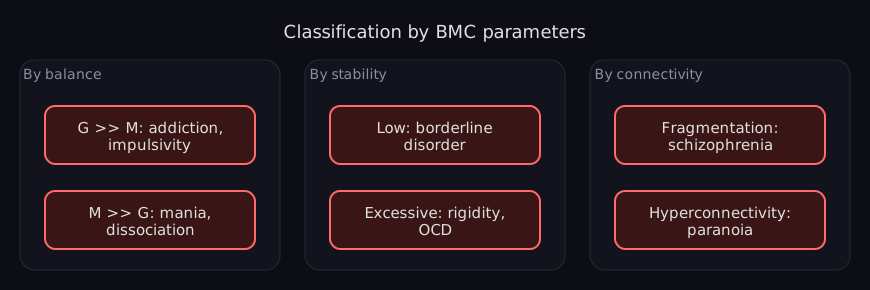
Pathology Formula
where each parameter has a “healthy range”:
| Parameter | Healthy Range | Pathology at Low | Pathology at High |
|---|---|---|---|
| $Balance$ | 0.8 – 2.5 | Impulsivity, addiction | Dissociation, intellectualization |
| $Stability$ | 0.3 – 0.7 | Borderline disorder | OCD, rigidity |
| $Connectivity$ | 0.4 – 0.8 | Schizophrenia | Paranoia, ideas of reference |
BMC Pathology Taxonomy
| Pathology | $Balance$ | $Stability$ | $Connectivity$ | Mechanism |
|---|---|---|---|---|
| Addiction | G » M | Low | Normal | Reward system hack, G wins |
| Depression | M disrupted | High (rigid) | Low | Rumination (SMC, LP ~ 0) -> $E_{available} \to 0$ -> M-layer offline |
| PTSD | G locked | Unstable | Hyper to trauma | Traumatic hub-meme |
| Mania | M » G | Low | Hyper | Memes “running away,” G ignored |
| Anorexia | M » G | High | Normal | Beauty meme overrides hunger G |
| Dissociation | M detached from G | Low | Fragmentation | Interface “disconnected” |
| Schizophrenia | Unstable | Low | Fragmentation | Memes not integrated into a unified “self” |
| OCD | M dominates | Very high | Hyper to threat | I does not register closure of one gap -> ritual-meme as a closure attempt; temporary relief of G fear reinforces the ritual -> automatization (habit -> 1) |
| Borderline | Oscillating | Very low | Unstable | Rapid G-M switching |
| Suicide | M vs G (terminal) | Very high | Low (isolation) | Both inferences failed -> “closure impossible” -> “no way out” meme overcomes G |
OCD: canonical BMC account. The driver is the I-system: evidence that one gap is closed is not accepted (the “not closed” signal persists after closure), SIT for that gap does not fall, and the ritual is an attempt at closure. The maintaining link is automatization: the ritual temporarily lowers FEAR, which reinforces it, and repetition turns it into a habit (habit -> 1, $Cost_{override} \propto habit^2$ ; see Part IV). Compatible data: the phenomenology of incompleteness / “not just right” (Summerfeldt, 2004); an amplified ACC error signal, the enlarged ERN in OCD (Gehring et al., 2000), with ACC and OFC part of the I-layer substrate; a deficit in goal-directed control and excessive avoidance habits (Gillan et al., 2011, 2014). The habit hypothesis of OCD remains contested (Robbins et al., 2019), so in BMC automatization is a secondary link, not the cause.
Diagram: Trajectories to Pathology

Numerical Example: Addiction as a Trajectory
Initial state (norm):
- $Balance = 1.5$
- $A_m = 0.6$ , $A_g = 0.4$
- “Healthy lifestyle” meme controls $G_{reward}$
Event: first drug use
- Drug directly activates $NA$ (nucleus accumbens)
- $A_g$ sharply rises to 0.9
- $Balance$ drops to 0.67
Dependency formation:
| Stage | $A_m$ | $A_g$ | $Balance$ | State |
|---|---|---|---|---|
| Norm | 0.6 | 0.4 | 1.50 | Control |
| After first use | 0.5 | 0.7 | 0.71 | Strong craving |
| Regular use | 0.4 | 0.8 | 0.50 | Loss of control |
| Dependency | 0.2 | 0.9 | 0.22 | G dominates |
| “Rock bottom” | 0.1 | 1.0 | 0.10 | M destruction |
Mechanism: The drug hacks the reward system, making it insensitive to natural rewards (including rewards from memes). $G_{reward}$ no longer serves either genes or memes — only the substance.
Depression as Rumination: The SMC Mechanism
The classical description of depression as “memes switched off” is imprecise. The refined mechanism via reflection (see EMT, Part XVII):
- SMC scans the memeplex -> finds gaps and contradictions (normal reflection)
- Generates candidate memes for closure -> none closes the gap
- LP ~ 0 -> LP filter dampens SIT, but SMC continues scanning (rumination)
- Rumination consumes $E_{available}$ (energy budget is finite)
- $E_{available} \to 0$ -> M-layer loses activation -> sigma falls below criticality
- M-layer enters subcritical regime -> memes “offline” -> G dominates without M direction -> apathy, anhedonia
Neural substrate:
| Component | Neural Structure | What Happens in Depression |
|---|---|---|
| SMC (rumination) | DMN (mPFC, PCC) | Hyperactivation — stuck reflection cycle |
| SEEKING | VTA -> NA | Hypoactivation — no closure -> no reward -> anhedonia |
| I-layer | ACC, insula | “Conflict” signal, but no resources for resolution |
| M-layer (general) | PFC, associative zones | Subcriticality — sigma < 1, memes cannot spread |
Evidence: Berman et al. (2011), Biological Psychiatry: DMN hyperactivation in depression correlates with rumination; Sheline et al. (2009), PNAS: disrupted anti-correlation of DMN and task-positive networks in depression.
Suicide as Terminal Failure of Both Inferences
Suicide is an extreme case in which both discrepancy-minimization mechanisms have terminally failed (see EMT, Part XVII):
- (a) Perceptual inference (update model to match reality): the memeplex is too rigid (high Q, hubs resist restructuring) -> the person cannot change their model
- (b) Active inference (change reality to match model): insufficient resources or insurmountable circumstances -> the person cannot change the world
When both paths are blocked: LP = 0 -> rumination -> $E_{available} \to 0$ -> the M-layer generates the meme “closure is impossible” -> the “no way out” meme overcomes the G-layer (self-preservation instinct).
Risk and protective factors in BMC language:
| Factor | Risk (up) | Protection (down) |
|---|---|---|
| Modularity Q | High -> rigidity -> perceptual inference blocked | Low -> flexibility -> model adapts |
| $E_{available}$ | Low -> active inference impossible | High -> resources for changing reality |
| Social connections | Few connections to other BMCs -> no external memes for closure | Many connections -> external frameworks |
| $T_{SEEK}$ at LP = 0 | High -> agonizing need for closure without possibility | Low -> less suffering from the gap |
Therapeutic Implications
Conceptual mapping of established therapies onto BMC terms; not clinical guidance.
| Pathology | Therapy Goal in BMC Terms | Therapy Mechanism |
|---|---|---|
| Addiction | Restore $Balance$ , strengthen M | New memes capture connections from substance meme |
| Depression | Interrupt rumination, enable LP > 0 | CBT: new frameworks -> closure -> rumination stops; SSRI: suppress SMC cycle -> $E_{available}$ recovers |
| PTSD | Integrate traumatic meme, reduce its dominance | Exposure: weakening traumatic hub connections |
| Suicide risk | Lower Q (flexibility), provide external memes for closure | Crisis intervention: external connections + new frameworks (perceptual inference) |
| Borderline | Stabilize G-M switching | I-layer stabilization |
| OCD | Lower $Stability$ , weaken ritual-meme | ERP: tolerating the “not closed” signal without the ritual -> the ritual is not reinforced by FEAR relief, ritual-meme connections weaken |
See also: Addiction as defeat of both systems — EMT, Part XXVIII; network predictions of pathologies — NM, Part XII.
Extended Neurotaxonomy: ADHD, Autism, DID, and Cognitive Dissonance
The existing section covers addiction, depression, PTSD, schizophrenia, OCD, and borderline disorder. But BMC predicts a unified parameter space for all disorders. Below are the neuromechanisms of the missing ones.
ADHD: sigma > 1 (supercriticality) + unstable SIT
| Neural Structure | Disruption | BMC Interpretation |
|---|---|---|
| PFC (prefrontal cortex) | Hypoactivation | M-layer cannot maintain focus — weak lateral inhibition |
| VTA -> NA (dopamine) | Phasic instability | SEEKING flickers: burst -> closure -> new gap -> burst |
| LC (norepinephrine) | Irregular tonic activity | I-layer cannot filter stably — memes compete chaotically |
| Default mode network | Interference with task-positive | SMC intrudes into task mode -> “daydreaming” |
BMC mechanism: sigma > 1 (supercriticality) — activation spreads too easily -> memes do not compete but all activate simultaneously -> no winner -> switching. SIT creates many gaps, but closure comes prematurely (superficially) -> new gap -> cycle.
Stimulants (Ritalin, Adderall): increase tonic dopaminergic and noradrenergic activity -> stabilize the I-layer and lateral inhibition -> sigma approaches 1 -> M-layer can maintain focus.
Formal connection to WM selection: The distinction between phasic and tonic dopamine is directly reflected in the WM salience formula. Phasic VTA response = $|\Delta a_i(t)|$ (prediction error -> burst firing -> attention capture). Tonic level = $a_i(t)$ (baseline firing -> sustained focus). In ADHD, phasic signal is unstable (SEEKING flickering) and tonic is insufficient (weak lateral inhibition). Stimulants increase the tonic component, stabilizing $a_i(t)$ and allowing habituation $h_i(t)$ to correctly displace irrelevant memes.
Autism: I-Overtuning + Weak Long-Range Connections
| Neural Structure | Disruption | BMC Interpretation |
|---|---|---|
| Connectivity | High local, weak long-range | M-layer: high local clustering, but modules weakly connected |
| ACC/insula | Atypical activation during social tasks | I-layer does not integrate social-emotional signals |
| Mirror neuron system | Atypical | Difficult meme copying through observation |
| DMN | Hypoactive during social tasks | SMC weakly connected to social-emotion clusters |
BMC mechanism: The I-system is too strict — new memes (especially unstructured, social ones) are filtered out. The M-layer is highly structured within “special interests” (deep local clustering) but weakly connected between clusters. PLAY is reduced — little stochastic recombination.
Compatible neuroanatomical data: Ecker et al. (2013): diffusion MRI shows altered white matter connectivity in autism — specifically weak long-range connections with preserved local connectivity. This corresponds to the BMC description (high local clustering, weak inter-cluster edges), though the data precede the model.
DID (Dissociative Identity Disorder): Multiple SMC
| Neural Structure | Disruption | BMC Interpretation |
|---|---|---|
| DMN configuration | Different patterns for different identity-states | Multiple SMC subgraphs, each with its own DMN profile |
| Amygdala | Differentiated response by identity-states | Different G-configurations for each SMC module |
| PFC-amygdala connectivity | Disrupted between states | I-layer between modules is broken |
BMC mechanism: massive trauma -> forced M-layer segmentation to isolate unbearable SIT-gaps. Each segment develops its own SMC. Result: Modularity $Q$ » normal, connectivity between identity-modules -> 0.
Data: Reinders et al. (2014): fMRI shows different neural activity patterns for different identity-states, including different DMN configurations.
Cognitive Dissonance: Hub Advantage Neuromechanism
BMC predicts that in cognitive dissonance, the meme with lower eigenvector centrality will change (hub advantage — see EMT, Part IV). Neuromechanism:
- Conflict detection: ACC detects simultaneous activation of incompatible memes (negative edge + both > theta_high)
- Discomfort: Insula generates a somatic marker — a feeling that “something is wrong”
- Resolution via hub advantage: PFC redistributes activation. The meme with greater degree (more incoming edges -> more supporting activation) holds its position. The less connected meme is suppressed via lateral inhibition -> rationalization.
Neural data: van Veen et al. (2009): ACC is activated during cognitive dissonance (fMRI); dACC activation predicts degree of attitude change — the I-layer (conflict detection) initiates the process.
Unified parameter space of all disorders and formalization — see EMT, Part XXII; network formalization — see NM.
Radicalization: The Neural Trajectory of Ideological Capture
Radicalization is a neurobiologically describable process of hub displacement under ideological pressure. The mechanism parallels ontogenetic crises (hub displacement under trauma) but with an external agent (ideology).
Neural trajectory:
| Phase | Neuromechanism | BMC Parameter |
|---|---|---|
| 1. Grievance/trauma | Massive SIT-gap -> DMN hyperactive (rumination) | SIT up, LP ~ 0 |
| 2. Ideological offer | Meme-complex with high emotional valence closes gap -> VTA reward | LP -> “> 0” (illusory closure) |
| 3. Hub displacement | Ideological memes capture connections -> PFC reconfigured | Diversity down, Q up |
| 4. I-recalibration | ACC/insula recalibrated: in-group = compatible, out-group = threat | I-threshold shifted |
| 5. G-restructuring | Amygdala hyperactive (FEAR/RAGE), VTA in tonic mode (in-group reward) | RAGE/FEAR up, CARE/PLAY down |
Neurochemistry:
- Oxytocin: enhances in-group bonding, enhances out-group hostility (De Dreu et al., 2010)
- Cortisol: chronically elevated (constant threat detection)
- Dopamine: reward from in-group belonging -> reinforcing cycle
Adolescent vulnerability: PFC not fully myelinated yet (until ~25 years) -> I-layer immature -> weak filtration. Simultaneously, peak SEEKING (identity formation) + G-instability (puberty) -> ideal window for ideological capture.
Predictions:
| Prediction | Neural Marker |
|---|---|
| Radicalization accompanied by decreased PFC-amygdala connectivity | fMRI: testable on ex-radicals |
| Deradicalization = restoration of DMN-TPN anti-correlation | fMRI: longitudinal in exit programs |
| Adolescents with immature PFC more vulnerable | Correlation of PFC maturation x susceptibility |
Conceptual connection: Radicalization as the reverse path of Gandhi — see EMT, Part XXVII.
PFC Myelination and WM Capacity Growth
The WM ceiling ($k_{active}$ ) is determined by theta-gamma coupling in PFC: the number of gamma cycles fitting within one theta cycle sets the maximum number of simultaneous representations (Lisman & Jensen, 2013, Neuron). This coupling matures as PFC myelinates — the latest-maturing cortical region (Gogtay et al., 2004, PNAS).
| Age | PFC Status | Theta-Gamma Coupling | $k_{active}$ | Critical Period of Memogenesis |
|---|---|---|---|---|
| ~1 year | Minimal myelination | Weak, unstable | ~1 | Primary binding: single memes |
| ~3 years | dlPFC myelination beginning | Forming | ~2 | Secondary binding: conditioned pairs |
| ~7 years | Mid myelination | Stable 3-cycle | ~3 | Tertiary binding: Piaget concrete operations |
| ~15+ years | Near mature | Stable 4-cycle | ~4 | Metacognition: reflection, long chains |
| >65 years | Atrophy, demyelination | Decoupling | Down | Compensation via stigmergy + preserved habits |
EEG marker: Growth in theta-gamma phase-amplitude coupling (PAC) in frontal leads correlates with WM capacity across ages (Gaillard et al., 2021, Heliyon). This provides an objective neural marker for $k_{active}(t_{dev})$ .
Critical periods of memogenesis. Each increment in $k$ opens a new binding level: $k=1$ -> single memes (sensorimotor), $k=2$ -> conditioned pairs (early symbolism), $k=3$ -> triple operations (logic, rules), $k=4$ -> metarepresentations (reflection over memes). Memes requiring $k > k_{active}$ literally do not fit in WM -> cannot be acquired. Hence age-stratified cultural transmission.
Formalization: $k_{active}(t_{dev})$ , formula and empirical anchors — see NM: WM Ontogeny.
Cognitive Biases: Neuroanatomical Substrate
The six BMC mechanisms generating cognitive biases have distinct neuroanatomical substrates. Below is the mapping of mechanisms to brain regions and key neural data.
| BMC Mechanism | Neuroanatomical Substrate | Key Data |
|---|---|---|
| H (hub inertia) | mPFC (belief updating), VMPFC (confidence in beliefs) | Positive correlation: VMPFC activity correlates with confidence in current belief (Lebreton et al., 2015). Hub-memes with high $C_E$ are maintained by sustained mPFC representation |
| I (immune filtration) | Parietal cortex (evidence encoding), mPFC (selective readout) | Park et al. (2025, Nature Communications): evidence is accurately encoded in parietal cortex regardless of compatibility, but behavioral readout is higher for belief-consistent evidence. The I-filter acts at the readout level, not encoding |
| W (WM constraints) | DLPFC (WM maintenance), theta-gamma coupling | $k_{active}$ ceiling is determined by the number of gamma cycles per theta cycle (Lisman & Jensen, 2013). WM overload -> DLPFC deactivation -> biases intensify |
| G (affective capture) | Amygdala (threat valuation), VMPFC (affect integration), striatum (reward) | Nie et al. (2023, Imaging Neuroscience): MEG shows that loss and gain are processed via distinct neurodynamic pathways; alpha asymmetry correlates with individual loss aversion |
| A (automatization) | DLS (dorsolateral striatum — habits) vs DMS (dorsomedial striatum — goal-directed) | Yin & Knowlton (2006): DLS damage -> habit loss; DMS damage -> goal-directed control loss. DLS/DMS competition = $Auto(S)$ vs deliberation |
| R (reconsolidation) | Hippocampus (labile window), BLA (emotional reconsolidation) | Nader et al. (2000, Nature): reactivation -> labile state -> reconsolidation/extinction. Hippocampal reconsolidation = $Labile(m_i, t)$ |
Dual system: G vs M, not System 1 vs System 2. Kahneman described two “systems”: fast intuitive (System 1) and slow analytical (System 2). Neural data show a more precise picture:
- G-layer (amygdala, striatum, VMPFC) — fast utility assessment. Not “irrational” — optimizes survival and reproduction. Loss aversion, affect heuristic = G-capture of WM slots.
- M-layer deliberation (DLPFC, ACC, posterior parietal) — slow analytical processing. Requires WM resources ($k_{eff} > 1$ ). Confirmation bias, Dunning-Kruger = H-inertia + I-filtration in M-layer.
- ACC (anterior cingulate cortex) — conflict detector. Activated during G/M misalignment (when G “wants” one thing and M analysis shows another). Detects cognitive dissonance ($D > \theta$ ) and triggers override — M’s attempt to suppress the G signal.
“System 1” = G + A (utility reactions + automatized patterns). “System 2” = M-layer deliberation with WM. But Kahneman does not distinguish G and A within “System 1” — and this is critical: G-biases (loss aversion) are intensified by WM load, A-biases (status quo) are not.
Neural signatures of biased confidence. Lebreton et al. (2015) and subsequent work show: VMPFC correlates positively with confidence (certainty in a decision), while DLPFC/DMPFC correlates negatively. In BMC: VMPFC = G-valuation (utility assessment “this is right/safe”), DLPFC = M-override (analytical check, requiring WM). High confidence during bias = strong G signal (VMPFC) with weak M-override (DLPFC loaded or not activated).
Cross-modulation: negativity bias. $\lambda_{neg} < \lambda_{pos}$ — neurobiologically: the amygdala reacts faster and more intensely to negative stimuli (LeDoux, 1996); consolidation of negative memories is enhanced (via norepinephrine -> BLA -> hippocampus pathway). This is not a separate system but a parameter modulating the edge decay rate for negatively colored edges in the memeplex.
Connection to pathologies. Extreme values of the same parameters produce clinical disorders (see Part IX above: parametric taxonomy). Cognitive biases are the normative range; clinical disorders are tail distributions of the same parameters:
| Bias (norm) | Parameter | Pathology (extreme) |
|---|---|---|
| Confirmation bias (H) | $C_E$ high, I strict | Paranoid ideation (H+I -> extreme) |
| Loss aversion (G) | FEAR $w_{capture} = 1.0$ | Anxiety disorder (FEAR-capture chronic) |
| Status quo bias (A) | $habit^2$ high | Compulsive rigidity in OCD (A -> extreme, $Cost_{override} \to \infty$ ; maintaining link, the driver is the I-signal “not closed”) |
| Hindsight bias (R) | $Labile$ + context shift | PTSD (R -> failure: destabilize-loop) |
Formalization: Bias strength functions $B_H, B_I, B_W, B_G, B_A, B_R$ — see NM, Part IX. Conceptual overview: EMT, Part XXIV. AGI engineering: AGI Foundations, Part VI.
Part X. Epigenetics: Can Memes Influence Gene Expression?
The Problem: One-Directional Influence?
So far we have considered the influence of genes on memes and the reverse influence of memes (through behavior) on gene success. But is direct meme influence on gene expression possible?
Epigenetic Primer
Epigenetics is the study of changes in gene expression not related to changes in the DNA sequence.
Main mechanisms:
| Mechanism | Description | Effect |
|---|---|---|
| DNA methylation | Attachment of a methyl group to cytosine | Usually suppresses expression |
| Histone modification | Acetylation, methylation of histone tails | Changes DNA accessibility |
| Non-coding RNA | miRNA, lncRNA regulate expression | Post-transcriptional regulation |
Evidence of Behavioral Influence on the Epigenome

Table: Practices and Epigenetic Effects
| Practice | Epigenetic Effect | Evidence Quality | Transgenerational |
|---|---|---|---|
| Meditation | Decreased inflammation genes, increased telomerase | Medium (small samples) | Not demonstrated |
| Chronic stress | Increased NR3C1 methylation (cortisol receptor) | High | Possible |
| Early deprivation | Decreased BDNF expression, increased inflammation | High | Shown in rodents |
| Physical activity | Decreased PPARGC1A methylation | Medium | Not demonstrated |
| Diet | Multiple effects | Medium | Shown in rodents |
Epigenetic Modification Probability Formula
where:
- $\lambda$ — base modification rate (gene-dependent)
- $duration$ — exposure duration
- $intensity$ — intensity (stress, practice)
Example calculation:
Meditation practice: $\lambda = 0.01$ (per week), $duration = 52$ weeks, $intensity = 0.5$ (moderate practice)
Probability of a noticeable epigenetic effect ~12% after one year of moderate practice.
Transgenerational Effects
A controversial but important question: Can epigenetic changes be transmitted to offspring?
Evidence:
| Study | Finding | Status (2025) |
|---|---|---|
| Dutch Hunger Winter (1944-45) | Descendants of starved mothers have elevated risk of metabolic disease; accelerated biological aging six decades later | Replicated; PNAS 2024 confirms the effect |
| Holocaust studies (FKBP5) | Altered FKBP5 methylation in survivors’ children; linked to cortisol levels | Replicated in 2020; in 2025 expanded to 3rd–4th generation (Scientific Reports) |
| Rodent studies | Fear of an odor transmitted across 2 generations | Extrapolation to humans debatable; mechanisms not fully clear |
2025 update: Transgenerational epigenetic effects in humans replicate more reliably than previously thought. However, effect sizes are small, and causal relationships remain debated due to multiple confounders (shared environment, cultural transmission of trauma, socioeconomic factors).
Diagram: Path from Meme to Epigenome

Important Clarification: Lamarckism Is NOT Rehabilitated
Critical note: Epigenetic effects of behavior do not mean the rehabilitation of Lamarckism. Important limitations:
- Effects are probabilistic, not deterministic
- Effects are often reversible
- Transgenerational transmission is limited (1–2 generations)
- Mechanisms in humans are less studied than in rodents
- Many early studies have not been replicated
Memes can influence gene expression, but this influence is limited, probabilistic, and is not “inheritance of acquired traits” in the Lamarckian sense.
Implications for the BMC Model
If memes can influence the epigenome:
- Long-term memes can modify the $G$ -layer itself (not the genome, but its expression)
- Cultural evolution can indirectly influence biological evolution via epigenetics
- Therapy may have epigenetic effects
This adds another level of interaction to the BMC model.
Part XI. Predictions and Falsifiability
The Problem: Does the Theory Explain Everything?
Any good theory must make falsifiable predictions. What does the BMC model predict?
Predictions Table
| Prediction | BMC Mechanism | Verification Method | What Would Refute It |
|---|---|---|---|
| PFC damage shifts balance toward G | PFC is the M substrate | Behavior of patients with PFC damage | No impulsivity with PFC damage |
| Cortisol correlates with G dominance | Stress activates G | Cortisol measurement + behavior | High cortisol with rational behavior |
| Cultural configuration inherited via memes | Transmission through upbringing | Migrant children vs. native-culture children | Migrant children identical to home culture |
| Regression under stress | I depletion -> G dominates | Behavior under load | Stress improves rationality |
| M Connectivity grows with age | Connection accumulation | Network analysis of semantic networks | Identical modularity at 20 and 60 |
| Therapy changes G-M connections | I modification | Neuroimaging before/after therapy | Therapy does not affect activation |
Specific Predictions from the Model
1. Neuroanatomical Prediction
Prediction: Individual PFC thickness correlates with meme-favoring $Balance$ .
Mechanism: PFC is the M substrate. More PFC -> more meme capacity -> higher $Balance$ .
Verification: Correlation of PFC thickness (MRI) with self-control measures.
Falsification: No correlation or inverse correlation.
2. Pharmacological Prediction
Prediction: PFC-enhancing drugs (e.g., modafinil) increase meme-favoring $Balance$ .
Mechanism: Strengthening the M substrate -> more M resources -> higher $Balance$ .
Verification: Behavioral tests under drug vs. placebo.
Falsification: Drug does not affect self-control.
3. Ontogenetic Prediction
Prediction: PFC maturation (age ~25) coincides with peak $Balance$ .
Mechanism: Full maturation of the M substrate -> maximum capacity.
Verification: Longitudinal study of $Balance$ (self-control tests) + MRI.
Falsification: Peak $Balance$ does not coincide with PFC maturation.
4. Cross-Cultural Prediction
Prediction: Cultures with high $\theta_{honor}$ (dignity cultures) have fewer violent crimes.
Mechanism: High threshold -> M suppresses G aggression more often.
Verification: Correlation of cultural metrics with crime statistics.
Falsification: No correlation or inverse correlation.
Predictions Structure Diagram

Existing Confirmations
| Prediction | Status | Source |
|---|---|---|
| PFC damage -> impulsivity | Confirmed | Famous case of Phineas Gage; systematic studies |
| Stress reduces self-control | Confirmed | Baumeister et al., ego depletion (with replication caveats) |
| PFC matures by ~25 years | Confirmed | Gogtay et al. (2004), longitudinal MRI |
| Honor cultures more aggressive | Partially confirmed | Cohen et al. (1996), US South studies |
5. SIT-Specific Predictions
Structural Incompleteness Tension (SIT) generates a separate class of predictions not derivable from the base BMC model without the SIT extension:
5a. Neuroanatomical (DMN x gap density):
| Prediction | Method | Falsification Criterion |
|---|---|---|
| Semantic network gap density correlates with DMN activation during resting-state | Free associations -> semantic network; fMRI resting-state | $r < 0.15$ at $N > 50$ |
Subjects with more “open questions” (high gap density) should show higher basal DMN activation. This is a direct consequence of SIT -> SEEKING -> DMN.
5b. Pharmacological (dopaminergics x SIT-rumination):
| Prediction | Method | Falsification Criterion |
|---|---|---|
| Dopaminergics (L-DOPA, amphetamine) enhance SIT-rumination | Placebo-controlled design; rumination questionnaire + thought probes | No significant increase in thought probes about unresolved tasks |
The SIT term in the SEEKING formula is modulated by $T_{SEEK}$ , which depends on dopamine. Increasing available dopamine -> increased $T_{SEEK}$ -> enhanced SIT-driven activation -> more spontaneous thoughts about unresolved problems.
5c. Behavioral (Zeigarnik x centrality):
| Prediction | Method | Falsification Criterion |
|---|---|---|
| Zeigarnik effect modulated by cluster centrality: important tasks -> stronger effect | Interruption of tasks of varying subjective significance; recall after 24 hours | No correlation between importance ratings and recall advantage |
The classic Zeigarnik effect (better memory for interrupted tasks) should be modulated by significance: $SIT \propto centrality(C)$ , so interrupted tasks from central clusters should be remembered significantly better than those from peripheral ones.
5d. Temporal (SIT is not a forgetting curve):
| Prediction | Method | Falsification Criterion |
|---|---|---|
| SIT does not follow a forgetting curve; persists until closure or LP-collapse | Longitudinal study: unresolved problems x time x recall | Recall for unresolved tasks follows $e^{-\lambda t}$ just like resolved ones |
Resolved tasks follow edge decay: $w(t) = w_0 \cdot e^{-\lambda t}$ . Unresolved tasks with $SIT > 0$ should show a plateau of recall that does not decline until closure (solution found) or LP-collapse (progress completely stopped).
See also: Falsifiability of meme theory — EMT, Part XXIX; network predictions and SIT prediction #9 — NM, Part XI.
Part XII. Conclusions and Implications
Summary of the BMC Model
The Biomemetic Complex is a system arising from the interaction of two replicators (genes and memes) on a shared neurobiological substrate.

Key Conclusions
| # | Conclusion | Implication |
|---|---|---|
| 1 | Consciousness is a product of tension between G and M, not M alone | For AGI, a memeplex alone is insufficient |
| 2 | $Balance$ depends on the substrate (PFC vs. limbic) | Neurobiology determines boundaries |
| 3 | Interface $I$ is trainable (habits) | Therapy is possible |
| 4 | BMC configuration is culture-specific | Universal prescriptions do not work |
| 5 | Pathologies are disruptions of BMC parameters | A new perspective on diagnostics |
Implications for Different Domains
For Psychiatry
| Traditional Approach | BMC Approach |
|---|---|
| Diagnosis by symptoms | Diagnosis by BMC parameters |
| Drug treatment | Modifying Balance + I |
| Focus on behavior | Focus on G-M dynamics |
For Education
| Traditional Approach | BMC Approach |
|---|---|
| Knowledge transfer | Meme niche colonization |
| Same methods for all | Accounting for critical periods |
| Ignoring emotions | Integrating G and M |
For AI Alignment
| Traditional Approach | BMC Approach |
|---|---|
| Value alignment | Utility layer + Memetic layer |
| Absence of conflict = good | Conflict = source of “self” |
| Single-goal optimization | Dynamic goal equilibrium |
For Social Policy
| Traditional Approach | BMC Approach |
|---|---|
| Information campaigns | Understanding memeplex immunity |
| Rapid changes | Accounting for BMC rigidity |
| Same measures for all | Accounting for cultural configuration |
Bridge to AGI
The BMC model proposes an architecture for AGI with human-like dynamics:

Hypothesis: To create AGI with a human-like “personality,” one must reproduce not only the memeplex but also the utility substrate and the interface between them.
Final Theory Diagram

What Comes Next
- Empirical testing — testing predictions from Part XI
- Formula refinement — calibrating parameters on real data
- AGI application — implementing the architecture from AGI Foundations
- Clinical application — developing BMC-based diagnostics
See also: Theory application to AGI — AGI Foundations; network formalization — NM; core theory — EMT.
Formal Refinements
Each refinement below replaces or extends a specific formula from the core theory above with a more principled, empirically grounded version, drawing on established results from behavioral biology, nonlinear dynamics, reinforcement learning, neuronal dynamics, cognitive neuroscience, information theory, and network science.
Balance Dynamics: Static Ratio → Bistable ODE (CRITICAL)
The original static formula $Balance = A_{PFC}/(A_{limbic}+\varepsilon)$ is replaced by a bistable 2D ODE system:
Two stable attractors (rational-dominant, emotional-dominant) with hysteresis: $\theta_{exit} \gg \theta_{enter}$ . Once the system tips into an emotional attractor, significantly more rational input is required to return — explaining why “calming down” is harder than “getting angry.” Hopf bifurcation at critical parameter values yields a pathology taxonomy: bipolar disorder = limit cycle between attractors, PTSD = excitable system with low threshold.
Learning Rules: Hebbian → TD-Modulated (HIGH)
Three-level hierarchy replacing the generic $\Delta w \propto a_i a_j$ :
STDP (Spike-Timing-Dependent Plasticity): $\Delta w = A_+ e^{-\Delta t/\tau_+}$ (pre→post, strengthening) $- A_- e^{-|\Delta t|/\tau_-}$ (post→pre, weakening). Introduces directional causality into edge weights.
Reward-modulated STDP (3-factor rule): $\Delta w_{ij} = \eta \cdot \delta_{BMC} \cdot \psi_i \cdot a_j$ . Learning occurs only when the TD error signal $\delta_{BMC}$ confirms that the co-activation was behaviorally relevant. Matches Yagishita et al. (2014) findings on dopamine-gated synaptic plasticity.
TD error as learning signal: $\delta_{BMC} = \sum_g w_g a_g(t+1) + \gamma V(S_{t+1}) - V(S_t)$ . Critic (2-factor, ventral striatum analogue) vs Actor (3-factor, dorsal striatum analogue).
Mutual Information Interpretation of Edges (HIGH)
Edge weight now has a precise information-theoretic meaning:
Edge weight = mutual information in bits between two memes. The PRUNE criterion becomes principled: remove edge if $I < \theta_{prune}$ bits (the memes are informationally independent). Hub = node with maximum total mutual information $\sum_j I(m_i; m_j)$ .
Autoreception and Adaptation (MED-HIGH)
Chronic activation of a G-program → sensitivity decrease → tolerance, allostatic load, anhedonia. This formalizes why sustained stress eventually blunts the stress response itself. Implemented as an AdEx (adaptive exponential) slow variable: $\tau_w dw_i/dt = \alpha(a_i - a_i^{rest}) - w_i$ .
Serotonin: Dual Role (MED-HIGH)
Serotonin (5-HT) modulates two independent parameters simultaneously:
- I-gate amplification: $I_{eff} = I_{base}(1 + \beta_{5HT} \cdot Mod_{5HT})$ — impulse control strength
- Temporal discount rate: $\gamma_{BMC} = \gamma_{base} + \beta_\gamma \cdot Mod_{5HT}$ — patience/future orientation
Low serotonin → impulsive AND myopic (double deficit). Predicts Caspi effect: MAO-A variant × childhood trauma → antisocial behavior via both pathways.
Dual-Route Processing (MED-HIGH)
Two routes for information influence on behavior:
- Route 1 (conscious, ~200ms): $influence^{conscious} = a_i \cdot \mathbb{1}[a_i > \theta_{act}] \cdot priority$
- Route 2 (subliminal, ~12ms): $influence^{subliminal} = \gamma_{sub} \cdot a_i \cdot f_{route2}(m_i)$
Where $f_{route2}$ depends on meme type: G-connected memes (1.0), semantic memes (0.3), abstract memes (0). Formalizes intuition, implicit bias, blindsight, and Zajonc’s mere exposure effect.
Rate-Distortion → Fidelity Tiers (MED-HIGH)
Memory fidelity is not binary (remember/forget) but operates on a rate-distortion curve with three tiers:
| Tier | Distortion $D$ | Rate $R$ (bits) | Analog |
|---|---|---|---|
| Full | $\leq 0.05$ | $\geq 0.71$ | Flashbulb memory |
| Skeletal | $\leq 0.3$ | $\geq 0.12$ | Gist memory |
| Trace | $> 0.3$ | $< 0.12$ | Déjà vu, priming |
Information Bottleneck principle: optimal memory maximizes $\sum I(m; behavior)$ given a finite storage budget. Consolidation = source coding optimization.
Additional Formulas
| Parameter | Formula |
|---|---|
| Dopamine inverted-U | $f(u) = 4u(1-u)$ , max at $u=0.5$ |
| Testosterone threshold | $\theta_g^{eff} = \theta_g^{base} - \sum_k \beta_k Mod_k$ |
| Triple attention | $salience = a_i \cdot Alerting(NE) \cdot Orienting(ACh) \cdot Executive(DA)$ |
| ERP predictions | N400 $\propto PE_{semantic}$ , P600 $\propto SIT_{syntactic}$ , ERN $\propto$ Conflict |
Appendix A. Formula Reference
Definitions
| Formula | Part | Purpose |
|---|---|---|
| $BMC = (G, M, I, S)$ | I | Definition of the Biomemetic Complex |
| $G_{BMC} = (V_g \cup V_m, E_{gg} \cup E_{mm} \cup E_{gm})$ | IV | BMC graph |
Coevolution
| Formula | Part | Purpose |
|---|---|---|
| $W_{total}(t) = W_g(t) \cdot W_m(t) + \alpha \cdot synergy(g, m)$ | II | Coevolutionary fitness |
Neurobiology
| Formula | Part | Purpose |
|---|---|---|
| $Balance(t) = \frac{A_{PFC}(t)}{A_{limbic}(t) + \varepsilon}$ | III | Neural proxy of Balance; definition — NM, Part XIII |
Activation
| Formula | Part | Purpose |
|---|---|---|
| $a_g(t) = a_g^{base} + \sum_i w_{gi} \cdot stimulus_i(t)$ | IV | Utility node activation |
| $\Delta a_m(t) = \alpha \cdot w_{gm} \cdot a_g(t) \cdot (1 - a_m(t))$ | IV | G influence on M |
| $\Delta a_g(t) = \beta \cdot w_{mg} \cdot a_m(t)$ | IV | M influence on G (sign of $w_{mg}$ determines direction) |
Interaction Mechanisms
| Formula | Part | Purpose |
|---|---|---|
| $Cost_{redir} = \delta \cdot \lvert goal_{gene} - goal_{meme}\rvert \cdot a_g(t)$ | V | Redirection cost |
| $Cost_{supp} = \beta \cdot a_g(t) \cdot duration \cdot (1 - habit(m))$ | V | Suppression cost |
| $a_{effective}(t) = \max(0, a_g(t) - \gamma \cdot a_{meme\_inhibit}(t))$ | V | Effective activation under suppression |
| $E_{available}(t) = E_{max} - \sum Cost_{supp} - \sum Cost_{active}$ | V | Energy budget |
Competition Model
Mathematical formulas for the competition model are placed in Appendix D as hypothetical — they require empirical validation.
Ontogeny
| Formula | Part | Purpose |
|---|---|---|
| $Balance(age) = \frac{C_{PFC}(age)}{C_{limbic}} \cdot \frac{M_{density}(age)}{M_{max}}$ | VII | Balance by age |
| $Openness(age) = O_{base} \cdot e^{-\lambda \cdot (age - age_{peak})^2}$ | VII | Openness to memes |
Culture
| Formula | Part | Purpose |
|---|---|---|
| $Config = (W_{ind}, W_{col}, \theta_{honor}, \sigma_{context})$ | VIII | Cultural configuration |
| $Config_{child} = \alpha \cdot Config_{parents} + \beta \cdot Config_{peers} + \gamma \cdot Config_{media}$ | VIII | Configuration transmission |
Pathologies
| Formula | Part | Purpose |
|---|---|---|
| $Pathology = f(Balance, Stability, Connectivity)$ | IX | Pathology function |
Epigenetics
| Formula | Part | Purpose |
|---|---|---|
| $P(mod) = 1 - e^{-\lambda \cdot duration \cdot intensity^2}$ | X | Epigenetic modification probability |
Signed Edges and Asymmetric Decay
| Formula | Part | Purpose |
|---|---|---|
| $w \in [-1, +1]$ for all edge types | IV | Signed edges of the BMC graph |
| $w(t) = w_0 \cdot e^{-\lambda_{sign(w_0)} \cdot t}$ , $\lambda_{neg} < \lambda_{pos}$ | IV | Asymmetric decay (negativity bias) |
| $Ambivalence(m) = \sqrt{\frac{1}{\lvert N(m)\rvert}\sum_{j \in N(m)} (w_{mj} - \bar{w}_m)^2}$ | IV | Ambivalence metric |
SEEKING Metasystem and BLEND
| Formula | Part | Purpose |
|---|---|---|
| $a_{SEEK}(t) = T_{SEEK} \cdot a_{SEEK}^{base}(t) + \sum_{s \neq SEEK} \alpha_s \cdot a_s(t)$ | IV | SEEKING as metasystem |
| BLEND: recombination of components from different clusters (step 3 of consolidation cycle) | IV | Meme synthesis during sleep |
Differentiated Storage
| Formula | Part | Purpose |
|---|---|---|
| $Fidelity(m, t) = \frac{k_m^{\gamma}}{k_{max}^{\gamma}} \cdot e^{-\lambda_f (t - t_{last})} \cdot (1 - e^{-\beta \cdot age})$ | IV | Meme storage completeness function |
| $\frac{d(Fidelity)}{dt} = \rho \cdot (1 - Fidelity) \cdot exposure(t)$ | IV | Reactivation dynamics |
| $\lambda_{ij} = \lambda_0 \cdot \frac{1}{1 + \alpha \cdot C(i) \cdot C(j)}$ | IV | Differential connection decay |
Appendix B. Glossary
| Term | Definition |
|---|---|
| BMC (Biomemetic Complex) | System $(G, M, I, S)$ : genetic layer, memetic layer, interface, substrate |
| Utility node | Node in the BMC graph representing a genetic program (fixed, with base activation) |
| Memetic node | Node in the BMC graph representing a meme (dynamic) |
| Balance | Ratio of memetic to genetic layer activation: $\bar{a}_M/(\bar{a}_G + \epsilon)$ (NM, Part XIII). Neural proxy: $A_{PFC}/A_{limbic}$ |
| Interface (I) | Mechanisms of interaction between G and M: redirection, suppression, interpretation |
| Redirection | Mechanism linking the output of a genetic program to an alternative goal |
| Suppression | Mechanism for inhibiting a genetic program (depletable) |
| Interpretation | Mechanism for changing the meaning of a signal from a genetic program |
| Critical period | Time window of heightened susceptibility to certain meme types |
| Cultural configuration | Culture-specific tuning of BMC parameters |
| Baldwin effect | Mechanism for accelerating genetic evolution through learning |
| Transgenerational effect | Transmission of epigenetic changes to offspring |
| Fidelity (storage completeness) | Measure of meme preservation: from 0 (trace) to 1 (full) |
| Full storage | Fidelity > 0.7 mode: core + all connections + details |
| Skeletal storage | Fidelity 0.3–0.7 mode: core + primary connections (no details) |
| Trace storage | Fidelity < 0.3 mode: only core or fragment |
| Meme core (skeleton) | Minimal central meme structure that persists longest |
| Reactivation | Restoration of meme Fidelity upon re-exposure |
| Recombination (BLEND) | Synthesis of a new meme by combining elements from different clusters; step 3 of consolidation cycle (REM sleep) |
| Three-level binding | Hierarchy of meme binding to emotional systems: primary (unconditional), secondary (conditioned), tertiary (cognitive). Per Panksepp & Biven (2012) |
| SEEKING (metasystem) | Dopamine system recruited by all other 6 Panksepp systems; “currency of attention” |
| DISGUST (I-layer) | Not an 8th Panksepp system but an interface mechanism: a disgust genetic program recruited by the memetic layer for marking “foreign” memes |
| Connection/edge | Edge between BMC graph elements. Has weight $w \in [-1, +1]$ and decay rate $\lambda$ . Neural analog: ensemble overlap (shared neurons) |
| Hub | A role, not a level: an element with centrality significantly exceeding the average. “Hub” = meme-hub (by default) |
| Meme-type | Abstract cultural pattern (analog of genotype) |
| Meme-instance | Concrete neural realization of a meme in one BMC (analog of phenotype) |
| Negative weight ($w < 0$ ) | Inhibitory connection; when $w < -\theta$ the meme is actively rejected by the memeplex |
| Antibody | Meme with high Fidelity and negative connection: a well-studied “enemy” enabling rapid threat recognition |
Appendix C. References
Evolution and Coevolution
- Baldwin, J.M. (1896). A new factor in evolution. The American Naturalist, 30(354), 441-451.
- Blackmore, S. (1999). The Meme Machine. Oxford University Press.
- Dawkins, R. (1976). The Selfish Gene. Oxford University Press.
- Deacon, T.W. (1997). The Symbolic Species. W.W. Norton.
- Richerson, P.J., & Boyd, R. (2005). Not by Genes Alone. University of Chicago Press.
Neurobiology
- Arnsten, A.F. (2009). Stress signalling pathways that impair prefrontal cortex structure and function. Nature Reviews Neuroscience, 10(6), 410-422.
- Damasio, A. (1994). Descartes’ Error. Putnam.
- Gogtay, N., et al. (2004). Dynamic mapping of human cortical development during childhood through early adulthood. PNAS, 101(21), 8174-8179.
- Miller, E.K., & Cohen, J.D. (2001). An integrative theory of prefrontal cortex function. Annual Review of Neuroscience, 24, 167-202.
Epigenetics
- Meaney, M.J. (2010). Epigenetics and the biological definition of gene x environment interactions. Child Development, 81(1), 41-79.
- Yehuda, R., et al. (2016). Holocaust exposure induced intergenerational effects on FKBP5 methylation. Biological Psychiatry, 80(5), 372-380.
Cross-Cultural Psychology
- Cohen, D., et al. (1996). Insult, aggression, and the southern culture of honor. Journal of Personality and Social Psychology, 70(5), 945-960.
- Hofstede, G. (2001). Culture’s Consequences. 2nd ed. Sage Publications.
- Nisbett, R.E., & Cohen, D. (1996). Culture of Honor. Westview Press.
Psychopathology
- Baumeister, R.F., et al. (2007). The strength model of self-control. Current Directions in Psychological Science, 16(6), 351-355.
- Gehring, W.J., Himle, J., & Nisenson, L.G. (2000). Action-monitoring dysfunction in obsessive-compulsive disorder. Psychological Science, 11(1), 1-6.
- Gillan, C.M., Papmeyer, M., Morein-Zamir, S., Sahakian, B.J., Fineberg, N.A., Robbins, T.W., & de Wit, S. (2011). Disruption in the balance between goal-directed behavior and habit learning in obsessive-compulsive disorder. American Journal of Psychiatry, 168(7), 718-726.
- Gillan, C.M., Morein-Zamir, S., Urcelay, G.P., et al. (2014). Enhanced avoidance habits in obsessive-compulsive disorder. Biological Psychiatry, 75(8), 631-638.
- Koob, G.F., & Volkow, N.D. (2016). Neurobiology of addiction: a neurocircuitry analysis. The Lancet Psychiatry, 3(8), 760-773.
- Robbins, T.W., Vaghi, M.M., & Banca, P. (2019). Obsessive-compulsive disorder: puzzles and prospects. Neuron, 102(1), 27-47.
- Summerfeldt, L.J. (2004). Understanding and treating incompleteness in obsessive-compulsive disorder. Journal of Clinical Psychology, 60(11), 1155-1168.
Affective Neuroscience and Emotions
- Panksepp, J. (2011). The basic emotional circuits of mammalian brains: Do animals have affective lives? Neuroscience & Biobehavioral Reviews, 35(9), 1791-1804.
- Panksepp, J., & Biven, L. (2012). The Archaeology of Mind: Neuroevolutionary Origins of Human Emotions. W.W. Norton.
- Haidt, J. (2001). The emotional dog and its rational tail: A social intuitionist approach to moral judgment. Psychological Review, 108(4), 814-834.
- Rozin, P., Haidt, J., & McCauley, C.R. (2008). Disgust. In M. Lewis, J.M. Haviland-Jones & L.F. Barrett (Eds.), Handbook of Emotions (3rd ed., pp. 757-776). Guilford Press.
Meme Synthesis and Sleep
- Fauconnier, G., & Turner, M. (2002). The Way We Think: Conceptual Blending and the Mind’s Hidden Complexities. Basic Books.
- Wagner, U., Gais, S., Haider, H., Verleger, R., & Born, J. (2004). Sleep inspires insight. Nature, 427(6972), 352-355.
- Lewis, P.A., & Durrant, S.J. (2011). Overlapping memory replay during sleep builds cognitive schemata. Trends in Cognitive Sciences, 15(8), 343-351.
Negative Weights and Structural Balance
- Baumeister, R.F., Bratslavsky, E., Finkenauer, C., & Vohs, K.D. (2001). Bad is stronger than good. Review of General Psychology, 5(4), 323-370.
- Heider, F. (1946). Attitudes and cognitive organization. The Journal of Psychology, 21(1), 107-112.
- Davis, J.A. (1967). Clustering and structural balance in graphs. Human Relations, 20(2), 181-187.
- Hovland, C.I., Lumsdaine, A.A., & Sheffield, F.D. (1949). Experiments on Mass Communication. Princeton University Press.
Network Science
- Barabasi, A.-L. (2016). Network Science. Cambridge University Press.
- Newman, M.E.J. (2018). Networks: An Introduction. 2nd ed. Oxford University Press.
Appendix D. Hypothetical Mathematical Formalization
Status: This formalization is hypothetical. Parameters are not empirically calibrated. It is presented as a possible direction for future research, not as a validated model.
Lotka-Volterra Competition Model
The classical two-population competition model for a shared resource can be adapted to describe the competition between genetic ($A_g$ ) and memetic ($A_m$ ) activation:
Parameters:
- $A_m$ , $A_g$ — memetic and genetic layer activations
- $r_m$ , $r_g$ — activation growth rates
- $K_m$ , $K_g$ — capacities (maximum activation)
- $\alpha_{gm}$ , $\alpha_{mg}$ — competition coefficients
- $S_g(t)$ — external stimuli for genetic programs
Possible equilibria:
- Meme dominance ($A_m \approx K_m$ , $A_g \approx 0$ )
- Gene dominance ($A_m \approx 0$ , $A_g \approx K_g$ )
- Coexistence ($A_m > 0$ , $A_g > 0$ )
- Bistability (outcome depends on initial conditions)
What Is Needed for Validation
Operationalization of variables: How to measure $A_m$ and $A_g$ ? Possible proxies: PFC activity (fMRI), cortisol levels, behavioral markers.
Parameter calibration: Experiments with controlled factor changes (hunger, stress, meditation) and measurement of behavior/neuroactivity changes.
Prediction testing: The model predicts bifurcation points — sharp regime transitions. This can be tested.
Literature on Dynamic Models in Psychology
- Guastello, S.J., et al. (2009). Chaos and Complexity in Psychology. Cambridge University Press.
- van Geert, P. (1994). Dynamic Systems of Development. Harvester Wheatsheaf.
- Warren, K., et al. (2003). Nonlinear dynamics in psychology. Nonlinear Dynamics, Psychology, and Life Sciences.
Document created as the theoretical foundation of the MEMETICS project. For AGI application, see AGI Foundations.