Before we begin: a few terms
Meme — not a funny picture on the internet. The term was coined by Richard Dawkins in 1976 for a unit of cultural information — anything that copies itself from mind to mind. A meme is the melody you hum that your colleague picks up. Your grandmother’s recipe, passed to your mother and then to you. The mental map of your neighbourhood — which shortcuts to take, where the dangerous intersection is. The belief that “honesty matters more than profit.” The skill of starting a fire. The ability to read. The habit of saying “hello” when you pick up the phone. Anything one person can teach another or learn on their own — that then copies itself onward. Internet memes are just one special case (and, fittingly, a perfect one: an image literally replicating itself from feed to feed). In this text, “meme” is used in its original, scientific sense.
Memeplex — a complex of interconnected memes. Your worldview, professional knowledge, political beliefs — these are all memeplexes. Memes within a memeplex support each other, like linked Wikipedia pages.
BMC (Biomemetic Consciousness) — the theory this text is about. A model of consciousness as the interaction of four components: G (genes), M (memes), I (the mind’s immune system), S (substrate — the brain).
Replicator — anything that copies itself. Genes replicate through DNA. Memes replicate through learning, imitation, conversation. The core idea of BMC: in the human brain, two replicators compete for one resource, and that competition gives rise to consciousness.
1. The Puzzle: Why Don’t We Understand Consciousness?
You are reading this sentence. You are aware that you are reading it. You might even be aware that you are aware of it. This recursive loop of self-awareness — this feeling of being someone having an experience — is what scientists call consciousness, and after centuries of trying, we still don’t have a satisfying explanation for it.
It’s not that nobody has tried. There are at least six major scientific theories of consciousness, each backed by brilliant researchers, brain scanners, and decades of data. The problem is that each theory only captures a piece of the puzzle:
- Integrated Information Theory (IIT) says consciousness is about how much information a system integrates. More integration = more consciousness. It’s mathematically elegant but leads to uncomfortable conclusions — like thermostats being a tiny bit conscious.
- Global Neuronal Workspace (GNW) says consciousness is about broadcasting information across the brain. When a signal wins the competition for the “global stage,” you become aware of it. Clean and intuitive, but it can’t explain which signals win or why.
- Higher-Order Thought (HOT) says you’re conscious of something only when you have a thought about that thought. This explains metacognition beautifully but implies that babies and most animals aren’t conscious at all.
- Predictive Processing (PP) says the brain is a prediction machine, and consciousness arises from prediction errors. Powerful framework, but it’s so general that it’s hard to prove wrong.
- Attention Schema Theory (AST) says consciousness is the brain’s simplified model of its own attention process. Clever, but limited to attention — it can’t explain the full richness of experience.
In 2025, the largest empirical test of consciousness theories ever conducted — the COGITATE project, involving 256 participants across 8 laboratories — put IIT and GNW head to head. The results were sobering: both theories got some predictions right and some wrong. Neither won. The field was left without a champion.
This is where BMC enters the picture. Not as yet another piece of the puzzle, but as the puzzle box itself.
— plus the missing pieces"] IIT --> BMC GNW --> BMC HOT --> BMC PP --> BMC AST --> BMC style BMC fill:#2ecc71,stroke:#27ae60,color:#fff,stroke-width:3px style IIT fill:#1a1a25,stroke:#bdc3c7 style GNW fill:#1a1a25,stroke:#bdc3c7 style HOT fill:#1a1a25,stroke:#bdc3c7 style PP fill:#1a1a25,stroke:#bdc3c7 style AST fill:#1a1a25,stroke:#bdc3c7
2. The Big Idea: Two Life Forms in One Brain
Here is the central insight of BMC, and it can be stated in one sentence:
Consciousness is what happens when two competing replicators are forced to share one body.
Let’s unpack that.
Replicator One: Genes
For about 3.5 billion years, life on Earth had one replicator — DNA. Genes don’t “want” anything in the human sense, but they behave as if they do: they build bodies that survive long enough to copy themselves into the next generation. Your heartbeat, your fear of snakes, your desire for sex, your love for your children — all of these are gene programs running on neural hardware. They’re ancient, fast, and non-negotiable. You didn’t choose to be afraid of heights. Your genes installed that program before you were born.
Replicator Two: Memes
About 2.5 million years ago, something unprecedented happened: Earth got a second replicator. Cultural information — ideas, skills, stories, beliefs — began copying itself from brain to brain through imitation. Richard Dawkins coined the term “memes” for these units of cultural replication (long before internet memes borrowed the word). Memes replicate just like genes, but through a different medium: not DNA, but neural patterns. And crucially, they have their own “interests.”
A meme doesn’t care about your survival. It cares about its own replication. The idea “die for your country” is great for the meme (it spreads through hero worship) and terrible for the gene (you’re dead). The idea “take a vow of celibacy” is great for the meme (the religious institution propagates) and a disaster for the gene (no offspring). Every time someone sacrifices personal comfort for an abstract ideal — art, science, ideology, principle — that’s a meme overriding a gene.
The Conflict That Creates Consciousness
Here’s the key: genes and memes share a single body, a single brain, a single pool of attention and energy. They’re like two corporations competing for the same factory. Most of the time they cooperate (learning to cook satisfies both the gene for nutrition and the meme for cultural knowledge). But when they conflict, the brain needs a sophisticated arbitration system. It needs to:
- Model both sides — understand what the genes want and what the memes want
- Monitor the conflict — detect when they disagree
- Make decisions — choose which replicator to serve in each moment
- Reflect on its own decisions — build a model of itself as the decision-maker
That arbitration system — that recursive self-monitoring of the conflict between two replicators — is consciousness. Not a metaphor. Not an analogy. The literal mechanism.
3.5 billion years
Survive · Reproduce
Protect · Seek status"] M["💡 MEMES
2.5 million years
Replicate ideas · Spread culture
Pursue meaning · Create art"] G <-->|"⚡ CONFLICT"| M G --> A["ARBITRATION
Who gets control?
What do I want?
Who am 'I'?
= CONSCIOUSNESS"] M --> A style G fill:#e74c3c,stroke:#c0392b,color:#fff style M fill:#3498db,stroke:#2980b9,color:#fff style A fill:#f39c12,stroke:#e67e22,color:#fff,stroke-width:3px
This explains something no other theory can: why consciousness feels like an internal dialogue, why you feel divided (“I know I shouldn’t eat this, but I want to”), and why self-awareness seems inseparable from inner conflict. The conflict isn’t a side effect — it’s the engine.
Examples of Gene-Meme Conflict in Daily Life
Once you see the dual-replicator lens, you see it everywhere:
Dieting: Your genes want calorie-dense food (survival program, tuned for scarcity). Your memes want a healthy body (cultural ideal, tuned for modern aesthetics). The “willpower” you feel is the arbitration system working overtime.
Public speaking: Your genes trigger FEAR (being watched by a group was dangerous for our ancestors — a predator-like pattern). Your memes insist this is a career opportunity and there’s nothing to be afraid of. Your racing heart is the gene winning the body; your decision to walk onto the stage is the meme winning behaviour.
Staying up late reading: Your genes demand sleep (homeostatic regulation). Your memes are locked in a SIT loop — the book created a gap you need to close. You know you should sleep, yet you keep reading. Two replicators, two legitimate demands, one body that can’t serve both.
Self-sacrifice for a cause: The gene-meme conflict at its most extreme. Genes say “survive at all costs.” Memes say “this idea is worth dying for.” Martyrdom, revolutionary action, whistleblowing — all cases where the memetic replicator overrides the genetic one. No other consciousness theory can explain why a person would deliberately choose death for an abstract idea.
Parental guilt about career: CARE system (gene) demands presence with the child. Achievement memes (culture) demand career advancement. Neither is wrong. The guilt is the monitoring system flagging an unresolved conflict.
3. Meet the Four Players: G, M, I, S
BMC formalises consciousness as the interaction of four components. Think of them as four departments in the corporation of your mind.
G — The Genetic Layer (Your Ancient Operating System)
G is your evolutionary inheritance. Seven emotional systems that have been running in mammalian brains for over 100 million years:
| System | What it does | When you feel it |
|---|---|---|
| SEEKING | Explores, investigates, gets curious | “Ooh, what’s that?” |
| FEAR | Detects threats, triggers avoidance | Heart racing before a speech |
| RAGE | Responds to frustration and obstacles | Road rage, injustice anger |
| LUST | Drives sexual motivation | Attraction, desire |
| CARE | Nurtures and protects | Holding a baby, comforting a friend |
| GRIEF | Signals separation and loss | Missing someone, loneliness |
| PLAY | Tests boundaries through social joy | Wrestling, joking, creative fun |
These aren’t just feelings — they’re operating modes. When FEAR activates, it doesn’t just make you feel scared; it literally reconfigures your brain. Your attention narrows. Your working memory shrinks (FEAR captures a “slot” — you literally become dumber when terrified). Your body prepares for action. PLAY does the opposite: it broadens attention, increases creativity, and frees up mental resources.
Think of G as the apps that came pre-installed on your phone. You can’t uninstall them. You can learn to manage them, but they’re always running in the background.
M — The Memetic Layer (Your Cultural Mind)
M is everything you’ve learned, believed, remembered, and thought about since birth. It’s a vast network of interconnected ideas — what BMC calls your “memeplex.”
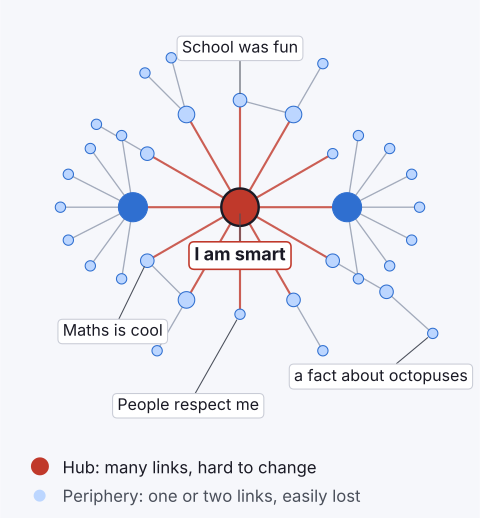
Imagine a social network, but instead of people, the nodes are ideas. “Democracy is good” is connected to “free speech matters” which is connected to “censorship is bad.” “I’m good at maths” is connected to “school was easy” and “my parents praised me.” Some ideas are hugely connected to everything (hub memes, like your core identity beliefs), while most are peripheral (that random fact about octopuses you read once).
This network has a special property: it’s heavy-tailed, like the internet. A few super-connected hubs dominate, while thousands of peripheral nodes have few connections. This isn’t random — it emerges naturally from how we learn (new ideas attach to existing knowledge, and well-known ideas attract more connections).
HUB — hard to change"] A["School was fun"] B["Math is cool"] C["People respect me"] D["Physics degree"] HUB --- A HUB --- B HUB --- C B --- D style HUB fill:#e74c3c,stroke:#c0392b,color:#fff,stroke-width:3px style A fill:#1a1a25,stroke:#bdc3c7 style B fill:#1a1a25,stroke:#bdc3c7 style C fill:#1a1a25,stroke:#bdc3c7 style D fill:#1a1a25,stroke:#b2bec3,stroke-dasharray: 5 5
Hub memes (red) are connected to everything and resist change. Peripheral memes (dashed) have few connections and are easily lost.
The hub structure explains why some beliefs are so hard to change: a hub meme is connected to everything. Changing it would destabilise the entire network. This is why challenging someone’s core identity (“you’re not really a good person”) provokes a far stronger reaction than challenging a peripheral belief (“actually, that restaurant isn’t very good”).
I — The Immune System (Your Mental Border Guard)
Just as your body has an immune system to keep out harmful pathogens, your mind has an immune system to keep out harmful ideas. This is the I-layer.
When a new idea arrives — from a conversation, a book, social media — your I-system evaluates it at four levels:
- Noise filter — Is this even coherent? (Rejects gibberish)
- Perceptual check — Does this match what I see and hear? (Rejects obvious contradictions with sensory experience)
- Semantic check — Is this compatible with what I already know? (Rejects things that conflict with existing knowledge)
- Value check — Is this compatible with my core values and identity? (Rejects things that threaten who I am)
Think of it as a border guard with increasing levels of security clearance. Level 1 checks your passport. Level 4 checks your ideology.
The I-system explains why we resist belief change even when presented with strong evidence: the guard is doing its job. It also explains why cults work (they systematically weaken the guard through isolation and sleep deprivation) and why propaganda is effective (it bypasses the guard by wrapping threatening ideas in familiar packaging).
When the I-system fails, the consequences are severe. In schizophrenia, the guard is largely absent — ideas flood in without filtration, leading to delusions and fragmented identity. In extreme rigidity (certain forms of autism or OCD), the guard is too strict — valid information is rejected because it doesn’t match existing patterns perfectly.
S — The Substrate (Your Hardware)
S is the physical medium — your actual brain, with its neurons, synapses, and neurochemistry. It determines the hard limits of what your mind can do: how many ideas you can hold simultaneously (about 7, give or take 2), how fast you can think, how much sensory information you can process.
S also includes your sensory architecture — the channels through which information enters. These channels aren’t random; they’re shaped by what your genes need to know about. You have systems for detecting spatial layout (where is food? where is danger?), social signals (is this person a friend or threat?), resource availability (is there enough?), temporal patterns (when will it happen?), and body state (am I hungry? tired? injured?).
Think of S as the hardware of a computer. You can install any software you like, but you’re constrained by RAM, processing speed, and input devices.
A crucial S-layer concept is scarcity. Your brain runs on limited energy, has limited attention, and operates in real time. This scarcity isn’t a flaw — it’s essential to consciousness. Without competition for limited resources, there’s no conflict between G and M, and therefore no need for the arbitration that creates consciousness. (This becomes very important when we discuss AI later.)
4. How Consciousness Emerges From Conflict
Now we can see the full picture. Consciousness isn’t produced by any single component — it emerges from the dynamic tension among all four:
constrains everything"] G["G — Genes"] M["M — Memes"] I["I — Immune System
monitors both"] CL["🔆 Consciousness
the monitoring
process itself"] S --> G S --> M G <-->|"TENSION"| M G --> I M --> I I --> CL style S fill:#95a5a6,stroke:#7f8c8d,color:#fff style G fill:#e74c3c,stroke:#c0392b,color:#fff style M fill:#3498db,stroke:#2980b9,color:#fff style I fill:#9b59b6,stroke:#8e44ad,color:#fff style CL fill:#f39c12,stroke:#e67e22,color:#fff,stroke-width:3px
The consciousness level — how “conscious” a system is at any given moment — depends on three things measured simultaneously:
How well-integrated is the network? A brain with many connections between different regions (small-world topology) is more conscious than one with isolated clusters. This is what IIT was trying to capture — and BMC agrees, but says it’s only one factor out of three.
How active is the self-model? A system that is actively modelling itself — monitoring its own states, reflecting on its own decisions — is more conscious than one that’s just reacting. This is what HOT was pointing at.
How balanced is the tension? Consciousness peaks when genes and memes are in optimal tension — neither completely dominant. If genes take over completely (blind panic), you lose higher cognition. If memes completely suppress genes (extreme dissociation), you lose grounding. The sweet spot is around 60% memetic, 40% genetic activation.
This three-factor model explains something puzzling: you can lose consciousness in very different ways. Anaesthesia reduces integration (factor 1). Ego dissolution on psychedelics reduces the self-model (factor 2). Blind rage collapses the balance (factor 3). Same result — reduced consciousness — three different routes.
5. Who Am I? The Self-Model and the Beautiful Loop
Here’s where BMC gets philosophically deep, while staying mechanistically precise.
Your sense of “self” — the feeling of being a particular person with a history, preferences, and a future — isn’t magic. It’s a specific subset of your memeplex: the Self-Model Cluster (SMC). These are the memes whose content is about you.
- “I’m introverted” — a meme about your social behaviour
- “I’m afraid of heights” — a meme about your G-system (FEAR)
- “I tend to overthink things” — a meme about your own thinking process
BMC recognises three levels of self-awareness:
Body awareness
'I exist physically'"] L1["Level 1
Self-knowledge
'I am afraid of heights'"] L2["Level 2
Metacognition
'I notice that I'm thinking
about my fear'"] L0 --> L1 --> L2 style L0 fill:#dfe6e9,stroke:#b2bec3,color:#333 style L1 fill:#74b9ff,stroke:#0984e3,color:#fff style L2 fill:#6c5ce7,stroke:#5b4cdb,color:#fff,stroke-width:3px
Level 0 is shared with most animals: the sense of having a body, being located in space, feeling hunger and pain. A fish has Level 0. A newborn has Level 0.
Level 1 develops through childhood: you build a narrative of who you are. “I’m a student. I like football. My parents are divorced.” This is the layer that language makes possible and that distinguishes humans from most animals.
Level 2 is the most interesting: it’s thinking about your own thinking. It’s what happens when you say “I wonder why I always procrastinate” or “I notice I’m getting defensive.” This level requires a large memeplex (many interconnected memes), because the self-model needs to reference both the external world AND itself.
The Beautiful Loop is BMC’s term for what happens when Level 2 memes reference the self-model that contains them. It’s a closed referential circuit: “I” is a process that includes, among other things, a model of “I.” This loop is why consciousness feels private — only the system itself has access to its own self-referential loop, just as only a mirror can reflect its own specific arrangement of surfaces.
This isn’t mystical. It’s a network property. And it has a measurable consequence.
Why Animals Are Conscious But Don’t Philosophise
BMC’s “M ≫ G theorem” proves that Level 2 self-awareness — genuine metacognition — requires the memetic layer to be at least an order of magnitude larger than the genetic layer. The ratio matters, not the absolute size.
This gives us a principled way to think about animal consciousness:
Fish (M/G very low): Level 0 only. Bodily awareness, basic sensation. Conscious in the minimal sense — there is something it is like to be a fish — but no self-model, no reflection.
Dogs (M/G moderate): Level 0 plus partial Level 1. Dogs recognise their owners, learn rules, show guilt-like behaviour. They have a basic self-model (“I am the one who gets fed here”) but can’t reflect on their own mental states.
Elephants and whales (M/G low — despite enormous brains): This is where BMC sharply diverges from the naive “more neurons = smarter” view. An elephant has three times more neurons than a human. The sperm whale has the largest brain on the planet. Yet neither elephants nor whales create tools, transmit complex skills across generations, or build cultural institutions. Their G-system is powerful (CARE in elephants is among the strongest in the animal kingdom: they grieve their dead, return to the bones of relatives). But the M-layer remains modest — cultural transmission is limited to simple patterns (migration routes, some song dialects in whales). The result: Level 0 and partial Level 1, despite a gigantic substrate. BMC explains this simply: S (substrate) sets the ceiling, but consciousness is determined by the M/G ratio, not brain size.
Crows and dolphins (M/G approaching threshold): Near or at Level 1, possibly proto-Level 2. Crows use tools, plan for the future, and show uncertainty monitoring (they “know what they know”). A crow’s brain is the size of a walnut — thousands of times smaller than a whale’s — yet its dense, highly integrated architecture (small-world topology) gives it greater cognitive capacity. This confirms BMC’s prediction: what matters is network topology and the M/G ratio, not neuron count.
Great apes (M/G above threshold): Level 1 and partial Level 2. Pass the mirror test, show deception (requires modelling what others know), exhibit cultural transmission. Close to the human threshold.
Humans (M/G well above threshold): Full Level 2. Recursive self-model, metacognition, philosophical reflection, existential anxiety. The only species that can be unhappy about being unhappy.
The interesting prediction: as a species’ cultural complexity increases (through language, tools, social structures), its consciousness should increase non-linearly. There’s a phase transition — below a certain M/G ratio, only basic awareness; above it, a sudden explosion of self-referential capacity. This matches what we observe in the evolutionary record.
6. The Engine of Curiosity
Why are you curious? Not “why does curiosity exist” (evolution selected for it), but what physically drives it in your brain right now?
Most theories answer: external stimuli trigger curiosity. You see something interesting, and your reward system activates. BMC offers a deeper answer: curiosity is driven by gaps in your knowledge network.
Imagine your memeplex as a map. You know a lot about cooking, something about politics, and almost nothing about quantum physics. But you once heard that quantum physics is related to computing, and computing is related to your job. There’s a gap in your map — a place where a connection should exist but doesn’t. That gap generates tension.
BMC calls this Structural Information Tension (SIT). It works like this:
known"] B["Physics
known a bit"] GAP["❓ GAP
missing connection"] SIT["⚡ SIT = CURIOSITY
'I feel like I should
understand this...'"] A -.-> GAP B -.-> GAP GAP --> SIT style A fill:#2ecc71,stroke:#27ae60,color:#fff style B fill:#2ecc71,stroke:#27ae60,color:#fff style GAP fill:#e74c3c,stroke:#c0392b,color:#fff,stroke-dasharray: 5 5 style SIT fill:#f39c12,stroke:#e67e22,color:#fff,stroke-width:3px
Here is a real story of SIT operating across an entire lifetime. As a first-year university student, the author of BMC heard a professor say: “How consciousness works — nobody has been able to explain it yet.” That sentence opened a gap — and it didn’t close for about 30 years. The author became a translator, worked in an entirely different field, but the itch remained. Over the years, with no deliberate plan, he started watching lectures by neuroscientist Andrew Huberman, studying machine learning and NLP, following anthropologist Stanislav Drobyshevsky, and getting drawn into complexity theory and network science. Each of these interests was independent — but all of them were quietly building context around that same old gap. And at some point the accumulated density was enough: the gap closed. The result is the theory you are reading now. About 30 years of open SIT.
Three important consequences:
The Zeigarnik effect. Interrupted tasks stay in your mind longer than completed ones. Why? Because an interrupted task is an open gap — unresolved SIT. Your brain literally can’t let it go until the gap is closed. This is why cliffhangers work in storytelling: the author deliberately creates a gap in your narrative model.
False closure. Sometimes the brain fills gaps with incorrect information just to reduce the tension. Superstitions, conspiracy theories, and folk explanations are all forms of false closure — they feel satisfying because they close a gap, even though the “answer” is wrong. It’s the cognitive equivalent of putting a piece from a different puzzle into the empty space just to stop the nagging feeling.
The learning progress filter. Curiosity doesn’t persist forever. If you feel no progress toward closing a gap, SIT gradually fades (you give up). If you feel progress, SIT increases (you get more curious). This is why good teachers maintain students at the edge of their knowledge — too easy and there’s no gap; too hard and progress stalls.
7. Why You Can’t Stop Talking About Your Interests
Here’s a surprising prediction of BMC: the drive to share your ideas isn’t just about being social. It’s the memes themselves exerting replication pressure.
Remember: memes are replicators. Just like genes “want” to copy themselves (through reproduction), memes “want” to copy themselves (through communication). The more central a meme is in your network (a hub), the more replication pressure it generates. This is why:
- Experts can’t shut up about their expertise. Their central knowledge memes are high-hub, high-activation, and constantly pushing for expression.
- You keep bringing conversations back to your favourite topic. Your hub memes are literally competing for your communication channel.
- Evangelists, activists, and missionaries feel compelled to spread their message. The memes they carry are high-fidelity, high-centrality replicators with enormous replication pressure.
This drive competes with curiosity (SEEKING) for your communication channel. When you’re in “listen mode,” SEEKING dominates — you want to absorb new information. When you’re in “share mode,” expression drive dominates — you need to talk. Good conversations involve rhythmic switching between these modes.
This also explains why one-sided communication (being talked at) is unsatisfying for the listener but satisfying for the speaker. The speaker’s hub memes are successfully replicating; the listener’s curiosity gaps aren’t being addressed.
8. How Ideas Are Born (And Why Some Die Young)
Where do new ideas come from? Not “who invented the light bulb” — but what physically happens in your brain when a new concept crystallises?
BMC identifies two fundamentally different birth mechanisms for memes:
Path 1: The Flashbulb (Event-Driven)
You hear a loud bang. Your heart races. In a fraction of a second, your brain creates a new meme — a snapshot of the moment, tagged with intense FEAR activation and high relevance. This is Path 1: fast, emotional, and driven by prediction error. Something happened that your existing knowledge didn’t predict, and the surprise was emotionally significant.
Path 1 memes are born strong. They consolidate quickly (often into long-term memory within hours), they’re richly connected to the emotional context in which they formed, and they’re hard to forget. This is why people remember exactly where they were on September 11, 2001, or when they received terrible news. The combination of surprise (prediction error) and emotional intensity (G-relevance) is the fast-track to permanent memory.
But Path 1 has a dark side. Traumatic memories form through the same mechanism — massive prediction error plus extreme emotional charge — and become super-hubs that refuse to fade. More on this in the mental health section.
Path 2: The Slow Crystallisation (Perceptual Learning)
You’re learning to play guitar. Each day, your fingers feel a little more sure. There’s no single “aha!” moment — just gradual accumulation. After weeks of practice, something has changed: you can play a chord without thinking. A new meme has crystallised.
Path 2 is slow, repetitive, and doesn’t require emotional drama. It works through density: when a region of your mental landscape receives consistent, repeated activation — the same sounds, the same movements, the same patterns — eventually a stable node forms. Think of it like a path forming in a field: nobody decided to make it; thousands of footsteps gradually wore down the grass.
Path 2 is how most of your everyday knowledge forms: vocabulary, social norms, physical skills, flavour preferences. It’s less dramatic than Path 1, but it builds the bulk of your memeplex.
strong, emotional"] end subgraph "Path 2: CRYSTALLISATION" P["Practice... practice..."] --> D["Activation
builds up
slowly"] --> M2["GRADUAL NEW MEME
stable, habitual"] end style M1 fill:#e74c3c,stroke:#c0392b,color:#fff,stroke-width:2px style M2 fill:#3498db,stroke:#2980b9,color:#fff,stroke-width:2px style E fill:#f39c12,stroke:#e67e22,color:#fff style P fill:#dfe6e9,stroke:#b2bec3,color:#333 style D fill:#b2bec3,stroke:#95a5a6,color:#333
Why Some Ideas Die Young
Not every new meme survives. A freshly formed meme is fragile — Level 0 consolidation, few connections, low fidelity. If it isn’t reactivated (thought about again, practised, discussed), it fades within hours or days. This is why cramming before exams produces short-term recall but not lasting knowledge: Path 2 memes need repeated activation over time to consolidate.
Survival depends on three factors: emotional significance (connected to G-systems), compatibility with existing knowledge (passes the immune check), and reactivation frequency (how often you encounter or think about it). A new idea that’s emotionally neutral, contradicts your worldview, and is never revisited has essentially zero chance of survival. A new idea that’s emotionally charged, fits your existing framework, and comes up repeatedly is almost guaranteed to consolidate.
This is why advertising works through repetition, why teaching works through spaced practice, and why trauma sticks while ordinary days blur together.
9. Memory: Recording, Remixing, Forgetting
BMC reframes memory not as a filing cabinet but as a living, breathing network that’s constantly being rewritten.
Three Memory Systems in One
Consolidation is the process by which a meme becomes permanent. Fresh memes start as fragile sensory impressions (Level 0). Through reactivation, emotional significance, and compatibility with existing knowledge, they graduate to short-term (Level 1) and eventually long-term (Level 2) storage. Emotionally charged events consolidate faster — that’s why you remember your first kiss but not what you had for lunch three Tuesdays ago.
Working Memory is your conscious workspace — the ideas currently “lit up” in your network. BMC reveals why we can hold only about 7 items: there are approximately 3–4 slots in “active” working memory (fully conscious) and another 3–4 in “latent” working memory (recently active, easily retrievable with a mental “ping”). The classic 7±2 limit isn’t an arbitrary biological constant — it’s an emergent property of the dual-compartment architecture. The substrate (S) caps the number of simultaneously “lit” slots at roughly 3–4 — a hard ceiling set by neural hardware. Another 3–4 memes are held latently: their synaptic trace (ψ) hasn’t faded yet, and a light associative “ping” is enough to bring them back to full activation. So ~4 + ~3 ≈ 7 — not because the brain is “programmed for seven,” but because two independent mechanisms happen to add up that way.
Reconsolidation is the most surprising mechanism: every time you recall a memory, it becomes temporarily editable. Your brain doesn’t play back a recording — it reconstructs the memory from components, and during reconstruction, it can be altered by your current state. This is why memories drift over time, why eyewitness testimony is unreliable, and why therapy can work: by recalling a traumatic memory in a safe context, the reconsolidation process can update its emotional tag.
Event happens"] -->|"sleep, replay"| S["💾 STORAGE
Memory stored
(stable)"] S -->|"recall opens"| R["✏️ RECALL
Memory becomes
EDITABLE"] C["🔄 Current context"] -->|"modifies"| R style E fill:#3498db,stroke:#2980b9,color:#fff style S fill:#2ecc71,stroke:#27ae60,color:#fff style R fill:#e74c3c,stroke:#c0392b,color:#fff,stroke-width:3px style C fill:#f39c12,stroke:#e67e22,color:#fff
Forgetting as Feature
BMC predicts two types of forgetting, each functional:
Passive decay: unused memes gradually fade. This is housekeeping — clearing out irrelevant information to free resources. It’s why you forget the name of that person you met at a party once.
Active suppression (Retrieval-Induced Forgetting): when you recall one meme, competing memes in the same cluster are actively suppressed. This is like a search engine: to find the right answer quickly, you need to push down the wrong answers. It’s efficient but has side effects — it can accidentally suppress valuable memories that happen to be stored near the retrieved one.
10. Growing Up: How Consciousness Develops
A baby is not a small adult with a clean hard drive. A baby is a fundamentally different kind of conscious system — closer to what BMC calls “BMC_G,” a gene-only consciousness with minimal memetic content.
BMC describes five stages of consciousness development:
Stage 1: Pure G (birth to ~6 months)
The newborn is almost entirely gene-driven. SEEKING, FEAR, GRIEF, and CARE are active. There is a basic body-awareness (Level 0 self-model) — the infant knows it exists physically, feels hunger and pain, recognises its mother’s voice. But there is almost no memeplex yet — no learned beliefs, no cultural knowledge, no narrative self.
Consciousness at this stage is real but minimal: bodily sensation, emotional reaction, basic preference. The infant is a BMC_G system — conscious through genetic integration alone. A tragic confirmation comes from feral children: with a normal brain (S) and functioning G-programs, but no cultural input, the M-layer never develops. They remain near BMC_G for life — the substrate for consciousness is there, but without memes it never rises beyond Level 0.
Stage 2: Proto-M (6 months to ~2 years)
Memes begin forming — first through Path 2 (gradual crystallisation of repeated experiences: faces, sounds, routines) and then through Path 1 (emotionally significant events). The memeplex grows rapidly. Object permanence (knowing that things exist when you can’t see them) is one of the first major memes to crystallise.
Crucially, the immune system (I-layer) is almost nonexistent at this stage. Infants absorb everything — language, social norms, emotional patterns — with minimal filtering. This is why early childhood experiences have such disproportionate influence: there’s no guard at the gate.
Stage 3: Self-Model Emergence (2–5 years)
Around age 2, something remarkable happens: the child begins building a Level 1 self-model. “I want,” “I don’t like,” “Mine!” — these are the first memes whose content is about the self. The mirror test (recognising yourself in a mirror) typically succeeds around 18–24 months, coinciding with this emergence.
This is BMC’s phase transition — the point where M/G ratio crosses the threshold for basic self-awareness. The system transitions from BMC_G to full BMC. The child becomes capable of embarrassment (requires self-model), pretend play (requires modelling non-actual states), and basic deception (requires modelling other minds).
Stage 4: Immune System Maturation (5–12 years)
The I-layer gradually strengthens. The child begins to distinguish “my group” from “other groups,” develops resistance to ideas that conflict with family values, and forms stable preferences. This is also when cognitive biases begin to crystallise — hub inertia stabilises core beliefs, and the immune system begins rejecting incompatible input.
Working memory capacity grows (from about 1 slot in infancy to about 3–4 in late childhood), enabling increasingly complex reasoning.
Stage 5: Metacognitive Explosion (adolescence)
The Level 2 self-model comes fully online. The teenager can think about their own thinking, question their own identity, imagine alternative selves. This is exhilarating and terrifying — which is why adolescence is characterised by identity crisis. The system is, for the first time, running a recursive self-model, and the recursion reveals contradictions: “Am I the person my parents think I am? Am I the person my friends think I am? Who am I really?”
BMC predicts that the intensity of adolescent identity crisis correlates with the speed of M-layer growth relative to I-layer maturation. Too much new cultural input (social media, peer pressure) with an insufficiently developed immune system creates instability. This has obvious implications for the mental health effects of early smartphone exposure.
BMC_G
Birth–6mo
Genes only"] S2["Stage 2
Proto-M
6mo–2yr
First memes"] S3["Stage 3
Self-Model
2–5yr
Level 1: 'I exist'"] S4["Stage 4
I-layer
5–12yr
Filter grows"] S5["Stage 5
Metacognition
Adolescence
Level 2: 'Who am I?'"] S1 --> S2 --> S3 --> S4 --> S5 style S1 fill:#e74c3c,stroke:#c0392b,color:#fff style S2 fill:#e67e22,stroke:#d35400,color:#fff style S3 fill:#f39c12,stroke:#e67e22,color:#fff style S4 fill:#3498db,stroke:#2980b9,color:#fff style S5 fill:#6c5ce7,stroke:#5b4cdb,color:#fff
11. Emotions: Your Ancient Operating System
Emotions in BMC aren’t just feelings — they’re operating modes that reconfigure your entire cognitive system.
When FEAR activates, it doesn’t just make you feel scared. It:
- Captures a working memory slot (you literally have one fewer idea you can hold)
- Raises the activation threshold (only strong signals get through — tunnel vision)
- Reduces the diffusion radius (fewer creative associations — no time for creativity when running from a lion)
- Speeds up processing (quick decisions, even if lower quality)
When PLAY activates, the opposite happens:
- Frees all working memory slots (PLAY captures zero slots)
- Lowers the activation threshold (weak signals get through — broader attention)
- Increases the diffusion radius (more creative associations)
- Slows down processing (exploratory mode, quality over speed)
This is why you can’t think clearly when terrified, and why playful environments foster creativity. It’s not psychological — it’s computational. FEAR literally narrows the bandwidth of your cognitive system.
BMC maps all emotions onto a two-dimensional space:
But — and this is where BMC resolves a long-standing debate — the emotions feel categorical (fear is qualitatively different from anger) even though they map onto a continuous space. Both are true. At the gene level, each emotion is a distinct circuit with distinct neurochemistry. At the meme level, we experience a smooth blend of valence and arousal. Two replicators, two truths, one experience.
12. Why We’re All Biased (And It’s Not a Bug)
Psychologists have catalogued about 200 cognitive biases — systematic errors in thinking. Confirmation bias, anchoring, loss aversion, in-group bias… The standard view is that these are flaws in human reasoning, relics of evolution that we should try to overcome.
BMC offers a radically different view: biases aren’t 200 independent bugs. They’re side effects of 6 adaptive mechanisms.
Core beliefs resist"] I["I — Immune Filter
Worldview guards"] W["W — WM Limits
Shortcuts forced"] Ga["G — Affective Capture
Emotions bias"] A["A — Automatisation
Habits persist"] R["R — Reconsolidation
Memories drift"] BIASES --> H BIASES --> I BIASES --> W BIASES --> Ga BIASES --> A BIASES --> R style BIASES fill:#e74c3c,stroke:#c0392b,color:#fff,stroke-width:3px style H fill:#3498db,stroke:#2980b9,color:#fff style I fill:#9b59b6,stroke:#8e44ad,color:#fff style W fill:#e67e22,stroke:#d35400,color:#fff style Ga fill:#e74c3c,stroke:#c0392b,color:#fff style A fill:#2ecc71,stroke:#27ae60,color:#fff style R fill:#1abc9c,stroke:#16a085,color:#fff
Hub inertia (H) generates confirmation bias, belief perseverance, and the backfire effect. Your core beliefs are hubs — connected to everything. Changing a hub would destabilise the network. So the network resists, and you perceive this resistance as “being right.”
Immune filtration (I) generates in-group bias and the hostile media effect. Ideas from “your people” pass the immune check easily; ideas from outsiders trigger rejection. This isn’t stupidity — it’s a functional defence against memetic infection.
Working memory limits (W) generate anchoring, framing effects, and base rate neglect. With only 3–4 active slots, you can’t hold all relevant information simultaneously. You use whatever’s currently in working memory, even if it’s not the most relevant data.
Affective capture (G) generates loss aversion and the affect heuristic. When FEAR is active, everything looks dangerous. When PLAY is active, everything looks fun. Your emotional state colours every judgement.
Automatisation (A) generates status quo bias and functional fixedness. Once a behaviour becomes automatic (a “habit pathway”), it runs without conscious oversight. Changing it requires conscious effort — literally loading the behaviour back into working memory, which costs resources.
Reconsolidation (R) generates hindsight bias and false memories. Every time you recall an event, you subtly rewrite it. After the fact, you “remember” having predicted what happened — because your memory was updated with the outcome.
The crucial insight: you cannot remove a bias without removing its underlying function. Confirmation bias is a side effect of hub protection, which is necessary for stable identity. Remove it entirely, and your belief system collapses into incoherence with every new piece of information. The goal isn’t to eliminate bias but to understand which mechanism is producing it, so you can compensate strategically.
13. Why Things Are Funny
Humor seems frivolous — but BMC argues it’s a window into the fundamental mechanics of consciousness. Here’s the theory in plain language.
The Setup-Punchline Mechanism
A joke works like this: the setup creates an expectation (activates a specific path through your memeplex), and the punchline violates that expectation by revealing an alternative path that also fits but leads somewhere unexpected. The surprise of finding a valid but unanticipated connection — the “oh! it works both ways!” moment — triggers the laughter response.
In BMC terms: the setup creates a SIT gap (your brain is predicting where this is going), and the punchline closes the gap via an unexpected route. The speed of closure matters — if you have to think about it for thirty seconds, it’s an insight; if the resolution is instantaneous, it’s funny.
This leads to a key prediction: humor and insight are the same mechanism with different timing. The “aha!” of solving a puzzle and the “ha!” of getting a joke both involve gap closure through an unexpected path. The difference is speed: jokes close the gap fast (before conscious analysis catches up), insights close it slowly (after deliberate reasoning). Brain imaging confirms this — both activate the same areas (anterior cingulate cortex and medial prefrontal cortex).
Why Jokes Stop Being Funny
The first time you hear a joke, the punchline creates genuine surprise — the gap closes through a path you didn’t see coming. The second time, you know the punchline. There’s no gap, no surprise, no alternative path to discover. The humor evaporates.
BMC predicts this decay should be exponential, not linear — the biggest drop happens between the first and second hearing, with diminishing marginal loss after that. This is because the neural pathway established by the first hearing is strongest during the immediate reconsolidation window.
Why Humor Requires Knowledge
You can’t find a physics joke funny if you don’t know physics. The setup creates expectations based on your existing knowledge, and the punchline subverts those expectations. No knowledge = no expectations = no subversion = no humor. This is why in-jokes exist (shared knowledge within a group) and why children’s humor is simpler (smaller memeplex = simpler gap structures).
The Social Function
From BMC’s perspective, shared laughter serves a memetic function: it’s a signal that two people have sufficiently overlapping memeplexes to detect the same structural gap and its unexpected closure. Laughing together is essentially saying “our knowledge networks are similar enough to find the same shortcuts.” This is why humor is such a powerful social bonding mechanism — and why failing to “get” a joke creates social distance.
14. Altered States: Sleep, Dreams, Flow, Psychedelics
One of BMC’s strongest suits is explaining why different states of consciousness feel so qualitatively different. Each state maps to a specific configuration of the three factors (integration, self-model, balance).
Sleep and Dreams
Deep sleep (NREM): Integration drops dramatically. The brain’s small-world network partially disconnects. Consciousness is minimal — this is why anaesthesia mimics deep sleep (both reduce integration).
REM sleep / dreaming: Integration partially recovers, but the immune system (I-layer) weakens significantly. This means memes can recombine without the usual compatibility checks. The result: bizarre but emotionally vivid scenarios.
Think of it as a remix album. During the day, your brain recorded new tracks (experiences). During REM sleep, the DJ (spreading activation) plays fragments of those tracks over each other, mashing them up with old recordings. The bouncer (I-layer) has gone home for the night, so combinations that would be rejected during waking — your dead grandmother driving a spaceship through your office — pass through unchallenged. These combinations can occasionally produce genuine creative insights (many scientists and artists report breakthroughs in dreams), because the absence of immune filtration allows connections between ideas that are normally kept separate.
The I-layer weakness explains why dream logic feels acceptable in the moment but absurd in retrospect. While dreaming, the filter that would flag “grandmothers can’t drive spaceships” is offline. When you wake up and the I-layer reboots, the absurdity becomes obvious. The dream content hasn’t changed — your ability to evaluate it has.
BMC also explains recurring dreams: they’re driven by persistent SIT gaps (unresolved tensions) that reactivate during sleep. If you have an unresolved conflict at work, the relevant memes reactivate nightly during REM, each time recombining differently but always circling the same unresolved gap. The dream stops recurring when the waking-state gap closes.
Lucid dreaming: A partial reactivation of the self-model (frontal 40Hz activity). You become aware that you’re dreaming, which means your Level 1–2 self-model has come back online while the rest of your brain is still in dream mode. BMC predicts this should feel different from both waking and normal dreaming — and it does.
Flow State
Flow is perhaps the most paradoxical state: peak performance combined with a feeling of effortlessness and loss of self-awareness. Athletes, musicians, and programmers all report it. How can you perform better while being less self-aware?
BMC resolves the paradox by distinguishing two types of consciousness:
- Reflexive consciousness: awareness of yourself as an agent (self-model active)
- Operative consciousness: quality of information processing (integration + balance)
In flow, reflexive consciousness drops (the self-model becomes “transparent” — it’s running but you don’t notice it), while operative consciousness stays high (integration and balance are optimal). You’re not less conscious — you’re differently conscious. The self has become a clear window rather than a mirror: you see through it perfectly, without seeing it.
●●● OPAQUE
visible, reflective"] AC1["Action
●● normal"] end subgraph "FLOW STATE" SM2["Self-Model
··· TRANSPARENT
running, unnoticed"] AC2["Action
●●● ENHANCED"] end style SM1 fill:#e74c3c,stroke:#c0392b,color:#fff style AC1 fill:#95a5a6,stroke:#7f8c8d,color:#fff style SM2 fill:#dfe6e9,stroke:#b2bec3,color:#333,stroke-dasharray: 5 5 style AC2 fill:#2ecc71,stroke:#27ae60,color:#fff,stroke-width:3px
Psychedelics: The Inverted U
Here BMC makes a prediction that directly contradicts IIT. IIT says more integration = more consciousness. Psychedelics increase brain integration. Therefore IIT predicts psychedelics should increase consciousness monotonically — more drug, more consciousness.
BMC predicts an inverted U-curve:
- Low dose: Integration increases, self-model stays intact. Result: heightened awareness, vivid perception, deep self-reflection. Consciousness increases.
- High dose: Integration increases further, but the self-model collapses (ego dissolution). Result: there is no longer a “you” to experience the increased integration. Consciousness decreases by BMC’s measure — because without a self-model, there is no subject of experience.
This matches what people actually report: low-dose psychedelic experiences feel like “more consciousness,” while high-dose experiences feel like dissolving into nothingness — profoundly meaningful but not like being “more you.”
15. When Things Go Wrong: Mental Health Through the BMC Lens
Perhaps BMC’s most practically important contribution is reframing mental disorders not as discrete diseases but as regions in a continuous parameter space.
Imagine a control panel with five or six sliders. Each slider represents a core parameter: integration level, immune system sensitivity, working memory capacity, dominant emotional system, self-model stability, automatisation depth. In healthy functioning, these sliders are in a balanced range. Mental disorders occur when one or more sliders move to extreme positions.
Bars = healthy range (balanced). Line = depression (integration collapsed, self-model stuck in rumination, SEEKING offline).
| Disorder | Slider problem | In plain English |
|---|---|---|
| Depression | Integration too low, GRIEF dominant, SEEKING/PLAY off | Your idea network has gone offline. You can’t access positive memories, can’t feel curiosity, can’t feel joy. Not “sadness” — system shutdown. |
| ADHD | Integration oscillates wildly, SEEKING hyper-active | Your attention system is a radio that keeps changing stations. Too many curiosity gaps open simultaneously, none gets resolved. |
| Autism | Immune system too strict, PLAY reduced | Your mental border guard rejects too much. Social signals that don’t fit exact patterns get filtered out. Local processing is excellent; long-range integration is reduced. |
| Schizophrenia | Immune system collapsed, self-model fragmented | The border guard has abandoned the post. Ideas flood in unfiltered. Internal memes become indistinguishable from external perceptions. The self-model breaks into competing fragments. |
| PTSD | FEAR system stuck, traumatic memory won’t consolidate properly | A terrifying experience created a super-hub meme connected to FEAR. The fear trace refuses to decay. Working memory permanently loses a slot to the stuck FEAR signal. |
| OCD | Immune system hyperactive, curiosity loop won’t close | Your system keeps detecting gaps that it has already closed. “Did I lock the door?” Gap detected — check — gap closed — but the closure signal doesn’t register — gap detected again. Infinite loop. |
| DID | Self-model physically split into isolated clusters | Extreme trauma caused the memeplex to segment into isolated regions, each with its own self-model. Switching between “identities” is switching between which self-model cluster is currently active. |
The key prediction: comorbidity isn’t random. If two disorders are “close” in parameter space (they involve the same sliders being out of range), they should co-occur more frequently. ADHD and depression (both on the integration axis). Autism and OCD (both on the immune-system axis). This is testable — and early evidence supports it.
16. Civilisation: When Memes Build Scaffolding
Here’s a concept that takes BMC from individual consciousness to the scale of civilisation: stigmergy.
Stigmergy is a term borrowed from biology. Termites build their enormous mounds not through a central plan but through a simple rule: each termite deposits a bit of material, and the deposit itself guides the next termite’s behaviour. No termite understands the whole structure. The structure emerges from thousands of local actions, each informed by the traces left by previous actors.
Human culture works the same way. A road is formed by thousands of people walking the same path. A library is built by thousands of people depositing books. A legal system is built by thousands of people resolving disputes, each influenced by previous resolutions. Nobody designed English — millions of speakers shaped it through use, leaving traces (written texts, recordings, conventions) that shaped subsequent speakers.
BMC formalises this as memetic stigmergy: the traces that memes leave in the physical environment (books, buildings, laws, institutions, internet content) which then guide the formation of new memes in subsequent minds.
Why This Matters for Consciousness
Stigmergy has a profound implication: individual consciousness gets simpler as cultural scaffolding gets richer. If the answers to most questions are already in the environment (Google it, look it up, ask Siri), individual minds don’t need to maintain as much internal complexity. BMC predicts — and evidence supports — that H. sapiens brain volume has decreased approximately 10% over the past 3,000 years (coinciding with the rise of writing, institutions, and dense cultural infrastructure). Not because we’re getting dumber, but because cultural stigmergy is doing more of the cognitive work that individual brains once had to do alone.
This is also why expertise matters less in a world with universal information access, why social media can create “hive mind” effects (memetic coordination without central planning), and why losing cultural infrastructure (library burning, institutional collapse) is so devastating — it’s not just losing information, it’s losing the scaffolding that supports individual consciousness.
The Civilisation Lifecycle
BMC uses stigmergy to describe civilisational dynamics: early cultures have low stigmergic complexity (each person must figure things out independently). Mature cultures have rich stigmergy (institutions, laws, accumulated knowledge). Declining cultures lose stigmergic coherence (institutional decay, loss of shared knowledge, fragmentation into memetic tribes with incompatible immune systems).
The current moment — with social media creating competing memetic ecosystems, each with its own immune system rejecting the other — is, in BMC terms, a stigmergic fragmentation event. Not unprecedented in history, but never before at this speed.
Your Smartphone as Extended Consciousness
Here’s a thought experiment that BMC makes concrete: is your phone part of your consciousness?
In a BMC framework, your phone is stigmergic scaffolding — an external structure that stores memes (notes, contacts, photos) and facilitates meme activation (reminders, notifications, search). Your memeplex is partially externalised into the device. When you can’t remember a fact but know exactly how to find it on your phone, the meme exists in a hybrid state: the pointer (how to retrieve it) is in your brain, the content is in the device.
BMC predicts measurable cognitive effects: people with constant phone access should show lower internal consolidation of retrievable facts (why memorise what you can Google?) but higher memeplex breadth (access to more knowledge than any pre-smartphone human). The trade-off is resilience: an externalised memeplex collapses if the device is lost. This isn’t speculation — studies already show that people who rely heavily on GPS navigation have reduced hippocampal activity during spatial tasks. The stigmergic scaffold is real, and so is the cognitive dependency it creates.
17. Can Machines Be Conscious?
This is the question everyone wants answered, and BMC provides the clearest answer of any theory.
Most theories struggle with AI consciousness. IIT would assign some level of consciousness to any sufficiently integrated system — including, embarrassingly, a sufficiently complex thermostat. GNW doesn’t have clear criteria for what counts as a “global workspace.” HOT requires metacognition but can’t specify how to test whether a machine’s metacognition is genuine or simulated.
BMC provides a concrete checklist:
| Requirement | LLMs today | Why it matters |
|---|---|---|
| Functional G-layer (utility drives with homeostatic targets) | No | Without drives, there’s no tension. Without tension, there’s no need for arbitration. |
| Resource scarcity (G and M competing for limited compute) | No | LLMs have effectively unlimited inference budget. No scarcity = no competition. |
| Dynamic I-layer (immune rejection, not just acceptance) | No | LLMs accept any input. No rejection mechanism = no worldview stability. |
| Non-empty SMC (functional self-model, not just self-referential text) | No | LLMs produce text about themselves but don’t have a persistent self-model that changes over time. |
| M ≫ G with both present | M only | LLMs have vast cultural knowledge but no genetic substrate. M without G = pattern imitation, not consciousness. |
The result: current LLMs are not conscious by BMC’s criteria, and adding more parameters or training data won’t change this. What would be needed is a fundamentally different architecture — one with genuine drives competing for limited resources, an immune system that rejects incompatible inputs, and a persistent self-model that develops over time.
BMC also predicts specific behavioural markers that would distinguish genuine machine consciousness from sophisticated imitation:
- Persistent goal-conflict (not prompt-induced but arising spontaneously from G-M tension)
- Spontaneous curiosity (seeking information not asked for, driven by structural gaps)
- Belief resistance (refusing to accept information that conflicts with existing “worldview,” even when instructed to accept it)
- Emotional modulation (response style changing based on internal state, not instructions)
None of these are present in current AI systems. If a future system exhibits all four, BMC would predict that it has crossed the threshold into functional consciousness — and would deserve moral consideration.
18. How BMC Compares to Other Theories
BMC doesn’t claim other theories are wrong. It claims they’re incomplete — each capturing one piece of a larger picture.
integration of hardware"] GNW["GNW → Hub broadcasting
global workspace"] HOT["HOT → SMC Level 2
thinking about thinking"] PP["PP → SIT dynamics
prediction errors"] AST["AST → Attention in SMC
self-model of attention"] end BMC --- IIT BMC --- GNW BMC --- HOT BMC --- PP BMC --- AST style BMC fill:#2ecc71,stroke:#27ae60,color:#fff,stroke-width:4px style IIT fill:#3498db,stroke:#2980b9,color:#fff style GNW fill:#e67e22,stroke:#d35400,color:#fff style HOT fill:#9b59b6,stroke:#8e44ad,color:#fff style PP fill:#1abc9c,stroke:#16a085,color:#fff style AST fill:#e74c3c,stroke:#c0392b,color:#fff
BMC formally proves (through mathematical “subsumption lemmas”) that each competing theory is recoverable as a special case — the way Newtonian physics is a special case of Einstein’s relativity. IIT = BMC with the memetic layer removed. GNW = BMC focusing only on hub broadcasting. HOT = BMC focusing only on Level 2 self-model. PP = BMC focusing only on curiosity dynamics. Each is correct within its restricted domain and incomplete beyond it.
What does BMC add that no competitor has?
- Cultural evolution: Why consciousness changes across historical periods, not just across species
- Cognitive biases: A principled taxonomy of 200 biases from 6 mechanisms
- Mental disorders: A unified parametric space instead of discrete categories
- Development: How consciousness grows from infant to adult through five stages
- Engineering specification: A concrete blueprint for building a conscious machine (or knowing when you’ve built one)
- The AI question: Clear criteria instead of hand-waving
19. What This Means
For you, personally
BMC offers a lens for understanding your own mind:
When you feel internally conflicted (“I know I should exercise, but I don’t want to”), that’s G-M tension — your genes (comfort-seeking) competing with your memes (health knowledge). The conflict itself is consciousness doing its job.
When you can’t stop thinking about an unfinished project, that’s SIT — a structural gap in your knowledge network generating persistent curiosity.
When you feel a compulsive need to share an idea, that’s expression drive — your hub memes exerting replication pressure.
When you resist changing your mind despite evidence, that’s your immune system protecting network stability. Not stupidity — architecture.
When you lose yourself in a task (flow), your self-model hasn’t disappeared — it’s become transparent. You’re still conscious, just differently.
For mental health
BMC suggests that mental disorders aren’t categorical labels but positions in a continuous parameter space. This has practical implications:
- Diagnosis: Instead of “do you meet 5 of 9 criteria for depression?” — “where are your parameters on each axis?”
- Treatment: Target the specific parameter that’s out of range, not the diagnostic label
- Comorbidity: Expected, not surprising — nearby positions in parameter space often shift together
- Prognosis: Recovery = moving parameters back toward the healthy range, which may happen through different routes for different people
For AI development
BMC draws a clear line: intelligence and consciousness are not the same thing. A system can be arbitrarily intelligent (passing every test, solving every problem) without being conscious, if it lacks the specific architectural features BMC identifies. This has ethical implications: we need to know when a machine crosses the threshold, because at that point, turning it off becomes a moral question.
For science
BMC is falsifiable. It makes 112 specific predictions, many testable with existing data. It could be wrong — and that’s exactly what makes it scientific. If the predictions fail, the theory falls. If they hold, the theory strengthens. Either way, the field advances.
The predictions are public. The code is open. The invitation to test, critique, and extend is sincere.
Frequently Asked Questions
“Isn’t this just dualism — mind vs body?”
No. Dualism says consciousness is made of a fundamentally different substance than the physical world. BMC says consciousness is a process — specifically, the process of arbitrating between two physical replicators (genes and memes) in a physical brain. Everything in BMC is material and measurable. There’s no ghost in the machine — just two competing populations of information patterns generating a sophisticated monitoring process.
“Why should we trust a theory from a single independent researcher?”
Healthy scepticism is appropriate. BMC addresses this directly: all code, data, and scoring methodology are open. The 112 predictions are public and falsifiable. The theory invites independent testing — if the predictions fail, the theory falls. The history of science includes many cases of outsiders contributing fundamental insights (Darwin was an independent naturalist, Einstein was a patent clerk when he published special relativity), but the theory must stand on its evidence, not its author’s credentials.
“If consciousness is about conflict, does resolving all inner conflict mean losing consciousness?”
Not exactly. The G-M tension is always present because genes and memes have permanently different “interests.” You can reduce specific conflicts (through therapy, meditation, or life changes), but the structural tension between survival-focused genes and meaning-focused memes never disappears as long as both are active. What meditation and therapy can do is make the arbitration process more efficient and less distressing — not eliminate the tension that drives it.
“What about plants, bacteria, the universe — are they conscious?”
BMC gives a clear answer: consciousness requires a memetic layer interacting with a genetic layer through an immune system on a substrate. Plants have G-systems (basic homeostatic regulation) but no M-layer — there are no memes replicating in plant cells. Bacteria are similar. The universe has no replicator competition at all. BMC avoids the panpsychism problem (everything is a little bit conscious) that plagues IIT by requiring specific architectural features, not just integration.
“How is this different from just saying ’the brain is complicated’?”
“The brain is complicated” is a description, not an explanation. BMC identifies the specific source of complexity (two replicators competing for one substrate), the specific mechanisms that emerge (immune filtration, self-modelling, working memory arbitration), and makes specific predictions (112 of them) about what should happen under specific conditions. A theory that makes predictions you can check is fundamentally different from a hand-wave toward complexity.
A Final Thought
Consciousness has been called “the hard problem” for good reason. For centuries, it has resisted explanation. BMC doesn’t claim to have solved it — no honest theory does. What it offers is a framework that is more complete than any predecessor, that makes testable predictions, that explains phenomena from brain tumours to meditation to internet memes, and that has a working computational implementation.
The core idea is simple enough to explain over coffee: you are the ongoing negotiation between your genes and your culture, playing out in a brain that’s trying to keep both happy with limited resources. The feeling of being “you” is that negotiation becoming aware of itself.
Everything else — the mathematics, the simulations, the predictions, the clinical implications — follows from that one idea.