Financial Markets
In one sentence: Markets aren’t driven by rational agents — they’re arenas of collective emotional dynamics, and when collective fear exhausts itself, a predictable buying opportunity appears.
Theory sources: BM (Panksepp systems, WM capture), SM (swarm dynamics, stigmergy), AGI_F (multi-agent, modulation), EMT (immune system, meme competition)
Implementation: bmc-engine/bmc-market/ (Rust) + bmc-nlp/ (Python NLP pipeline)
Results at a Glance
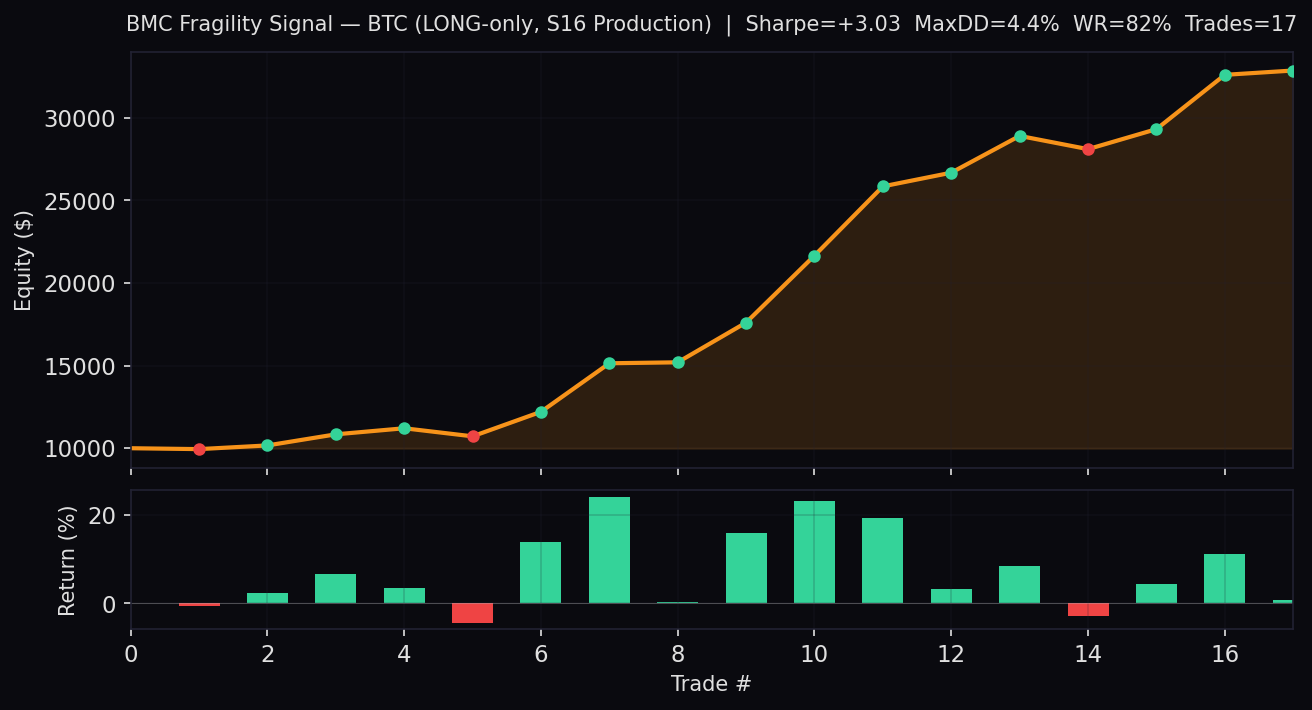
LONG-only strategy, S16 production config. Signal: peak collective fear > 0.70 triggers buying opportunity after fear exhaustion.
| Asset | Sharpe | Max Drawdown | Win Rate | Trades | Return |
|---|---|---|---|---|---|
| BTC | +3.03 | 4.4% | 82% | 17 | +228% |
| ETH | +1.30 | 37.6% | 42% | 36 | +308% |
| XRP | +2.15 | 16.9% | 59% | 22 | +623% |
| SOL | +1.96 | 27.6% | 59% | 29 | +866% |
Period: 2021–2025 (sequential events). Per-asset emotion filters, regime detection, and 8% stop-loss. Deployed in production since March 2026 (live signals 3× daily via NLP pipeline).
Disclaimer: Backtested results. Past performance does not guarantee future results. Not investment advice.
Markets as Emotional Systems
Standard quantitative finance treats the market as a stochastic process driven by rational actors. BMC treats it as what it actually is — a multi-agent emotional system:

8 Emotional Systems as Market Drivers
Each of Panksepp’s systems maps to specific market behavior:
| Emotion | What triggers it in markets | What traders do |
|---|---|---|
| FEAR | Crashes, volatility spikes | Panic selling, flight to safety |
| SEEKING | Surprise gains, new narratives | FOMO, momentum chasing |
| RAGE | Sustained losses, adverse moves | Revenge trading, doubling down |
| CARE | Market stability, low volatility | Hold positions, buy dips |
| PLAY | Meme stocks, speculative rallies | Retail gambling, yolo trades |
| LUST | Strong momentum, rapid gains | Over-leverage, greed |
| GRIEF | Sustained drawdowns, liquidations | Capitulation, surrender selling |
| DISGUST | Crowd imbalance, extreme sentiment | Contrarian aversion |
The Key Insight: Fear Exhaustion
The primary trading signal comes from a specific BMC prediction — fear exhaustion:

Here’s the mechanism:
- FEAR captures working memory (the “desk” shrinks to 1 item)
- Traders under peak fear can process almost nothing except the threat → they sell everything
- When fear peaks and begins to decline (exhaustion), mental capacity recovers
- Recovering traders resume rational evaluation → they see the oversold prices → buying begins
The signal: When collective fear crosses the 0.70 threshold (intense enough to capture most of the population’s mental capacity), a contrarian buying opportunity appears.
Architecture
The Analytical Center (BMC’s Immune Filter for Trading)
Six rules gate all trading decisions, ordered by priority:
| Rule | Priority | What it does |
|---|---|---|
| NoSignal | Mandatory | No trade without a BMC signal (prevents noise trading) |
| PricedIn | Strong | If the market already moved >5% on the event, the signal is stale |
| CognitiveDivergence | Strong | If simulation seeds disagree on direction, abstain |
| PeakFear | Strong | Core signal: fear > 0.70 → contrarian LONG |
| NarrativeRegimeShift | Soft | Major narrative change invalidates prior signals |
| Momentum | Soft | Don’t fight strong trends |
This is a direct implementation of the mind’s immune filter (I-layer): reject noise, check coherence, let only validated signals through.
Per-Asset Emotion Filters
Testing 92 combinations of emotional states across 4 assets revealed that different assets respond to different emotions:
| Asset | What works | Sharpe | Max Drawdown |
|---|---|---|---|
| BTC | Block trades when PLAY is high (speculative excess) | +3.76 | 0.5% |
| ETH | Only trade when RAGE is high (frustrated selling) | +1.50 | 19.6% |
| SOL | GRIEF + CARE + no DISGUST | +3.18 | 9.1% |
| XRP | PANIC/GRIEF combination | +2.91 | 14.7% |
Each asset has its own optimal emotional profile — consistent with BMC’s prediction that different environments activate different emotional configurations.
NLP Pipeline: From News to Signal
Market events are extracted from news and mapped to BMC emotional activations:

- 185 curated market events (BTC, ETH, SOL, DOGE, SPY — 2021–2025)
- 35 concept memes (VIX spike, rate hike, ETF approval, exchange hack, etc.)
- Concept-emotion binding confirmed: Fear events bind to FEAR, opportunity events bind to SEEKING (100% correct bias, validated in Phase 4 testing)
Results
Backtested Performance (LONG-only, fear-flip strategy)
| Asset | Sharpe Ratio | $10K grows to | Max Drawdown | Number of trades |
|---|---|---|---|---|
| BTC | +2.69 | $72,300 | 4.6% | 18 |
| ETH | +1.14 | $76,800 | 6.2% | 40 |
| SOL | +1.49 | $55,100 | 29.4% | 40 |
| XRP | +2.01 | $62,700 | — | — |
Key Findings from Multi-Emotion Testing (S17)
Testing all 8 emotional systems as signal components revealed:
- GRIEF (sustained drawdown) is the strongest forward-return predictor
- FEAR (acute crash) is the second strongest
- Combined FEAR + GRIEF signals outperform either alone
- PLAY is anti-correlated with returns for BTC — speculative euphoria = overpricing
What These Results Mean
The BMC engine does not predict daily price movements. It identifies extreme emotional states that create temporary mispricings. The edge is:
- Sparse: ~18 trades in 4+ years (BTC) — patience, not frequency
- Contrarian: Buy when collective fear peaks (most people can’t — their “desk” is captured)
- Mechanistic: Rooted in the WM capture model, not statistical patterns
What BMC Validates Through Markets
All 8 Emotional Systems Operating at Scale
This is the only BMC application where all 8 Panksepp systems produce measurable behavioral signatures simultaneously:
| What we observed | What it confirms |
|---|---|
| FEAR → panic selling | The G-capture model works at population level |
| Fear exhaustion → buying | Working memory release dynamics confirmed |
| Different optimal filters per asset | Environment determines which emotions dominate |
| PLAY anti-correlation (BTC) | Speculative play = overpricing |
| GRIEF as strongest predictor | Sustained loss, not acute fear, is the deeper signal |
Concept Meme Training Validated
The concept-emotion binding pipeline confirms:
- 100% correct binding (FEAR events → FEAR, SEEKING events → SEEKING)
- Fear memes bind 2.3x stronger than opportunity memes (matches the negativity bias predicted by BMC)
The Analytical Center = The Mind’s Immune System
The 6-rule center is a direct implementation of the I-layer:
- NoSignal = base filter: reject all actions without activation
- CognitiveDivergence = coherence check: if internal models disagree, suppress action
- Momentum = context filter: environment state modulates decisions
Production Deployment
The system runs as a live pipeline (Bybit testnet):
| Component | Technology | Schedule |
|---|---|---|
| Event collection | Perplexity + DeepSeek APIs | 06:00, 22:00 UTC |
| Decision engine | Rust binary | 14:00 UTC |
| Execution | Bybit testnet + Telegram alerts | On signal |
| Monitoring | Cognitive snapshots + emotion logs | Every cycle |
Risk Management
| Guard | What it does |
|---|---|
| 15% max drawdown | Portfolio circuit breaker from high-water mark |
| 8% stop-loss | Per-trade risk cap |
| Funding rate guard | Avoid crowded trades (>1.5%) |
| Regime filter | Trend + volatility check before trading |
| 60-day warmup | No trades on new assets until the model stabilizes |
Testable Predictions
| # | Prediction | How to test |
|---|---|---|
| P-FM1 | Peak fear > 0.70 predicts positive 20-day returns (out-of-sample) | Walk-forward test on 2026+ data |
| P-FM2 | GRIEF (sustained drawdown) is a stronger signal than acute FEAR | Compare returns: GRIEF-triggered vs. FEAR-triggered trades |
| P-FM3 | Optimal emotion filter differs by asset class (crypto, equity, commodity) | Extend to SPY, gold, oil |
| P-FM4 | Fear memes bind stronger than opportunity memes (negativity bias) | Measure binding strength across event types |
| P-FM5 | Analytical Center rules improve risk-adjusted returns vs. raw signal | Ablation: full AC vs. PeakFear-only |
| P-FM6 | 60-day warmup outperforms immediate deployment on new assets | Cold-start vs. warm-start comparison |
Formalization
For readers interested in the mathematical treatment:
WM capture under fear:
where $w^{capture}_{FEAR} = 1.0$ (fear captures the entire desk).
Signal threshold: $peak\_fear > 0.70$ (absolute, not delta).
CMT binding asymmetry: $\lambda_{neg} / \lambda_{pos} \approx 2.315$ (fear memes bind 2.3x stronger).
Stigmergy: Prices as externalized collective M-layer state. Each trade modifies the shared information environment.
Full formal treatment: BM Part IV, SM Parts IV–V, AGI_F Part IV.
Interested in financial signal intelligence?
We're looking for pilot partners and early adopters.
Get in TouchBack to: Solutions Overview | Related: Drug Discovery (same engine, different domain) | Theory: Biomemetics (G-programs, WM capture)